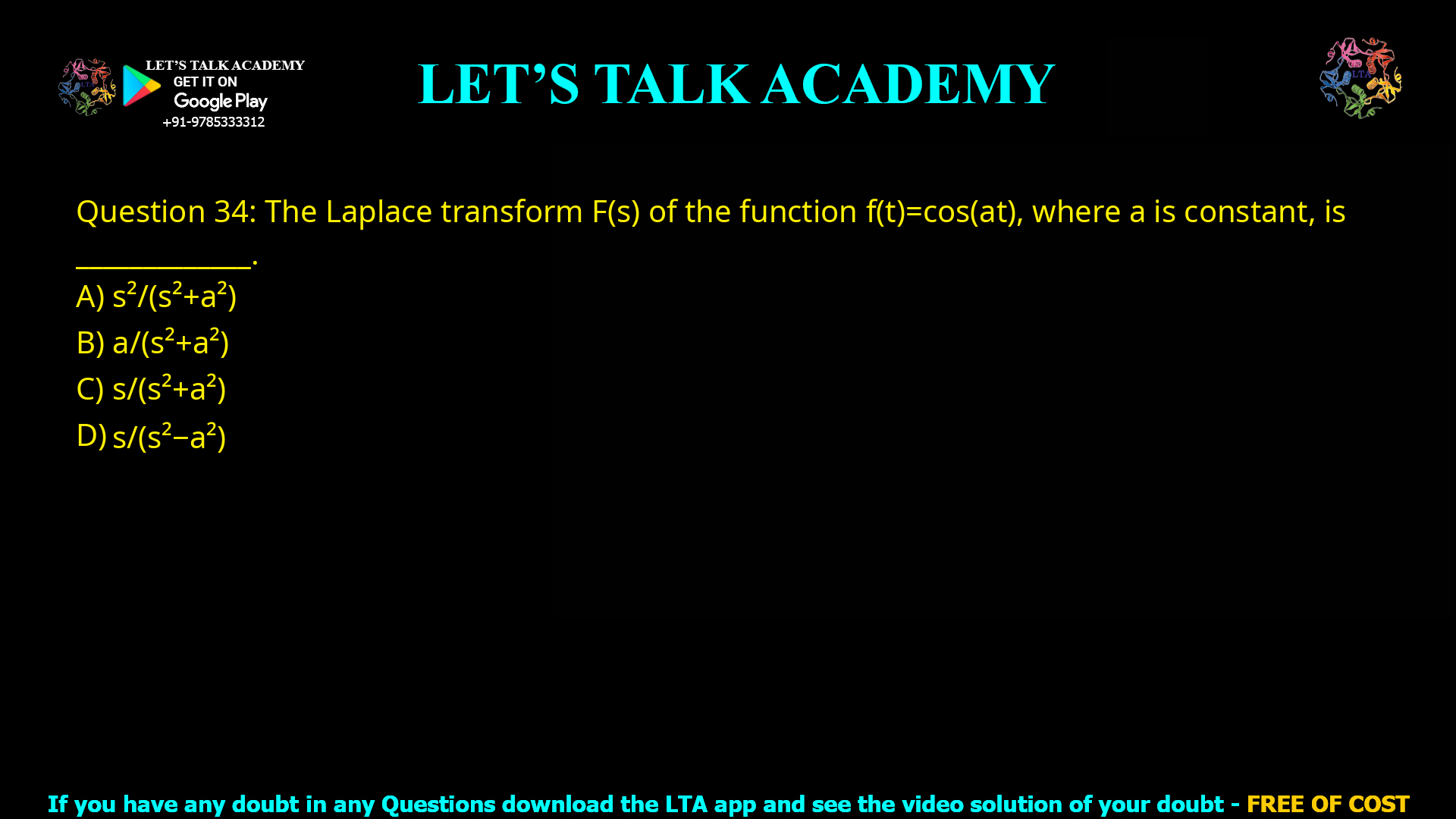
Q.34 The Laplace transform F(s) of the function
f(t) = cos(at), where a is constant, is ____________.
- (A) s2 / (s2 + a2)
- (B) a / (s2 + a2)
- (C) s / (s2 + a2)
- (D) s / (s2 − a2)
The Laplace transform of
f(t) = cos(at) is
s / (s2 + a2),
making Option (C) the correct choice in the given MCQ.
This standard result follows directly from the integral definition of
the Laplace transform and is widely used in engineering and physics.
Correct Answer
Option (C):
F(s) = L{cos(at)} = s⁄s2 + a2
Formula Derivation
By definition, the Laplace transform of a function f(t) is:
F(s) = ∫0∞ e−st cos(at) dt
Evaluating the integral using integration by parts or standard results:
F(s) = [ −e−st(s cos(at) + a sin(at))⁄s2 + a2]0∞ = s⁄s2 + a2
This result is valid for s > 0.
Option Analysis
Option (A)
s2⁄s2 + a2
Incorrect. This form does not decay properly for large s and resembles
transforms related to derivatives or constants, not cosine.
Option (B)
a⁄s2 + a2
Incorrect. This is the Laplace transform of
sin(at), not cos(at). The sine function starts at zero,
leading to an a-numerator.
Option (C)
s⁄s2 + a2
Correct. Cosine has an initial value of 1, which produces the
s-numerator in the Laplace transform.
Option (D)
s⁄s2 − a2
Incorrect. This corresponds to the Laplace transform of
cosh(at), not cos(at). The minus sign reflects
exponential growth rather than oscillation.
Applications in Engineering
Laplace transforms simplify ordinary differential equations in
control systems, signal processing, and electrical circuits.
The function cos(at) commonly represents oscillatory behavior,
such as in RLC circuits and vibration analysis.
For example, when a = 1:
L{cos(t)} = s⁄s2 + 1


