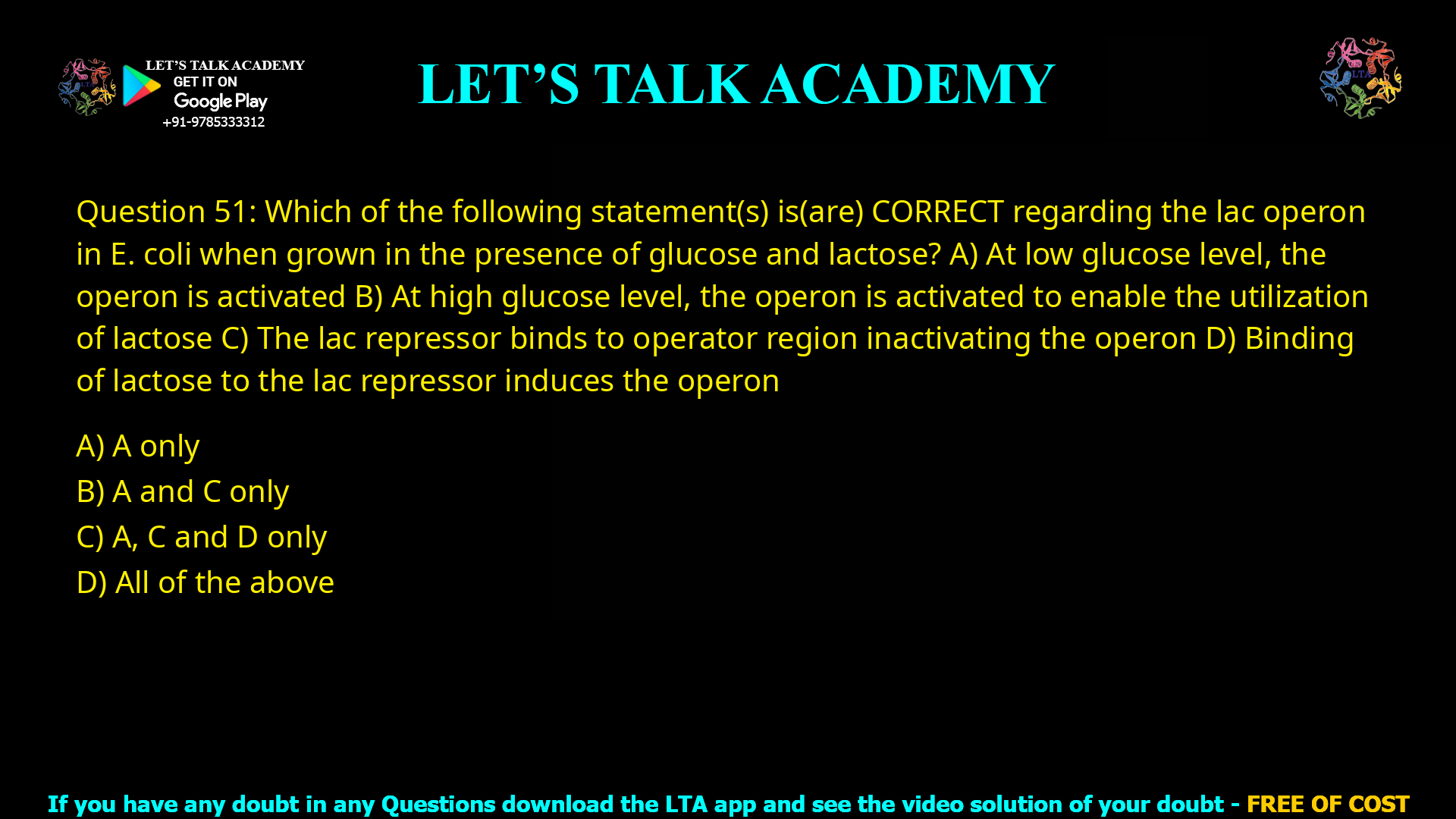
Q.51 Which of the following statement(s) is(are) CORRECT regarding the lac operon
in E. coli when grown in the presence of glucose and lactose?
(A) At low glucose level, the operon is activated
(B) At high glucose level, the operon is activated to enable the utilization of lactose
(C) The lac repressor binds to operator region inactivating the operon
(D) Binding of lactose to the lac repressor induces the operon
Lac Operon in E. coli: Regulation with Glucose and Lactose
The lac operon in E. coli remains repressed when grown in the presence of both glucose and lactose due to catabolite repression and repressor dynamics. Correct statements are (C) and (D).
Question Options Analysis
Option A: At low glucose level, the operon is activated
Incorrect. Low glucose alone does not activate the operon; lactose must also be present to inactivate the repressor, allowing full activation via CAP-cAMP binding.
Option B: At high glucose level, the operon is activated to enable the utilization of lactose
Incorrect. High glucose keeps cAMP levels low, preventing CAP activation, so the operon shows only leaky expression despite lactose presence.
Option C: The lac repressor binds to operator region inactivating the operon
Correct. Without lactose, the lac repressor binds the operator; even with lactose present alongside high glucose, full inactivation persists due to absent positive regulation.
Option D: Binding of lactose to the lac repressor induces the operon
Correct. Lactose (as allolactose) binds the repressor, releasing it from the operator to allow transcription, though glucose overrides this for maximal induction.
Regulation Summary Table
| Condition | Repressor Bound | CAP Active | Transcription Level |
|---|---|---|---|
| High Glucose + Lactose | No | No | Low (leaky) |
| Low Glucose + Lactose | No | Yes | High (activated) |
| High Glucose – Lactose | Yes | No | None |
| Low Glucose – Lactose | Yes | Yes | None |


