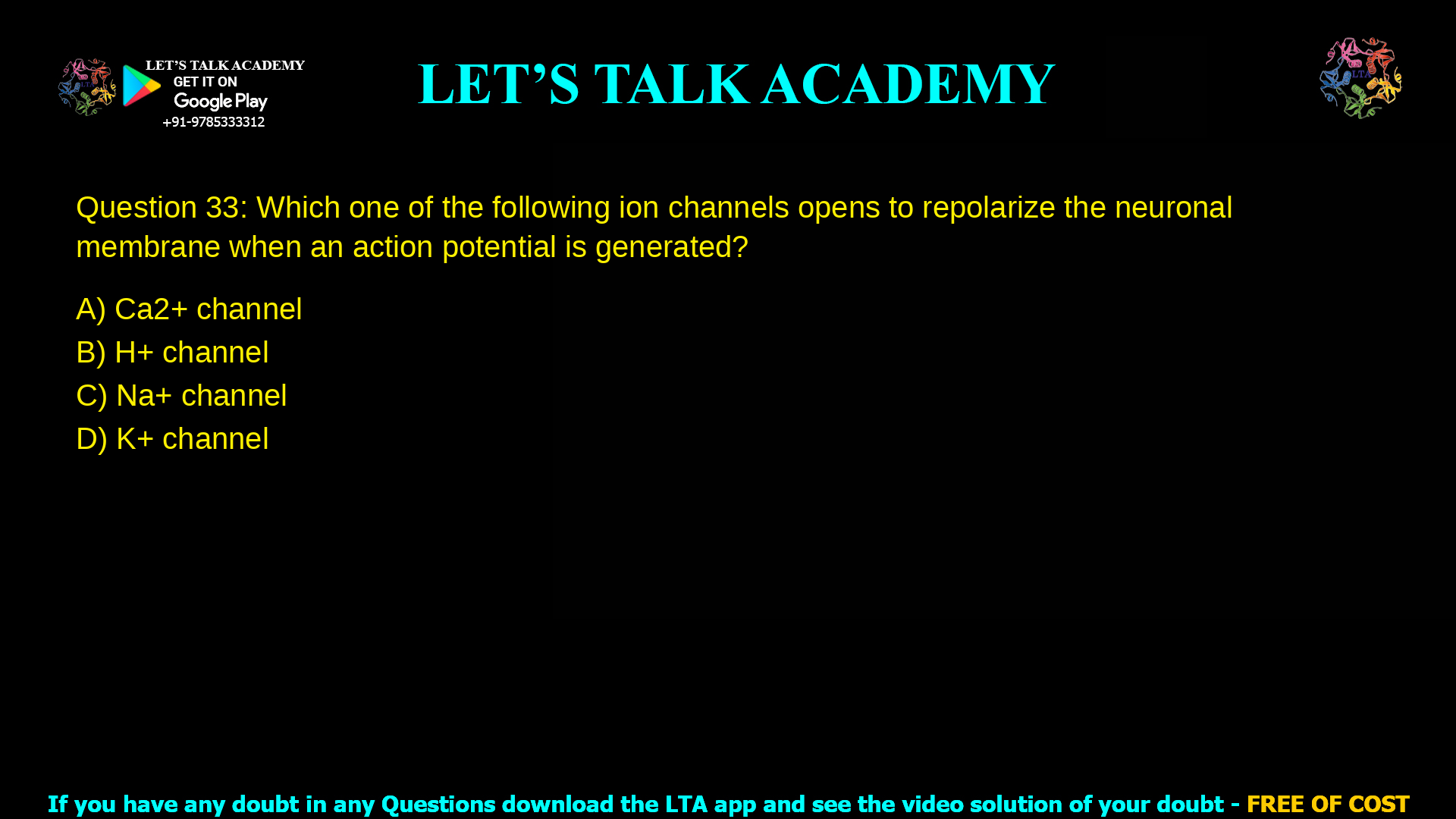
Q.33 Which one of the following ion channels opens to repolarize the neuronal
membrane when an action potential is generated?
(A) Ca2+ channel
(B) H+ channel
(C) Na+ channel
(D) K+ channel
Potassium (K+) channels open during the repolarization phase of an action potential, allowing K+ efflux that restores the neuronal membrane to its resting potential.
Option Analysis
Ca2+ channel (A): Calcium channels primarily contribute to neurotransmitter release at synapses and muscle contraction, not neuronal repolarization; their influx would prolong depolarization.
H+ channel (B): Proton (H+) channels, such as acid-sensing ion channels, respond to pH changes and play roles in pain sensation or ischemia but do not mediate standard action potential repolarization in neurons.
Na+ channel (C): Voltage-gated sodium channels drive depolarization by allowing Na+ influx but inactivate quickly, contributing indirectly to repolarization onset without restoring the negative potential.
K+ channel (D): Delayed rectifier K+ channels activate near the action potential peak, enabling K+ outflow due to high intracellular K+ concentration, which rapidly repolarizes the membrane toward -70 mV.
Action Potential Phases
Depolarization occurs first as Na+ channels open at threshold (~-55 mV), causing rapid Na+ entry and potential rise to +30 mV.
Repolarization follows with Na+ inactivation and K+ channel opening, driving K+ exit and membrane potential drop.
Hyperpolarization briefly overshoots due to lingering K+ conductance before Na+/K+ ATPase restores ion gradients.
Which ion channel opens to repolarize the neuronal membrane when an action potential is generated? This fundamental question tests understanding of neuronal excitability for CSIR NET Life Sciences aspirants studying ion channels and action potentials.
Understanding Repolarization in Neurons
Repolarization restores the neuronal membrane potential from +30 mV back to -70 mV after depolarization, primarily via voltage-gated K+ channels that permit potassium efflux. These delayed rectifier channels activate slowly during peak depolarization, countering Na+-driven positivity.
Why K+ Channels Are Essential
High intracellular K+ (~140 mM) versus low extracellular (~4 mM) creates an outward driving force when channels open, repolarizing the membrane efficiently within milliseconds. Na+ channel inactivation aids this but cannot repolarize alone, as Na+ influx sustains positivity.
Evaluating Other Ion Channels
-
Ca2+ channels enter during presynaptic events for vesicle fusion, not repolarization; excess Ca2+ delays it via secondary K+ effects.
-
H+ channels sense acidosis in specialized contexts like nociception, irrelevant to routine action potentials.
-
Na+ channels initiate depolarization but inactivate, halting influx without restoring negativity.
| Ion Channel | Primary Phase | Effect on Potential |
|---|---|---|
| Na+ | Depolarization | + (Influx) |
| K+ | Repolarization | – (Efflux) |
| Ca2+ | Synaptic release | Minimal in soma/axon |
| H+ | pH sensing | Not action potential |
CSIR NET Exam Relevance
Mastering ion channels repolarize neuronal membrane concepts ensures success in Unit 7 (Animal Physiology). Practice graphs showing K+ conductance peaks during repolarization downslope.


2 Comments
Sonal Nagar
January 5, 2026K+ channel
Bhanwar
January 21, 2026K+ Channel Repolarization