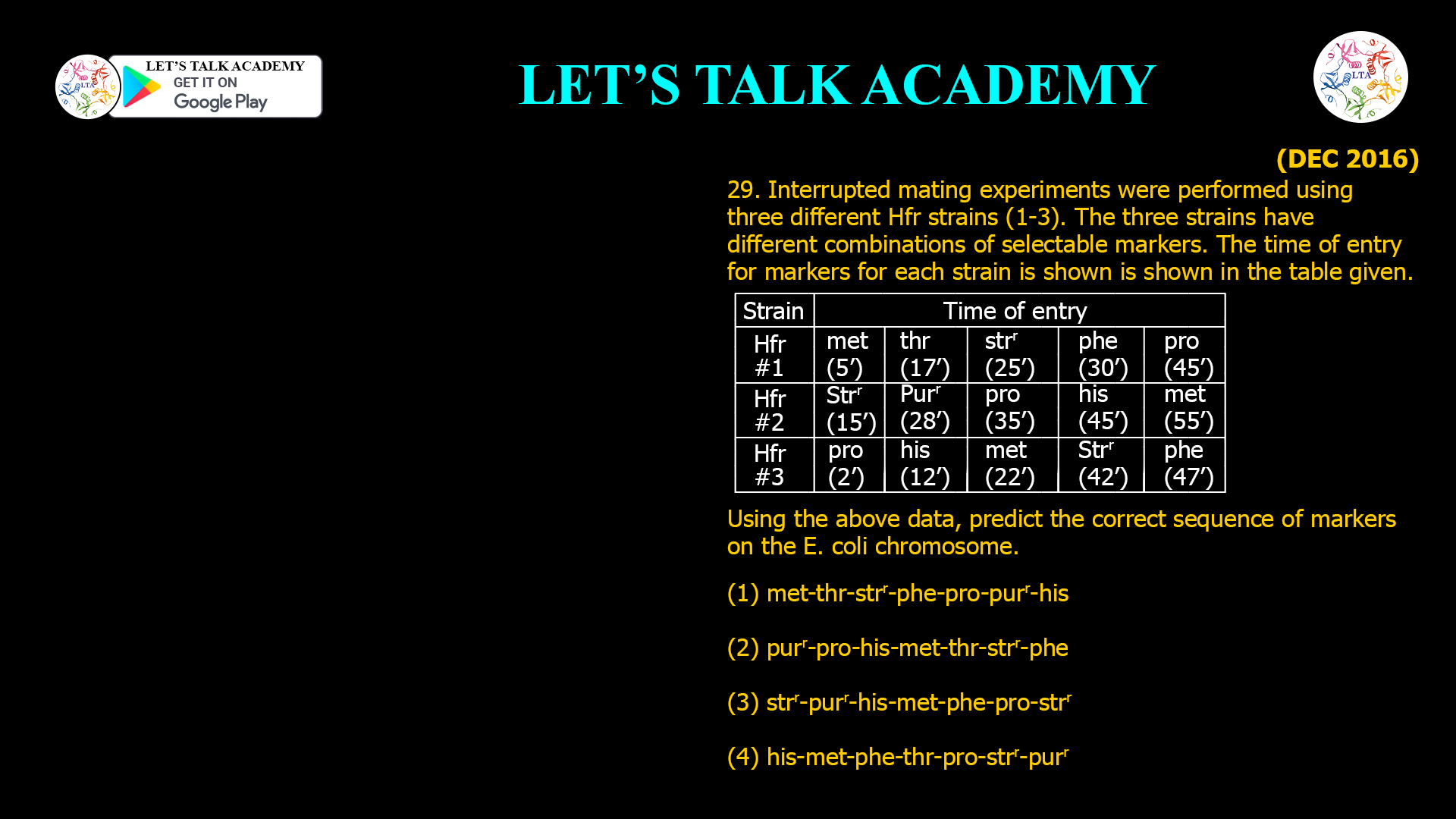
- Interrupted mating experiments were performed using three different Hfr strains (1-3). The three strains have different combinations of selectable markers. The time of entry for markers for each strain is shown is shown in the table given.
| Strain | Time of entrry | ||||
| Hfr #1 | met (5’) |
thr (17’) |
strr (25’) |
phe (30’) |
pro (45’) |
| Hfr #2 | Strr (15’) |
Purr (28’) |
pro (35’) |
his (45’) |
met (55’) |
| Hfr #3 | pro (2’) |
his (12’) |
met (22’) | Strr (42’) |
phe (47’) |
Using the above data, predict the correct sequence of markers on the E. coli chromosome.
(1) met-thr-strr-phe-pro-purr-his
(2) purr-pro-his-met-thr-strr-phe
(3) strr-purr-his-met-phe-pro-strr
(4) his-met-phe-thr-pro-strr-purr
The correct sequence of markers on the E. coli chromosome is: his–met–phe–thr–pro–str–pur (option 4).
Question data and logic
In interrupted mating with different Hfr strains, each strain transfers genes in a fixed order from its own origin, and the earliest entering marker in each cross is closest to the origin. By aligning the time‑of‑entry orders from all three Hfr strains and considering that each strain has a different origin and/or orientation, a single consistent circular order of markers is obtained:
his → met → phe → thr → pro → str → pur.
Key reasoning points:
-
In Hfr 1, the order from earliest to latest is: met → thr → str → phe → pro.
-
In Hfr 2, the order is: str → pur → pro → his → met.
-
In Hfr 3, the order is: pro → his → met → str → phe.
-
Combining these partial orders yields the only arrangement compatible with all three: his – met – phe – thr – pro – str – pur (cyclically, pro lies between thr and str, and str lies between pro and pur, etc.).
Option‑by‑option analysis
Option 1: met–thr–str–phe–pro–pur–his
-
This option puts str between thr and phe, matching Hfr 1, but then places pur immediately after pro, which contradicts Hfr 2 where str lies between pro and pur.
-
It also places his at the extreme end, whereas Hfr 2 and Hfr 3 together show that his must lie between pro and met, not after pur.
-
Therefore, option 1 is inconsistent with the combined time‑of‑entry data and is incorrect.
Option 2: pur–pro–his–met–thr–str–phe
-
This begins with pur–pro, but in Hfr 2, str enters before pur, so str should be upstream of pur, not after thr.
-
Hfr 3 indicates pro precedes his, which fits, but Hfr 1 demands that met and thr must lie before str, yet in this option str comes after thr but before phe, making the placement of phe and str incompatible with Hfr 3 (where str precedes phe) once all markers are aligned.
-
Hence option 2 cannot satisfy all three Hfr maps simultaneously.
Option 3: str–pur–his–met–phe–pro–str
-
This option is structurally flawed because it repeats str twice, which is impossible for a unique chromosomal locus.
-
Additionally, it positions his immediately after pur, contradicting Hfr 2 and Hfr 3, which together require pro between his and str and place his nearer to met than to pur.
-
Therefore, option 3 is biologically and logically invalid.
Option 4: his–met–phe–thr–pro–str–pur
-
This order allows Hfr 1 to read a segment as met → thr → str → phe → pro if its origin is between his and met and the transfer proceeds in the appropriate direction.
-
It also allows Hfr 2 to read str → pur → pro → his → met and Hfr 3 to read pro → his → met → str → phe with different origins and orientations, making this the only arrangement consistent with all three time‑of‑entry series.
-
Thus, option 4 correctly represents the chromosomal sequence.
SEO‑friendly introduction
Interrupted mating experiments with different Hfr strains are a classic method to map the order of genes on the E. coli chromosome using time‑of‑entry data. In this problem, three Hfr strains transfer markers such as met, thr, str, phe, pro, his and pur at different times, and combining these partial maps reveals the only chromosomal order that satisfies all datasets: his–met–phe–thr–pro–str–pur, with a detailed analysis clarifying why the other options fail.


