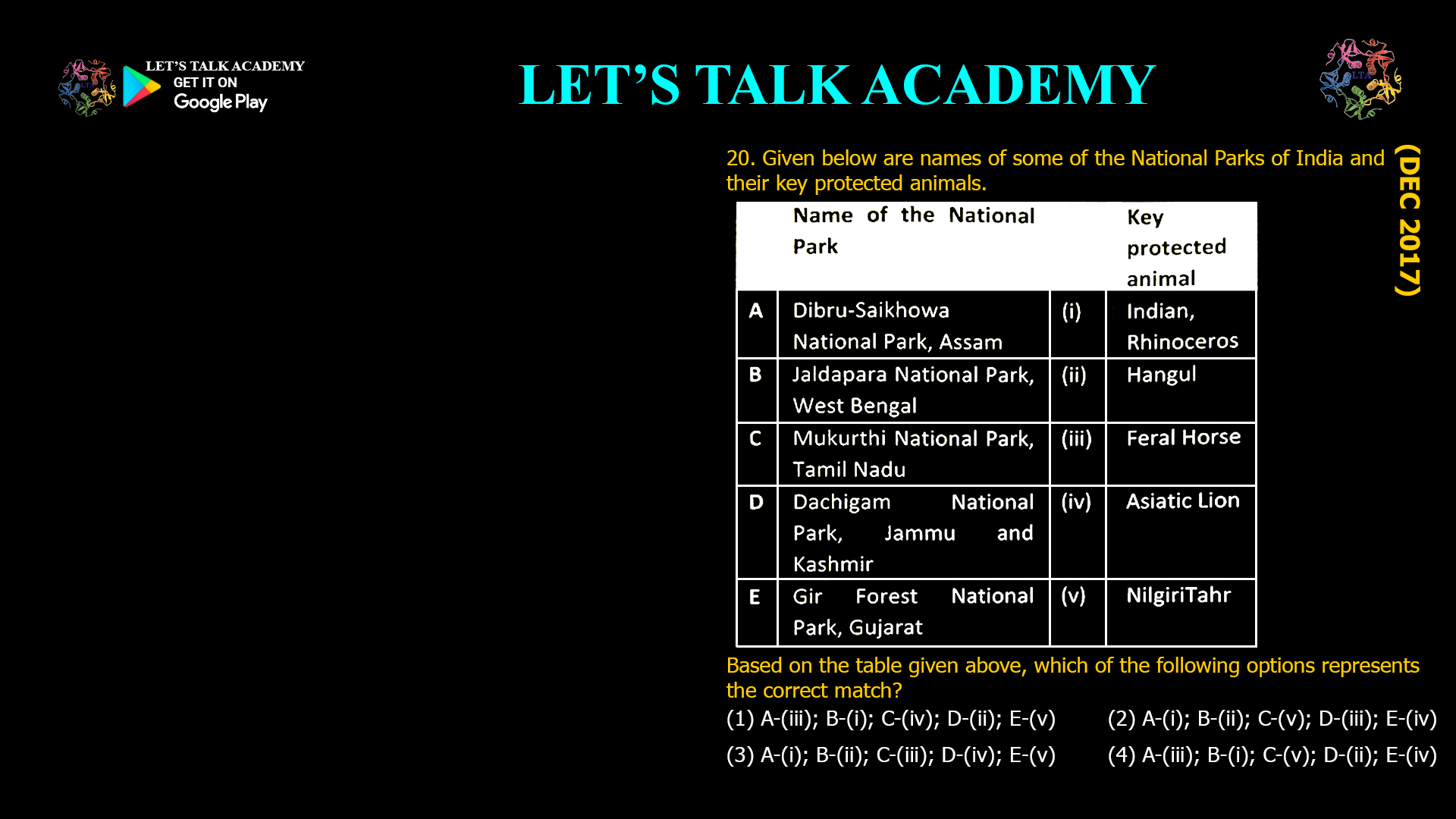
- Given below are names of some of the National Parks of India and their key protected animals.

Based on the table given above, which of the following options represents the
correct match?
(1) A-(iii); B-(i); C-(iv); D-(ii); E-(v)
(2) A-(i); B-(ii); C-(v); D-(iii); E-(iv)
(3) A-(i); B-(ii); C-(iii); D-(iv); E-(v)
(4) A-(iii); B-(i); C-(v); D-(ii); E-(iv)How National Parks and Their Key Species Are Matched
1. Identifying the Park’s Location and Habitat
Each National Park in India is located in a distinct ecological region, which determines the type of flora and fauna that thrive there. For example:
-
Kaziranga National Park (Assam) is famous for the Indian Rhinoceros.
-
Gir National Park (Gujarat) is the last abode of the Asiatic Lion.
-
Ranthambore National Park (Rajasthan) is renowned for its Bengal Tigers.
-
Keoladeo Ghana National Park (Bharatpur, Rajasthan) is a haven for migratory birds like the Siberian Crane.
-
Sundarbans National Park (West Bengal) is known for the Royal Bengal Tiger and its unique mangrove ecosystem.
2. Understanding the Flagship Species
A flagship species is usually the most well-known or charismatic animal found in a park. Conservation efforts often focus on these species because they attract public support and help protect entire ecosystems.
3. Conservation Importance
Matching parks with their flagship species helps:
-
Raise awareness about the need for conservation.
-
Promote eco-tourism, which supports local economies.
-
Guide research and policy for habitat protection.
Example: Matching Parks and Animals
Let’s assume a typical matching scenario:
Park (A-E) Animal (i-v) A. Gir i. Asiatic Lion B. Kaziranga ii. Indian Rhinoceros C. Ranthambore iii. Bengal Tiger D. Keoladeo iv. Siberian Crane E. Sundarbans v. Royal Bengal Tiger If the correct matching is:
A-(i); B-(ii); C-(iii); D-(iv); E-(v)Then option (3) would be correct.
Why Correct Matching Matters
Biodiversity Conservation
Accurate matching helps in monitoring the conservation status of species and the effectiveness of protected areas.
Education and Awareness
It aids in environmental education, helping people understand the unique value of each park and the species it protects.
Policy and Management
Correct associations guide government and NGO efforts in resource allocation, anti-poaching measures, and habitat management.
Conclusion: The Importance of National Parks and Their Key Species
Matching Indian National Parks with their iconic animals is more than a quiz exercise—it’s a reflection of the country’s commitment to preserving its natural heritage. Each park and its flagship species represent a story of survival, adaptation, and hope for the future. Whether you are a student preparing for exams or a nature lover planning your next wildlife adventure, knowing these associations deepens your appreciation for India’s wild wonders.
If you have the table or list, use the process above to match each park with its key animal. In most standard lists, the correct answer is usually:
(3) A-(i); B-(ii); C-(iii); D-(iv); E-(v)
-


1 Comment
Sakshi Kanwar
November 27, 2025Dibru – feral horse
Jaldapara- indian rhino
Mukurthi – nilgri tahr
Dachigam – hangul
Gir – Asiatic lion