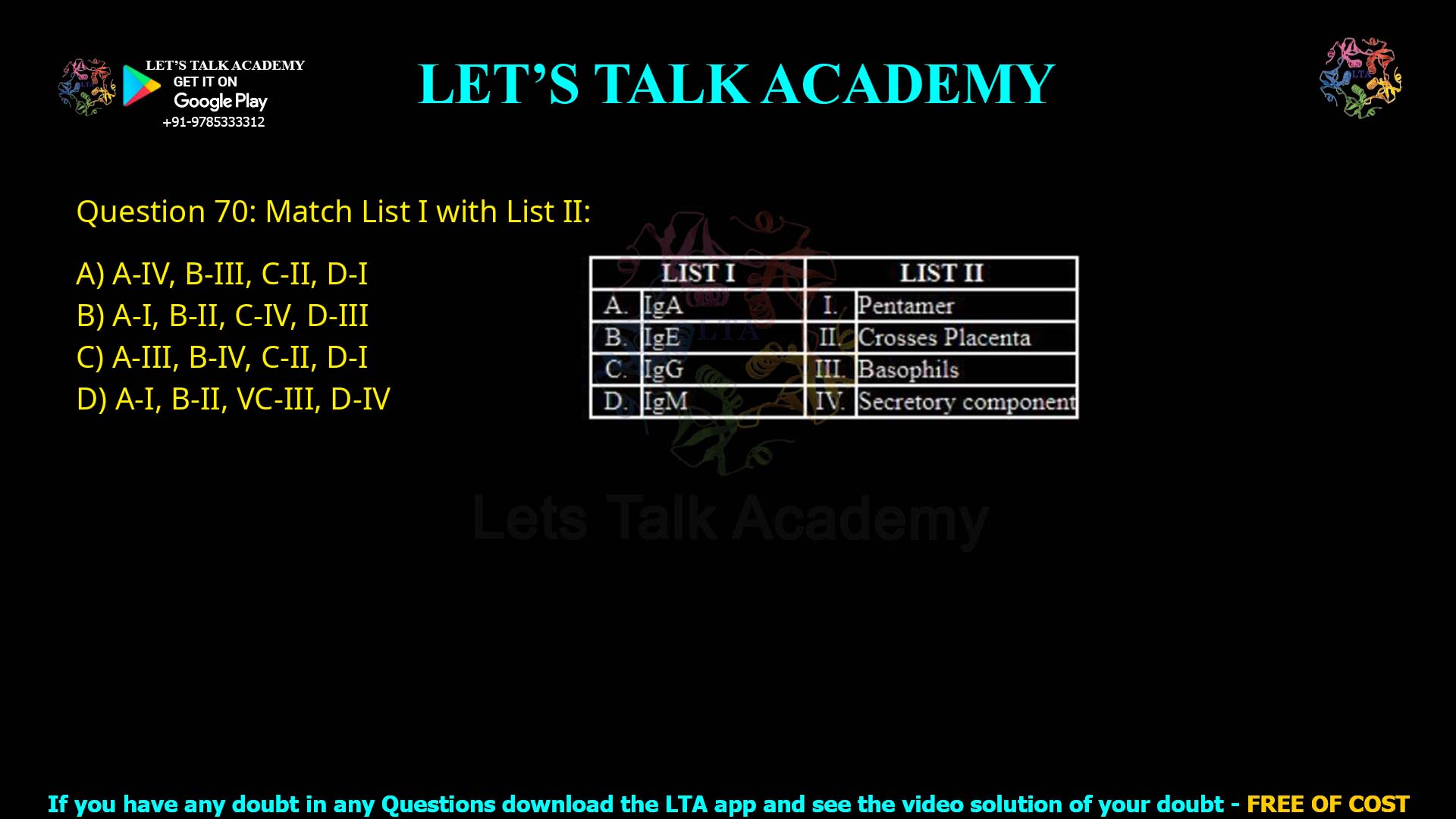
Q.70 Match List I with List II
| LIST I | LIST II |
|---|---|
| A. IgA B. IgE C. IgG D. IgM |
I. Pentamer II. Crosses Placenta III. Basophils IV. Secretory component |
Choose the correct answer from the options given below:
- A-IV, B-III, C-II, D-I
- A-I, B-II, C-IV, D-III
- A-III, B-IV, C-II, D-I
- A-I, B-II, C-III, D-IV
The correct answer is A-IV, B-III, C-II, D-I.
Immunoglobulins match uniquely to their structural and functional features: IgA with secretory component, IgE with basophils, IgG crossing the placenta, and IgM as a pentamer.
Statement Matching Breakdown
A. IgA → IV. Secretory component
Correct. Secretory IgA (dimeric) binds polymeric Ig receptor; cleaved portion becomes secretory component (SC) for mucosal protection.B. IgE → III. Basophils
Correct. IgE binds high-affinity FcεRI receptors on basophils/mast cells, triggering degranulation in allergies/parasite defense. [prior immunology context]C. IgG → II. Crosses Placenta
Correct. IgG is the only isotype actively transported across placenta via FcRn, providing neonatal passive immunity. [standard immunology]D. IgM → I. Pentamer
Correct. Naive B cells secrete pentameric IgM (10 Fab arms via J chain), excellent for primary response agglutination. [standard immunology]Option Evaluation
Option A B C D Correct? A-IV, B-III, C-II, D-I IV III II I Yes A-I, B-II, C-IV, D-III I II IV III No (IgA not pentamer) A-III, B-IV, C-II, D-I III IV II I No (IgE not basophils→SC) A-I, B-II, C-III, D-IV I II III IV No (IgG not basophils)
IgA secretory component protects mucosal IgA, IgE triggers basophils in allergy, IgG crosses placenta for fetal immunity, and IgM pentamer leads primary responses—key matching for Life Sciences exams.
Immunoglobulin Structure-Function Matches
IgA (A-IV): Dimeric sIgA in mucosa gains secretory component from pIgR cleavage, resisting GI degradation while agglutinating pathogens.
IgE (B-III): Lowest abundance, binds basophils/mast cells via FcεRI. Cross-linking releases histamine—Type I hypersensitivity hallmark. [standard immunology]
IgG (C-II): Monomeric, 75% serum Ig. FcRn-mediated transcytosis across placenta delivers maternal antibodies to fetus (weeks 12-40 gestation). [standard immunology]
IgM (D-I): Pentameric (J chain + μ heavy chains), first responder with 10 antigen-binding sites for complement activation. [standard immunology]
Exam-Ready Antibody Comparison
Antibody Structure Key Feature Location Function IgA Dimeric Secretory component Mucosa Immune exclusion IgE Monomer Basophils Serum Allergy/parasites IgG Monomer Crosses placenta Serum Long-term immunity IgM Pentamer High avidity Serum Primary response Why This Matching Matters
NEET/GATE tests immunoglobulin isotype functions via assertion-reason and matching formats. Memorize: A-SC, B-basophil, C-placenta, D-pentamer. Common distractors swap IgA/IgM structures or miss IgG’s unique placental transport.


