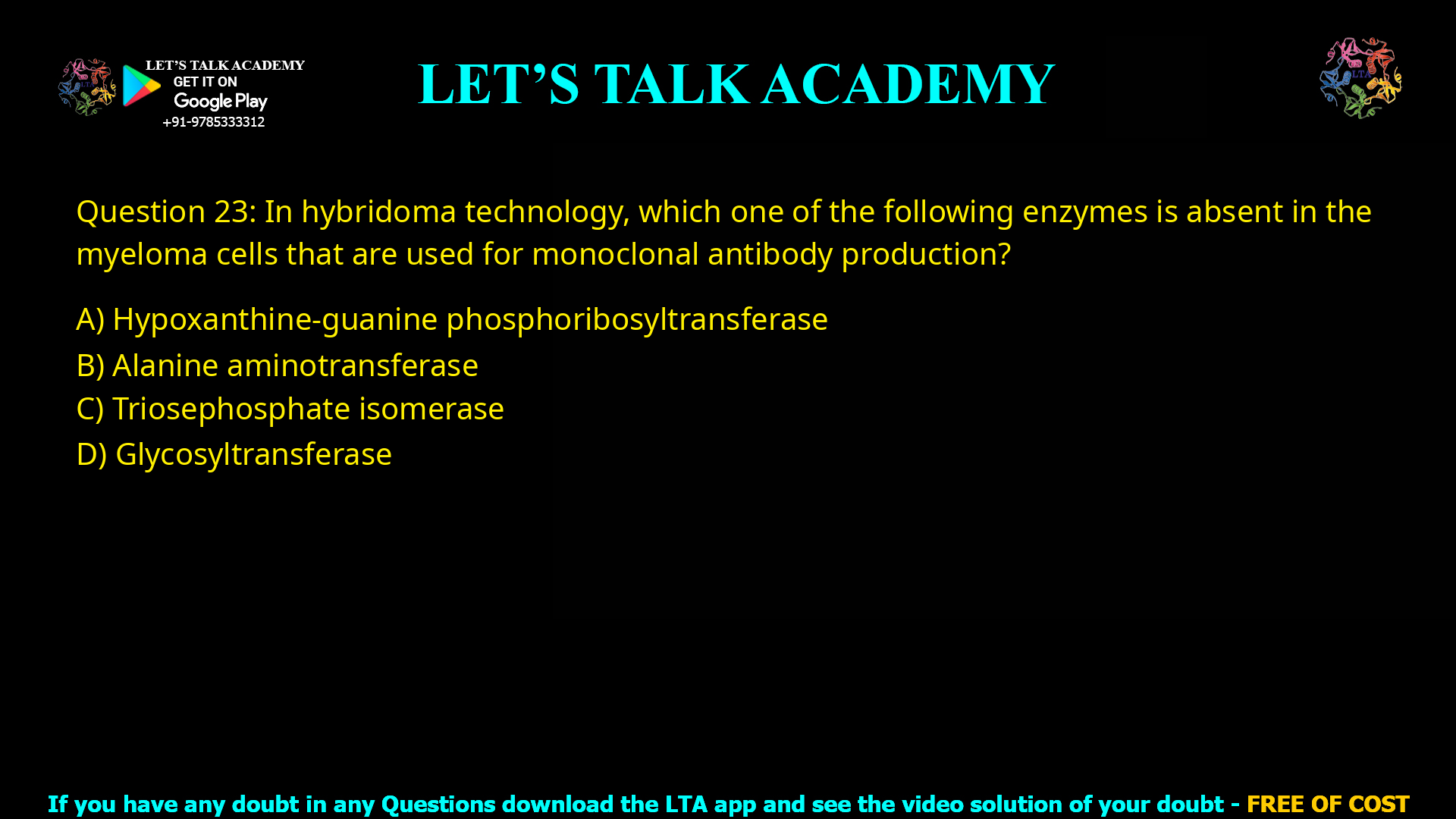
Q.23 In hybridoma technology, which one of the following enzymes is absent in the
myeloma cells that are used for monoclonal antibody production?
(A) Hypoxanthine–guanine phosphoribosyltransferase
(B) Alanine aminotransferase
(C) Triose phosphate isomerase
(D) Glycosyltransferase
Answer: (A) Hypoxanthine-guanine phosphoribosyltransferase
In hybridoma technology, myeloma cells lack HGPRT to enable selective growth of fused hybridomas in HAT medium. This deficiency prevents unfused myeloma survival while allowing hybrids to thrive using B-cell-derived enzymes.
Option Analysis
Hypoxanthine-guanine phosphoribosyltransferase (HGPRT): This enzyme is absent in myeloma cells used for monoclonal antibody production. Myeloma cells are selected via 8-azaguanine treatment, knocking out HGPRT and blocking the purine salvage pathway. In HAT medium, aminopterin inhibits de novo synthesis, killing unfused HGPRT-deficient myeloma cells, while hybridomas survive via B-cell HGPRT.
Alanine aminotransferase: This enzyme transfers amino groups in amino acid metabolism and is present in myeloma cells. It plays no role in HAT selection for hybridoma technology.
Triose phosphate isomerase: Essential for glycolysis, converting dihydroxyacetone phosphate to glyceraldehyde-3-phosphate, this enzyme functions normally in myeloma cells and unrelated to hybridoma selection.
Glycosyltransferase: Involved in glycosylation of proteins and antibodies, these enzymes operate in myeloma cells without deficiency required for hybridoma processes.
In hybridoma technology, HGPRT absent in myeloma cells ensures efficient monoclonal antibody production. This technique fuses antigen-specific B cells with immortal myeloma cells, selecting hybrids via HAT medium where only fused cells survive due to myeloma’s engineered HGPRT deficiency.
Hybridoma Technology Mechanism
Hybridoma technology revolutionized monoclonal antibody production since its 1975 invention by Köhler and Milstein. Myeloma cells, derived from plasmacytoma tumors, are pretreated with 8-azaguanine to eliminate HGPRT activity. Post-fusion:
-
Unfused myeloma cells die in HAT (hypoxanthine, aminopterin, thymidine) due to blocked nucleotide synthesis pathways.
-
Unfused B cells die naturally from limited lifespan.
-
Hybridomas inherit HGPRT from B cells, enabling indefinite proliferation and antibody secretion.
Role of HGPRT Deficiency
HGPRT absent in myeloma cells is critical for salvage pathway blockage. Normally, HGPRT recycles hypoxanthine and guanine into nucleotides. Aminopterin blocks de novo synthesis, making HGPRT essential for HAT survival. This selective pressure yields pure hybridoma clones producing identical antibodies for diagnostics, therapeutics, and research.
Exam Relevance
This concept appears frequently in IIT JAM, GATE Biotechnology, and CSIR NET Life Sciences. Understanding hybridoma technology enzyme deficiencies distinguishes top scorers, linking biotechnology with cell biology and metabolism.


