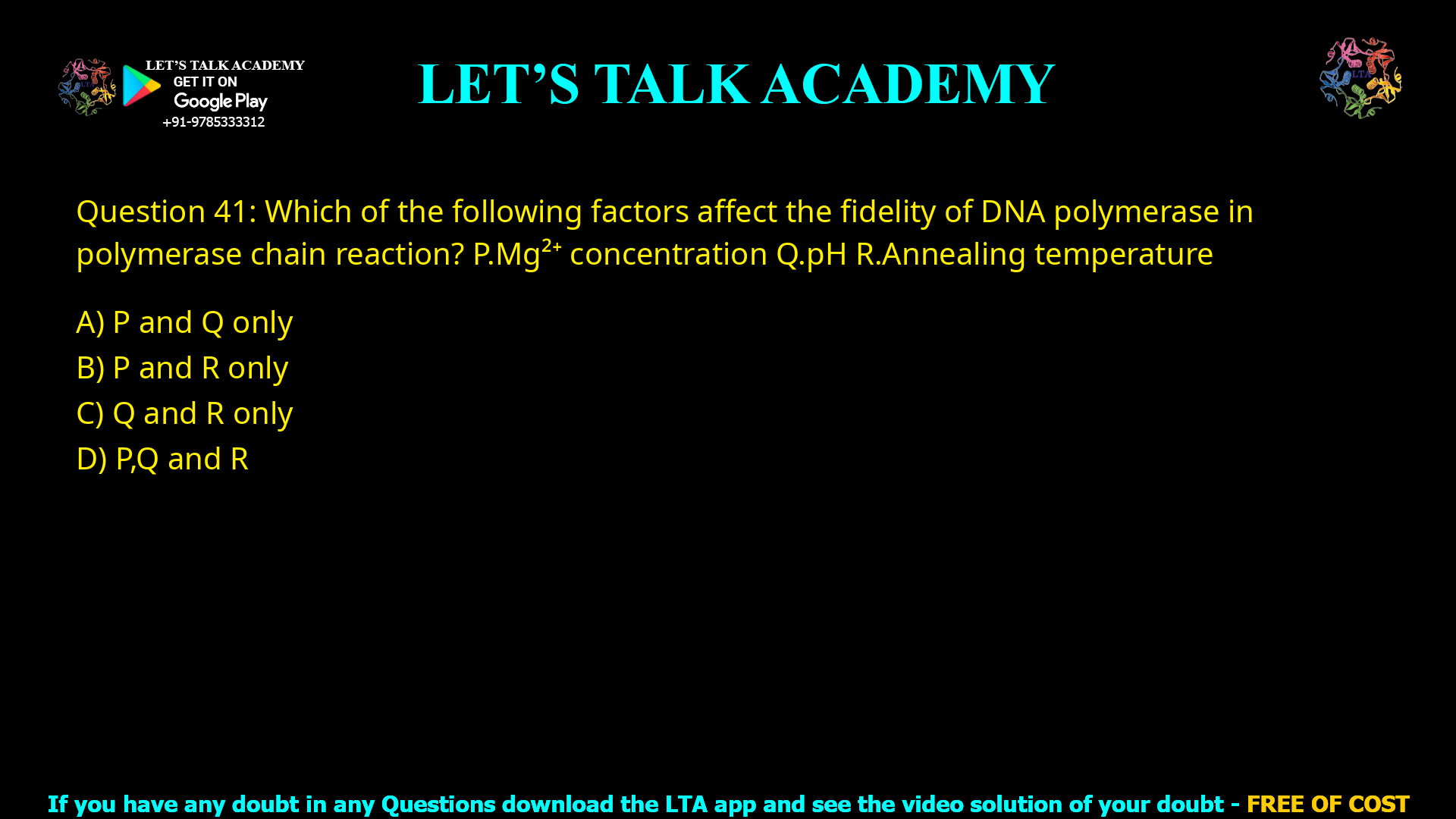
Q.41 Which of the following factors affect the fidelity of DNA polymerase in polymerase chain
reaction?
P. Mg2+ concentration
Q. pH
R. Annealing temperature
(A) P and Q only (B) P and R only
(C) Q and R only (D) P, Q and R
Mg2+ concentration, pH, and annealing temperature all influence DNA polymerase fidelity during PCR by impacting enzyme activity, substrate binding, and primer-template interactions. The correct answer is (D) P, Q and R, as each factor modulates error rates in DNA synthesis.
Option Analysis
P. Mg2+ Concentration
Mg2+ serves as a cofactor for DNA polymerase, stabilizing the enzyme-dNTP complex during nucleotide incorporation. Higher Mg2+ levels reduce fidelity by enabling mismatched base pairing and non-templated additions, while optimal low concentrations (e.g., not exceeding dNTP totals) enhance specificity. In PCR optimization, adjusting Mg2+ from 0.5-5 mM directly affects error rates, with excess promoting slippage in repetitive sequences.
Q. pH
pH alters the ionization of amino acids in the polymerase active site and dNTP substrates, influencing catalytic efficiency and proofreading. Buffers at pH 6 (e.g., Bis-Tris Propane at 70°C) improve fidelity by favoring correct base selection over mismatches, as extreme pH disrupts hydrogen bonding in primer-template hybrids. Studies confirm pH variations yield negligible fidelity changes in some microsatellites but significantly boost accuracy in standard PCR.
R. Annealing Temperature
Annealing temperature controls primer specificity; higher temperatures minimize off-target binding and mispriming, indirectly enhancing fidelity by reducing aberrant extension products. Lower temperatures increase non-specific annealing, elevating mutation rates, while touchdown PCR protocols refine this for high-fidelity outcomes. Though less direct than Mg2+ or pH on polymerase kinetics, it affects overall amplification accuracy.
Why All Three Factors Matter
In PCR, fidelity reflects the polymerase’s error rate (mutations per base pair), critical for cloning and sequencing. Mg2+ and pH directly tune enzymatic fidelity, while annealing temperature ensures template specificity—combined optimization prevents frameshifts and substitutions. For high-fidelity PCR, use proofreading polymerases alongside these adjustments.


