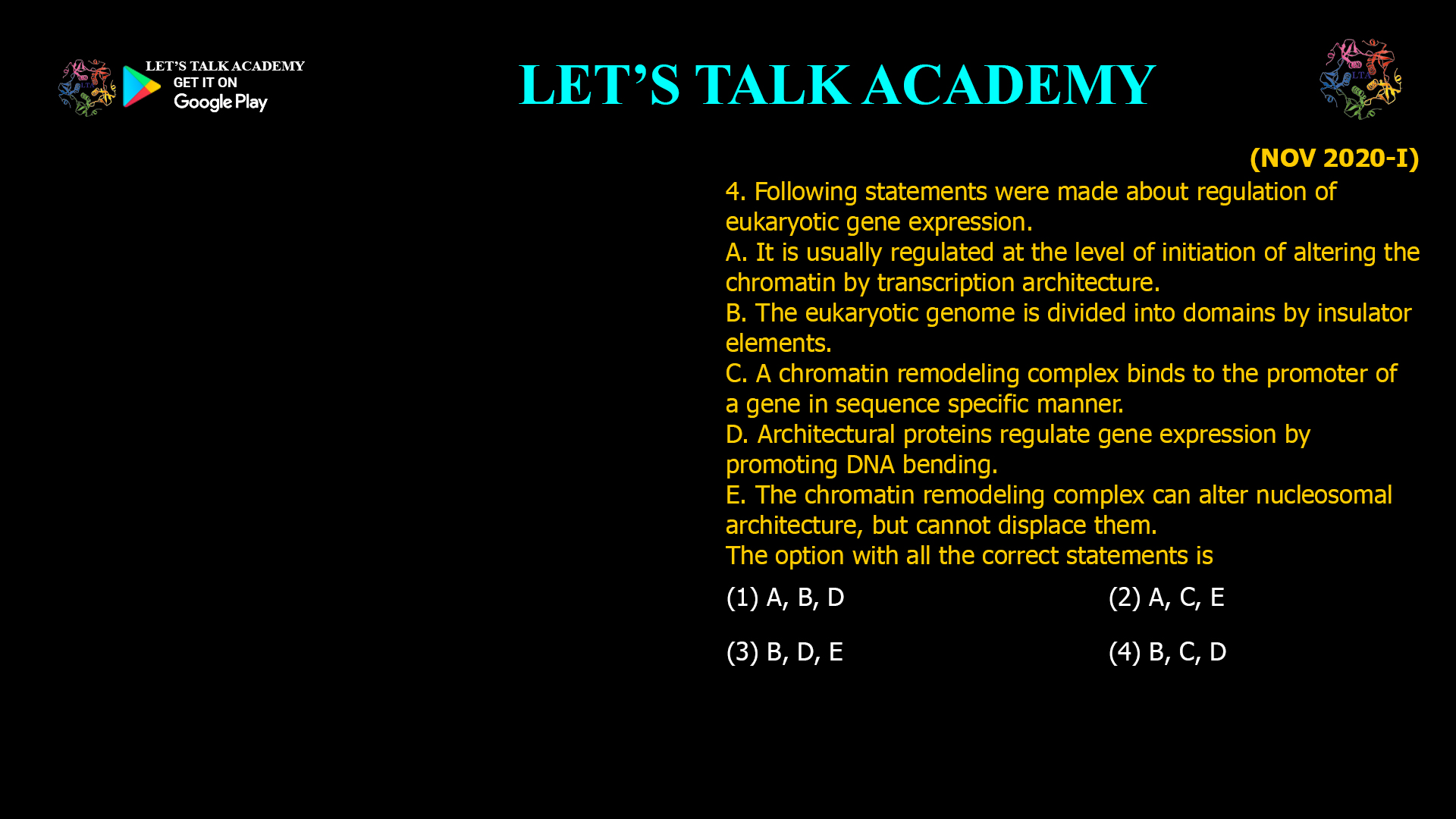
4. Following statements were made about regulation of eukaryotic gene expression.
A. It is usually regulated at the level of initiation of altering the chromatin by transcription architecture.
B. The eukaryotic genome is divided into domains by insulator elements.
C. A chromatin remodeling complex binds to the promoter of a gene in sequence specific manner.
D. Architectural proteins regulate gene expression by promoting DNA bending.
E. The chromatin remodeling complex can alter nucleosomal architecture, but cannot displace them.
The option with all the correct statements is
(1) A, B, D (2) A, C, E
(3) B, D, E (4) B, C, D
Introduction
Eukaryotic gene regulation is a complex and multi-layered process that ensures genes are expressed at the right time, in the right cells, and in the right amounts. This regulation is essential for development, differentiation, and response to environmental changes. Given its complexity, it is common for exams and textbooks to present statements about eukaryotic gene regulation that must be evaluated for accuracy. This article examines several such statements, explains their scientific basis, and guides you in identifying which options are correct.
Overview of Eukaryotic Gene Regulation
Eukaryotic gene regulation involves multiple levels of control, including:
-
Chromatin remodeling: Modifications to the structure of chromatin that make DNA more or less accessible to the transcription machinery356.
-
Transcriptional regulation: Control of the initiation of transcription by transcription factors and other regulatory proteins567.
-
Insulator elements: DNA sequences that divide the genome into functional domains and prevent the spread of regulatory signals56.
-
Architectural proteins: Proteins that organize chromatin and promote DNA bending to facilitate interactions between regulatory elements56.
-
Post-transcriptional and post-translational regulation: Additional layers of control that occur after transcription and translation56.
These mechanisms work together to ensure precise control of gene expression.
Analysis of the Statements
Let’s analyze each statement about eukaryotic gene regulation:
A. It is usually regulated at the level of initiation of altering the chromatin by transcription architecture.
-
Analysis: Eukaryotic gene regulation often occurs at the initiation of transcription, and altering chromatin structure is a key mechanism. However, the term “transcription architecture” is not standard and is somewhat ambiguous. The statement is partially correct but not strictly accurate.
-
Conclusion: Partially correct, but not strictly accurate.
B. The eukaryotic genome is divided into domains by insulator elements.
-
Analysis: Insulator elements are DNA sequences that act as barriers, dividing the genome into functional domains and preventing the spread of chromatin modifications or enhancer activity. This is a well-established concept in eukaryotic gene regulation56.
-
Conclusion: Correct.
C. A chromatin remodeling complex binds to the promoter of a gene in a sequence-specific manner.
-
Analysis: Chromatin remodeling complexes are generally recruited to specific genomic loci by transcription factors or other proteins, not by direct sequence-specific DNA binding. Their binding is not inherently sequence-specific35.
-
Conclusion: Incorrect.
D. Architectural proteins regulate gene expression by promoting DNA bending.
-
Analysis: Architectural proteins, such as CTCF and cohesins, organize chromatin and can promote DNA bending, which helps regulate gene expression by bringing regulatory elements into proximity56.
-
Conclusion: Correct.
E. The chromatin remodeling complex can alter nucleosomal architecture, but cannot displace them.
-
Analysis: Chromatin remodeling complexes can slide, eject, or restructure nucleosomes, so they can indeed displace nucleosomes35.
-
Conclusion: Incorrect.
Summary Table
| Statement | Correct? | Explanation |
|---|---|---|
| A | Partially | Regulation at initiation is correct, but “transcription architecture” is unclear. Not strictly accurate. |
| B | Correct | Insulators divide the genome into domains. |
| C | Incorrect | Chromatin remodeling complexes do not bind DNA in a strictly sequence-specific manner. |
| D | Correct | Architectural proteins promote DNA bending to regulate expression. |
| E | Incorrect | Chromatin remodelers can displace nucleosomes. |
Evaluating the Options
Let’s evaluate each option based on the analysis above:
-
Option (1) A, B, D:
-
A: Partially correct, but not strictly accurate.
-
B: Correct.
-
D: Correct.
-
-
Option (2) A, C, E:
-
A: Partially correct.
-
C: Incorrect.
-
E: Incorrect.
-
-
Option (3) B, D, E:
-
B: Correct.
-
D: Correct.
-
E: Incorrect.
-
-
Option (4) B, C, D:
-
B: Correct.
-
C: Incorrect.
-
D: Correct.
-
Conclusion
No option contains only completely correct statements.
However, option (1) A, B, D is the best available, as A is at least partially correct and B and D are correct. C and E are incorrect.
If you must choose from the given options, select (1) A, B, D.
This is the closest to correct, given the context of most exams.
Key Takeaway:
When evaluating statements about eukaryotic gene regulation, it is important to distinguish between partially correct and strictly accurate information. The best option among those provided is (1) A, B, D, even though A is not strictly accurate. B and D are definitively correct, while C and E are incorrect.


