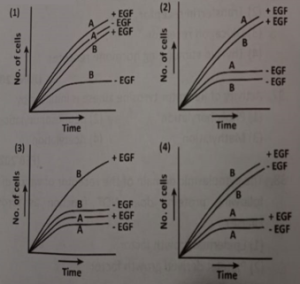
49. Epidermal growth factor (EGF) is needed for growth of almost all cells. EGF receptor is a transmembrane protein having an extracellular ligand-binding domain, a transmembrane domain and a cytosolic domain of protein tyrosine kinase (PTK). Binding of EGF to the receptor activates PTK resulting in activation of transcription factors through intracellular transducers. In cell type A, much of the extra cellular ligand-binding domain is deleted by proteases such that cytosolic domain of P TK becomes constitutively active whereas cell type B is having normal EGF receptor. What will be the best-fit graph for the growth of the cultures of cell type A and B in complete medium in presence (+) and absence (-) of EGF?
Introduction
Epidermal growth factor (EGF) is essential for the growth and proliferation of many cell types. The EGF receptor (EGFR) is a transmembrane receptor tyrosine kinase with an extracellular ligand-binding domain, a transmembrane region, and an intracellular protein tyrosine kinase (PTK) domain. Ligand binding activates EGFR’s PTK, triggering intracellular signaling that stimulates cell growth.
Recent studies reveal mutations or truncations deleting much of the extracellular ligand-binding domain can render the receptor’s kinase domain constitutively active — independent of ligand presence. This aberration leads to ligand-independent signaling events often implicated in unchecked cell proliferation.
Cell Types and Growth Behavior
-
Cell Type A: Has truncated EGFR missing most of the extracellular ligand-binding domain. The kinase domain is constitutively active.
-
Cell Type B: Expresses wild-type EGFR with intact ligand-binding domain and regulated kinase activity.
Expected Growth Patterns in Complete Medium
-
In presence of EGF (+EGF):
-
Cell Type B: EGF binds to EGFR, activating kinase activity and downstream proliferative signaling. Expect robust growth.
-
Cell Type A: Kinase is already constitutively active, so EGF presence has minimal additional effect. Cell growth remains high.
-
-
In absence of EGF (-EGF):
-
Cell Type B: Without ligand, EGFR remains mostly inactive, so growth is minimal or basal.
-
Cell Type A: Constitutively active kinase leads to continued proliferation despite absence of ligand.
-
Interpretation of Growth Curves
A graph plotting cell growth (y-axis) versus time (x-axis) under +EGF and -EGF conditions for both cell types will show:
-
Cell Type B:
-
Low growth curve without EGF (flat or slow).
-
High growth curve with EGF (significant increase).
-
-
Cell Type A:
-
High growth curve in both presence and absence of EGF, essentially overlapping.
-
Slight or no increase when EGF is added, because kinase is already active.
-
Biological and Clinical Relevance
EGFR mutations that truncate the extracellular domain (similar to EGFRvIII variant) contribute to ligand-independent receptor signaling observed in various cancers, promoting uncontrolled growth.
Such constitutive activation offers insight into therapeutic strategies targeting constitutively active kinases, emphasizing treatments that inhibit the kinase domain directly rather than blocking ligand binding.
Conclusion
Cell type A with truncated constitutively active EGFR exhibits high proliferative activity regardless of EGF presence, unlike normal cell type B, whose growth is ligand-dependent. This model explains how mutations leading to receptor truncations result in dysregulated cell growth.


