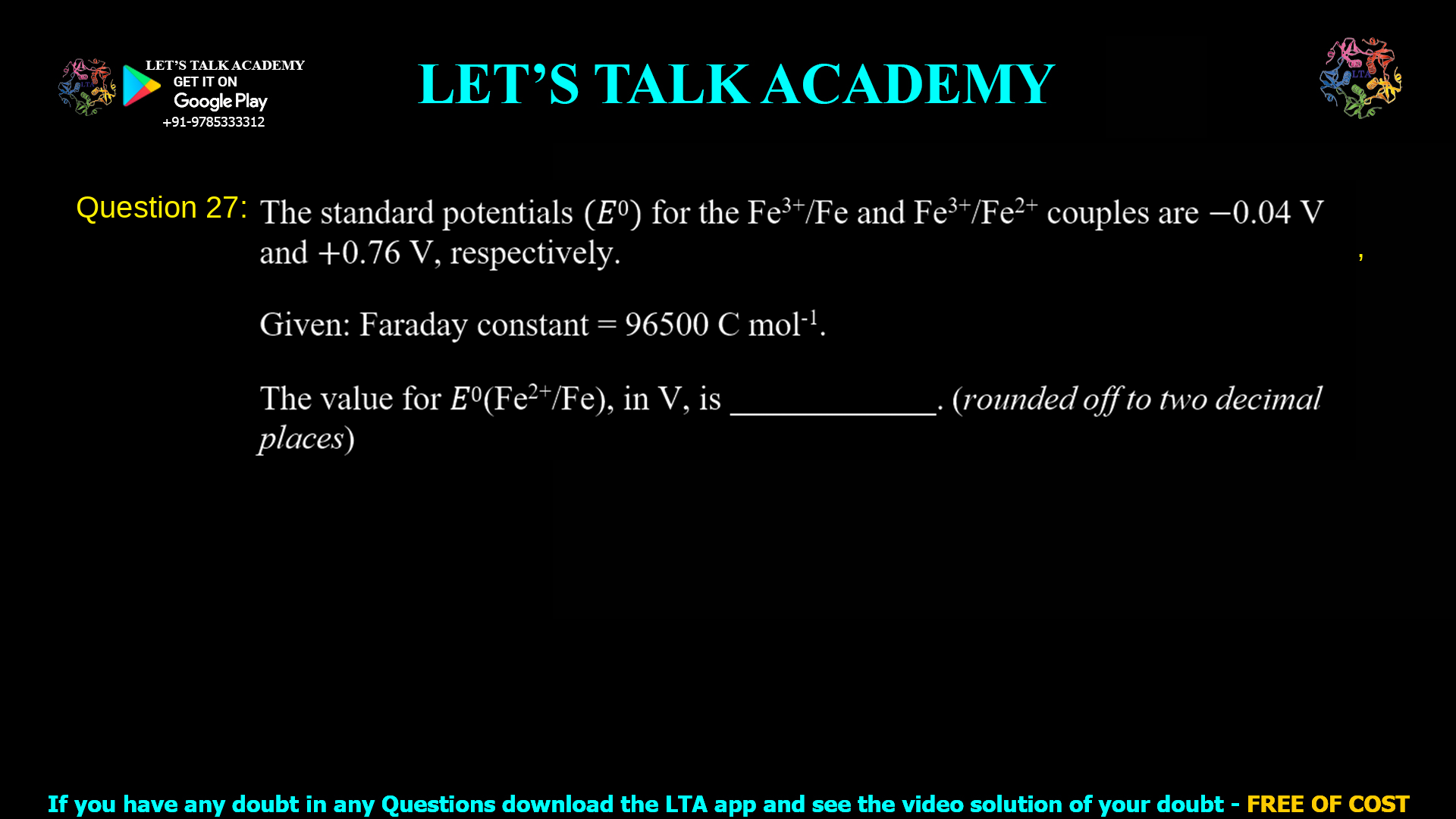
Q. 27 The standard potentials (𝐸0) for the Fe3+/Fe and Fe3+/Fe2+ couples are −0.04 V
and +0.76 V, respectively.
Given: Faraday constant = 96500 C mol–1.
The value for 𝐸0(Fe2+/Fe), in V, is ____________. (rounded off to two decimal
places)
Problem Statement
The standard potentials (E⁰) for the Fe³⁺/Fe and Fe³⁺/Fe²⁺ couples are −0.04 V and +0.76 V, respectively. Given: Faraday constant = 96500 C mol⁻¹. The value for E⁰(Fe²⁺/Fe), in V, is ____________. (rounded off to two decimal places)
Answer
The standard reduction potential E⁰(Fe²⁺/Fe) is -0.44 V.
Problem Analysis
The question provides E⁰(Fe³⁺/Fe) = −0.04 V for Fe³⁺ + 3e⁻ → Fe (3 electrons) and E⁰(Fe³⁺/Fe²⁺) = +0.76 V for Fe³⁺ + e⁻ → Fe²⁺ (1 electron). The task requires finding E⁰(Fe²⁺/Fe) for Fe²⁺ + 2e⁻ → Fe (2 electrons). The Faraday constant (96500 C mol⁻¹) indicates use of the Gibbs free energy relation ΔG⁰ = −nFE⁰, where potentials relate through additive free energies.
Solution Method
Combine reactions using Hess’s law for half-cells:
- Fe³⁺ + 3e⁻ → Fe, ΔG₁⁰ = −3F(−0.04)
- Fe + 2e⁻ → Fe²⁺, reverse of target: ΔG₂⁰ = +2FE⁰(Fe²⁺/Fe) [let E⁰(Fe²⁺/Fe) = x V]
Adding gives Fe³⁺ + e⁻ → Fe²⁺, so:
ΔG₁⁰ + ΔG₂⁰ = −FE⁰(Fe³⁺/Fe²⁺)
−3F(−0.04) + 2Fx = −F(0.76)
Divide by F:
0.12 + 2x = −0.76
2x = −0.88 ⟹ x = −0.44
Verification
Standard values confirm: E⁰(Fe³⁺/Fe²⁺) = 3E⁰(Fe³⁺/Fe) − 2E⁰(Fe²⁺/Fe). Substituting gives 0.76 = 3(−0.04) − 2(−0.44) = −0.12 + 0.88 = 0.76. Matches exactly.
CSIR NET Tips
- Practice this for multi-step redox potentials
- Common trap: Simple subtraction ignores n
- Verify with formula E⁰(Fe³⁺/Fe²⁺) = 3E⁰(Fe³⁺/Fe) − 2E⁰(Fe²⁺/Fe)
- Always use Gibbs free energy method for different electron counts
Step-by-Step Derivation
Reaction 1: Fe³⁺ + 3e⁻ → Fe, E⁰ = −0.04 V, n = 3, ΔG₁⁰ = −3F(−0.04) = 0.12F
Target reverse: Fe → Fe²⁺ + 2e⁻, E⁰ = −x, ΔG₂⁰ = 2Fx
Net: Fe³⁺ + e⁻ → Fe²⁺, ΔG⁰ = −F(0.76) = −0.76F
Balance: 0.12F + 2Fx = −0.76F, so x = −0.44 V


