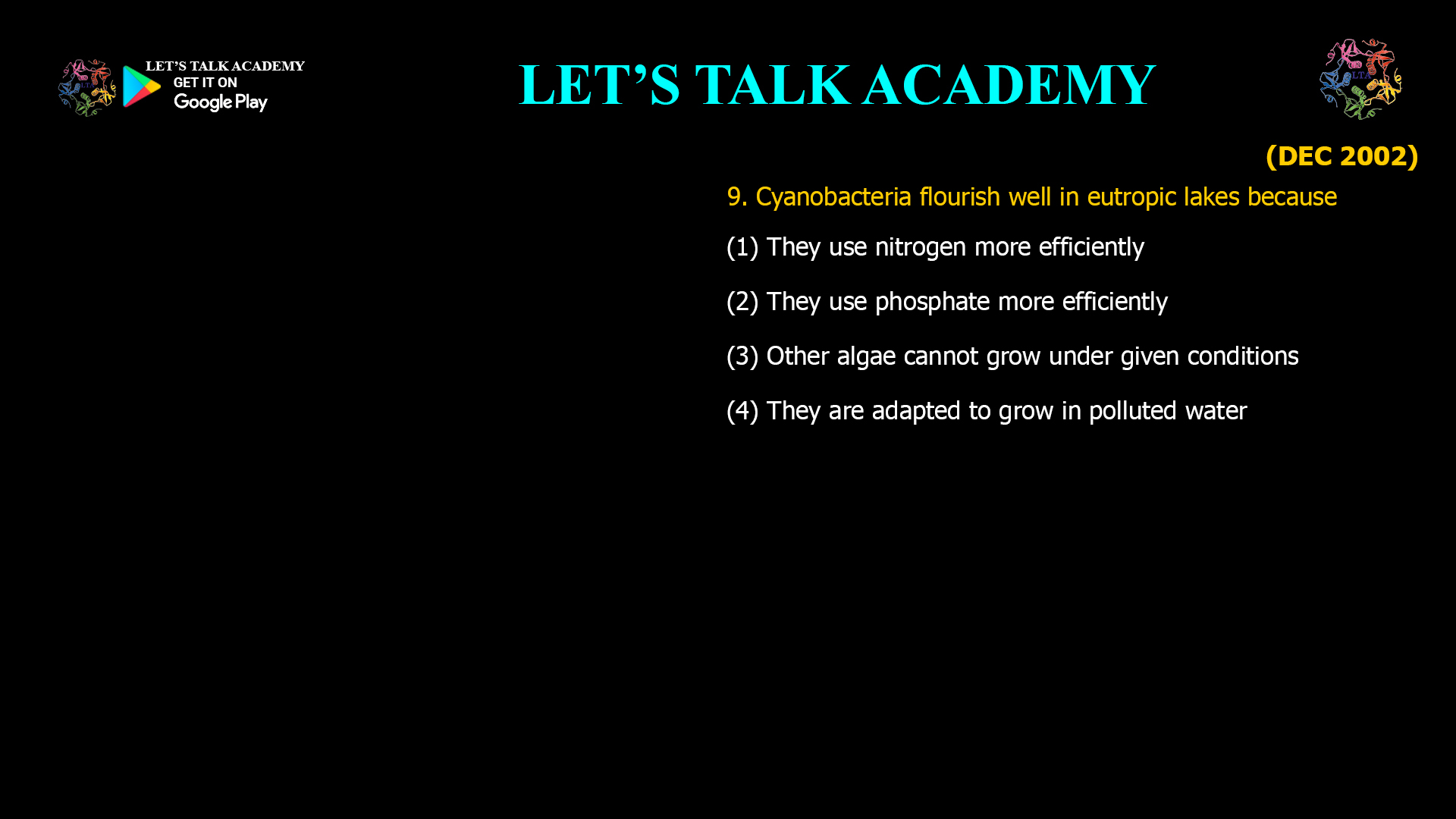
- Cyanobacteria flourish well in eutropic lakes because
(1) They use nitrogen more efficiently
(2) They use phosphate more efficiently
(3) Other algae cannot grow under given conditions
(4) They are adapted to grow in polluted water
Cyanobacteria, often called blue-green algae, are notorious for forming dense blooms in eutrophic lakes—water bodies enriched with excessive nutrients, especially nitrogen and phosphorus. Their dominance in such environments is not accidental; it is the result of a suite of adaptations and competitive advantages that allow them to outcompete other algae under specific conditions. This article explores why cyanobacteria flourish in eutrophic lakes, examining their nutrient use, ecological adaptations, and the limitations faced by other algal groups.
What Are Eutrophic Lakes?
Eutrophic lakes are characterized by high concentrations of nutrients, particularly nitrogen and phosphorus. These nutrients originate from sources such as agricultural runoff, urban wastewater, and industrial discharges. The abundance of nutrients leads to excessive growth of algae and aquatic plants, resulting in algal blooms, reduced water clarity, and, often, a shift in the dominant algal community toward cyanobacteria.
Why Cyanobacteria Dominate Eutrophic Lakes
1. Efficient Use of Nitrogen and Phosphorus
Cyanobacteria have evolved several strategies to utilize nutrients more efficiently than many other algae, especially under conditions of nutrient limitation or imbalance.
-
Nitrogen Fixation: Many cyanobacteria, especially filamentous types, can fix atmospheric nitrogen (N₂) into biologically available forms using specialized cells called heterocysts. This ability allows them to thrive even when dissolved inorganic nitrogen is scarce, giving them a competitive edge over algae that cannot fix nitrogen.
-
Phosphorus Utilization: Cyanobacteria are adept at taking up and storing phosphorus (P), sometimes in excess of their immediate needs—a phenomenon known as “luxury uptake.” This allows them to grow rapidly when phosphorus is available and to persist even when it becomes limiting.
-
Use of Organic Nutrients: Some cyanobacteria can utilize organic forms of phosphorus and nitrogen, further increasing their ability to exploit available nutrients in eutrophic lakes.
2. Adaptations to High Nutrient and Polluted Conditions
While cyanobacteria are often associated with polluted or nutrient-rich waters, their success is not solely due to pollution tolerance. Instead, they are highly adapted to exploit the specific conditions found in eutrophic lakes:
-
Buoyancy Regulation: Many cyanobacteria can regulate their buoyancy using gas vesicles, allowing them to float to the surface and access sunlight, even in turbid water.
-
Low Light Requirements: Cyanobacteria generally have lower light requirements than many eukaryotic algae, enabling them to photosynthesize efficiently even when water clarity is reduced by suspended particles or other algae.
-
Temperature Tolerance: Many cyanobacteria have higher temperature optima than other algae, making them more competitive during warm summer months when blooms are most common.
3. Competitive Exclusion of Other Algae
The dominance of cyanobacteria in eutrophic lakes is also due to the inability of other algal groups to compete under the prevailing conditions:
-
Nutrient Imbalance: When the ratio of nitrogen to phosphorus is low, cyanobacteria with nitrogen-fixing abilities can outcompete non-fixing algae.
-
Algal Toxins: Some cyanobacteria produce toxins that inhibit the growth of other algae or deter grazing by zooplankton, further reducing competition.
-
Surface Scums: Dense surface blooms of cyanobacteria can block sunlight, limiting the growth of submerged algae and aquatic plants.
4. Misconception: Adaptation to Polluted Water
While it is true that cyanobacteria are often found in polluted environments, their success is more accurately attributed to their ability to exploit high nutrient levels and specific ecological niches, rather than a general adaptation to pollution. Pollution often brings excess nutrients, but cyanobacteria themselves are adapted to nutrient-rich conditions, not necessarily to other forms of pollution.
The Consequences of Cyanobacterial Dominance
The proliferation of cyanobacteria in eutrophic lakes has several negative consequences:
-
Reduced Water Quality: Cyanobacterial blooms reduce water clarity and can produce unpleasant odors and tastes.
-
Oxygen Depletion: When blooms die and decompose, oxygen levels in the water can drop dramatically, leading to fish kills and other ecological disruptions.
-
Toxin Production: Many cyanobacteria produce toxins that can harm aquatic life, livestock, and humans, particularly through contaminated drinking water.
-
Loss of Biodiversity: The dominance of cyanobacteria can suppress the growth of other algae and aquatic plants, reducing overall biodiversity.
Comparing the Options
Let’s revisit the original options and evaluate their accuracy:
-
They use nitrogen more efficiently:
-
Accuracy: Partially correct. Many cyanobacteria can fix atmospheric nitrogen, giving them an advantage when dissolved nitrogen is limiting. However, not all cyanobacteria have this ability.
-
-
They use phosphate more efficiently:
-
Accuracy: Correct. Cyanobacteria are known for efficient phosphorus uptake and storage, especially under fluctuating nutrient conditions.
-
-
Other algae cannot grow under given conditions:
-
Accuracy: Partially correct. The conditions in eutrophic lakes (high nutrients, low light, high temperatures) often favor cyanobacteria over other algae, but this is more about competitive advantage than absolute inability of other algae to grow.
-
-
They are adapted to grow in polluted water:
-
Accuracy: Misleading. While cyanobacteria are often found in polluted, nutrient-rich waters, their success is due to adaptations to high nutrient levels, not pollution per se.
-
Key Adaptations of Cyanobacteria
-
Nitrogen Fixation: Allows growth when nitrogen is scarce.
-
Phosphorus Storage: Permits rapid growth and persistence.
-
Buoyancy Regulation: Facilitates access to light in turbid waters.
-
Low Light Requirements: Enables photosynthesis under reduced light conditions.
-
Temperature Tolerance: Favors dominance in warm waters.
-
Toxin Production: Reduces grazing pressure and inhibits competitors.
Ecological and Management Implications
Understanding why cyanobacteria thrive in eutrophic lakes is crucial for managing water quality and preventing harmful algal blooms. Reducing nutrient inputs, especially phosphorus, is the most effective way to control cyanobacterial dominance. Restoration efforts should also consider the unique adaptations of cyanobacteria and the factors that allow them to outcompete other algae.
Summary Table
| Adaptation/Feature | Cyanobacteria | Other Algae |
|---|---|---|
| Nitrogen fixation | Yes (some) | Rare |
| Phosphorus storage | Yes | Variable |
| Buoyancy regulation | Yes | Rare |
| Low light requirements | Yes | Variable |
| Temperature tolerance | High | Variable |
| Toxin production | Yes (some) | Rare |
Conclusion
Cyanobacteria flourish in eutrophic lakes primarily because they are highly efficient at using available nutrients, especially phosphorus, and many species can fix atmospheric nitrogen when it is limiting. Their suite of adaptations—including buoyancy regulation, low light requirements, and temperature tolerance—allows them to outcompete other algae under the conditions typical of eutrophic lakes. While it is sometimes said that they are adapted to grow in polluted water, their success is more accurately attributed to their ability to exploit high nutrient levels and specific ecological niches.
Among the options, the most accurate and comprehensive explanation is that cyanobacteria use phosphate more efficiently, though their ability to fix nitrogen and adapt to challenging conditions also plays a significant role in their dominance in eutrophic lakes. Understanding these adaptations is essential for effective lake management and the prevention of harmful cyanobacterial blooms.


5 Comments
Kirti Agarwal
November 6, 2025Cyanobacteria use phosphate more efficiently
Kajal
November 15, 2025Phosphate use
Sakshi Kanwar
November 28, 2025They use phosphate more efficiently
Manisha choudhary
December 12, 2025Use Phosphate more efficiently
Muskan Yadav
December 15, 2025They use phosphate more efficiently.