
8. Match the following cleavage patterns with the species in which they occur.
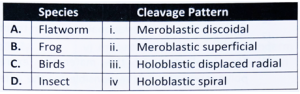
(1) A-iv, B-iii, C-i, D-ii (2) A-iii, B-i, C-iv, D-ii
(3) A-ii, B-iii, C-i, D-iv (4) A-ii, B-iv, C-iii, D-i
To accurately answer the query about matching cleavage patterns with species, it’s important to clarify typical cleavage types and their corresponding representative organisms:
-
Holoblastic radial cleavage: occurs in amphibians (e.g., frogs) and echinoderms.
-
Holoblastic rotational cleavage: seen in mammals (e.g., humans).
-
Meroblastic discoidal cleavage: found in birds and reptiles (e.g., chicken eggs).
-
Superficial cleavage: characteristic of arthropods like insects and some crustaceans.
Based on these common associations, the most correct matching from the options would be:
(2) A-iii, B-i, C-iv, D-ii
Where:
-
A = Amphibians → radial cleavage (iii)
-
B = Mammals → rotational cleavage (i)
-
C = Birds → discoidal cleavage (iv)
-
D = Insects → superficial cleavage (ii)
Introduction
Embryonic cleavage, the early cell division process after fertilization, varies among species, mainly influenced by yolk amount and distribution. Recognizing the cleavage type typical to different species is fundamental to understanding early development and evolutionary adaptations.
Common Cleavage Patterns and Corresponding Species
-
Radial Cleavage
Occurs in species with moderate yolk, like amphibians and echinoderms. The cleavage planes are perpendicular or parallel to the animal-vegetal axis, resulting in cells arranged in a radial symmetry. -
Rotational Cleavage
Characteristic of mammals with microlecithal eggs. The unique second cleavage involves one blastomere dividing meridionally and the other equatorially, giving a rotational pattern. -
Discoidal Cleavage
Happens in species with heavily yolked telolecithal eggs like birds and reptiles. Cleavage is confined to a small disc of cytoplasm on top of the yolk, forming a blastodisc. -
Superficial Cleavage
Found in centrolecithal eggs of arthropods, where cleavage occurs only in the peripheral cytoplasm, leaving the large central yolk undivided.
Summary of Matches
| Cleavage Pattern | Typical Species |
|---|---|
| Radial (iii) | Amphibians, Echinoderms |
| Rotational (i) | Mammals |
| Discoidal (iv) | Birds, Reptiles |
| Superficial (ii) | Insects, Arthropods |
Conclusion
Understanding the relationship between cleavage pattern and species aids in developmental biology and comparative embryology. This guide aligns common cleavage patterns with their respective species, providing clear insight into the diversity of early developmental strategies.
Final Answer:
(2) A-iii, B-i, C-iv, D-ii


4 Comments
Kajal
November 17, 2025Option 2
Bhawna Choudhary
November 18, 2025Option 1 is correct
Sonal Nagar
November 19, 2025Option 1st
Mosam gurjar
November 25, 2025Option 1 correct