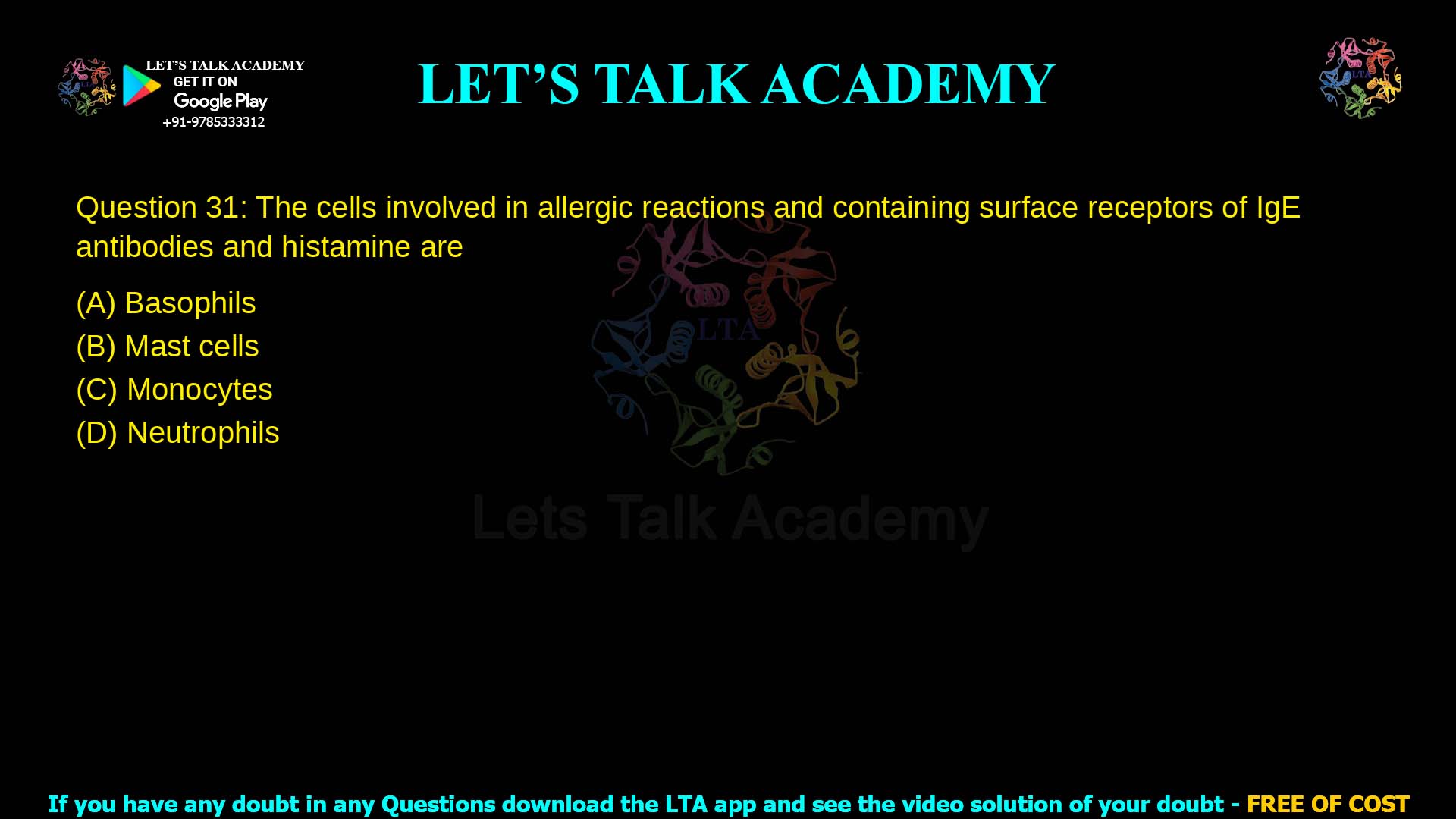
Q.31 The cells involved in allergic reactions and containing surface receptors of IgE antibodies and histamine are
(A) Basophils
(B) Mast cells
(C) Monocytes
(D) Neutrophils
Mast cells are the primary cells in tissues that express high-affinity IgE receptors (FcεRI) and store histamine in granules, making them central to type I hypersensitivity reactions like allergies. Both mast cells and basophils fit this description, but mast cells are the classic effectors due to their tissue location and role in initiating local allergic responses. This aligns with CSIR NET Life Sciences exam patterns focusing on immunology details.
Option Analysis
-
(A) Basophils: Circulating granulocytes that express FcεRI receptors for IgE and contain histamine granules, releasing them during systemic allergic reactions like anaphylaxis. However, they are less emphasized than mast cells for tissue-based allergies and are not the primary answer in standard MCQs.
-
(B) Mast cells: Tissue-resident cells with abundant FcεRI IgE receptors; they store and release histamine upon allergen cross-linking of IgE, triggering immediate allergic symptoms such as hives, rhinitis, and asthma. Correct choice as they line mucosal surfaces and drive both early and late-phase responses.
-
(C) Monocytes: Precursors to macrophages and dendritic cells; lack FcεRI IgE receptors and do not store histamine. They contribute to chronic inflammation but not type I allergic reactions.
-
(D) Neutrophils: Phagocytic cells involved in bacterial infections and late-phase inflammation; express low-affinity IgE receptors (not FcεRI) but do not contain preformed histamine granules.
Introduction to Cells in Allergic Reactions
Allergic reactions trigger when allergens bind IgE receptors on specific immune cells, releasing histamine for symptoms like itching and swelling. Cells involved in allergic reactions with IgE surface receptors and histamine granules are mainly mast cells and basophils, pivotal in type I hypersensitivity studied for CSIR NET exams.
Role of Mast Cells in Allergies
Mast cells reside in tissues like skin and lungs, expressing high-affinity FcεRI IgE receptors that sensitize them to allergens. Upon IgE cross-linking, they degranulate, releasing preformed histamine, leukotrienes, and cytokines, causing immediate effects like vasodilation and bronchoconstriction.
-
Histamine from mast cell granules increases vascular permeability.
-
Late-phase response recruits eosinophils and basophils.
-
Key in asthma, rhinitis, and anaphylaxis.
Basophils vs Mast Cells: Key Differences
Basophils, blood granulocytes, also have FcεRI and histamine but circulate rather than reside in tissues, amplifying systemic responses.
| Feature | Mast Cells | Basophils |
|---|---|---|
| Location | Tissues (mucosa, skin) | Blood circulation |
| IgE Receptor (FcεRI) | High density | Present, lower density |
| Histamine Storage | Abundant granules | Granules present |
| Primary Allergic Role | Local initiation | Systemic amplification |
Other Cells: Why Not Involved
Monocytes differentiate into non-histamine-storing phagocytes without FcεRI, handling adaptive immunity. Neutrophils focus on infections, lacking significant IgE receptors or histamine.
CSIR NET Exam Insights
Questions on cells involved in allergic reactions test FcεRI expression and mediator release. Mast cells are the standard answer due to tissue prominence.


