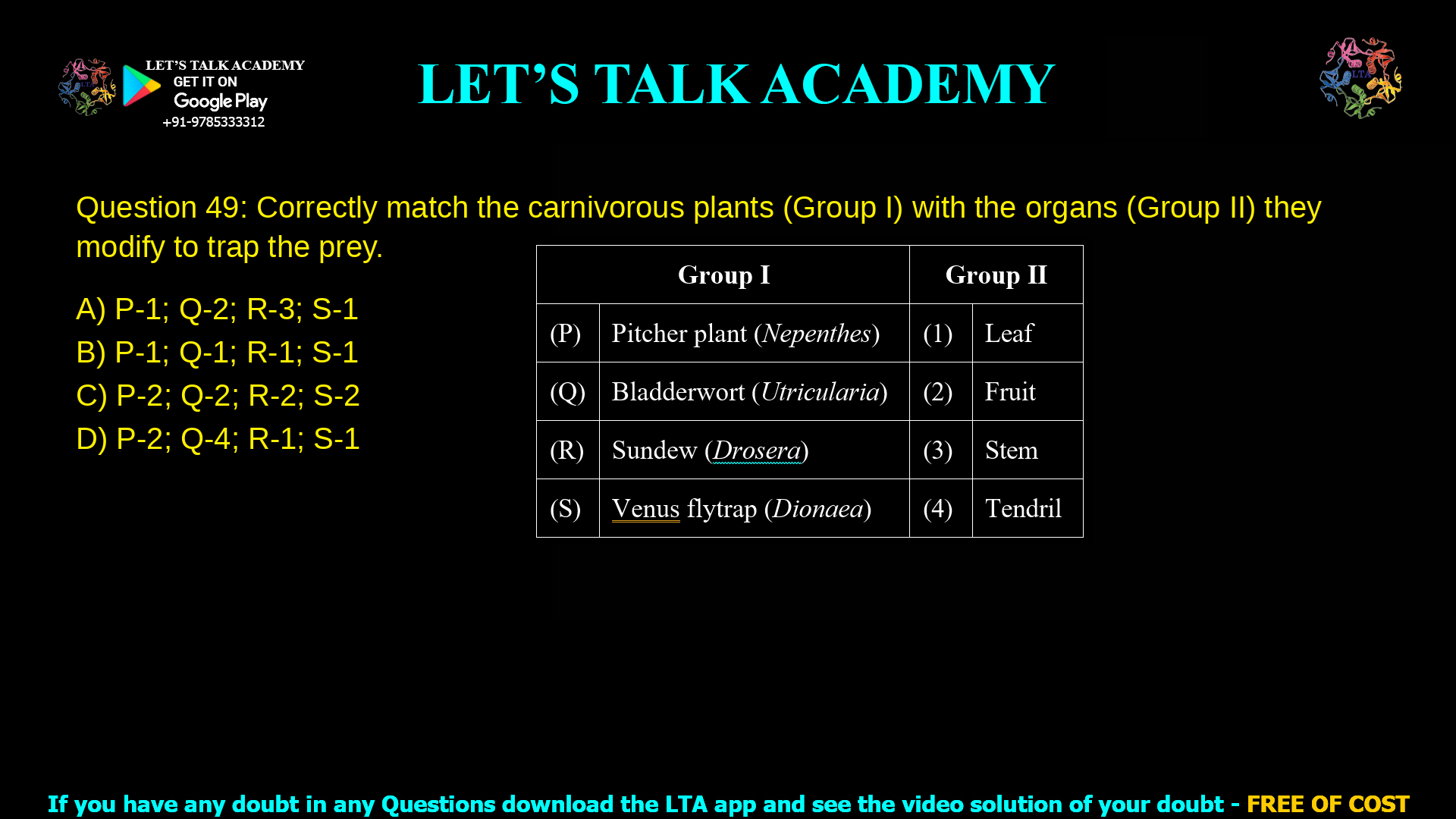
Q.49 Correctly match the carnivorous plants (Group I) with the organs (Group II) they modify to trap the prey.
| Group I | Group II |
|---|---|
| (P) Pitcher plant (Nepenthes) | (1) Leaf |
| (Q) Bladderwort (Utricularia) | (2) Fruit |
| (R) Sundew (Drosera) | (3) Stem |
| (S) Venus flytrap (Dionaea) | (4) Tendril |
Options:
- (A) P-1; Q-2; R-3; S-1
- (B) P-1; Q-1; R-1; S-1
- (C) P-2; Q-2; R-2; S-2
- (D) P-2; Q-4; R-1; S-1
The correct matching is: Pitcher plant – leaf, Bladderwort – leaf, Sundew – leaf, Venus flytrap – leaf, so the right option is (B).
Question overview
The question asks to match four carnivorous plants (Group I) with the plant organs (Group II) that are modified into traps:
-
Pitcher plant (Nepenthes)
-
Bladderwort (Utricularia)
-
Sundew (Drosera)
-
Venus flytrap (Dionaea)
Organs listed:
-
Leaf
-
Fruit
-
Stem
-
Tendril
Botanical studies show that, in all these classic carnivorous genera, the trapping structures are modified leaves or parts of leaves.
Correct matches explained
-
Pitcher plant (Nepenthes) – Leaf (1)
-
The characteristic pitcher is a pitfall trap formed by a modified leaf lamina that in-rolls and fuses at the margins to create a deep cavity.
-
The lower portion of the leaf remains flat and photosynthetic, while the upper part extends into a tendril that bears the pitcher at its tip, confirming the pitcher as a leaf modification, not a fruit or stem.
-
-
Bladderwort (Utricularia) – Leaf (1)
-
Bladderworts are rootless aquatic or semi-aquatic plants whose traps are tiny bladders derived from leaf segments.
-
These bladder-like leaves create suction traps that actively capture small invertebrates, again demonstrating that the trapping organ is a specialized leaf.
-
-
Sundew (Drosera) – Leaf (1)
-
Sundews bear flat leaves covered with glandular tentacles that secrete sticky mucilage, functioning as flypaper traps.
-
Each tentacle and the sticky surface are modifications of the leaf blade, allowing insects to be captured and digested on the leaf itself.
-
-
Venus flytrap (Dionaea) – Leaf (1)
-
Venus flytrap has snap traps formed from a pair of lobes at the end of each leaf, hinged along the midrib.
-
Sensitive trigger hairs on these lobes initiate rapid closure, confirming that the entire trapping structure is a highly specialized leaf.
-
Thus, P–1, Q–1, R–1, S–1 corresponds to option (B).
Why other options are wrong
-
Option (A): P–1; Q–2; R–3; S–1
-
Assigns fruit (2) to Bladderwort and stem (3) to Sundew, but in both plants the traps are leaf-based; neither uses fruits or stems for carnivory.
-
-
Option (C): P–2; Q–2; R–2; S–2
-
Claims all traps are fruits, which is incorrect because fruits are reproductive structures, whereas all known traps in these genera are vegetative leaf modifications.
-
-
Option (D): P–2; Q–4; R–1; S–1
-
Assigns fruit (2) to Pitcher plant and tendril (4) to Bladderwort, contradicting anatomical evidence that Nepenthes pitchers and Utricularia bladders are modified leaves and not tendrils or fruits.
-
Introduction
Carnivorous plants modified organs are a classic exam topic in botany and competitive tests, because they beautifully illustrate how leaves can evolve into sophisticated traps. Understanding which organ is modified in Pitcher plant, Bladderwort, Sundew and Venus flytrap helps students grasp plant adaptation and answer matching-type questions with confidence.
Carnivorous plants and leaf modification
-
In the major insectivorous genera Nepenthes, Utricularia, Drosera and Dionaea, the prey-catching traps arise from leaves or parts of leaves, not from stems, roots or fruits.
-
These leaf modifications include pitfall pitchers, suction bladders, sticky flypaper surfaces and snap traps, each adapted to specific habitats and prey types.
Organ modification in each plant
-
Pitcher plant (Nepenthes)
-
The pitcher is a pitfall trap developed from the leaf blade, with a lid, peristome and digestive fluid inside.
-
The leaf base remains flat and photosynthetic, while the petiole extends as a tendril that supports the pitcher, confirming leaf modification rather than fruit or stem.
-
-
Bladderwort (Utricularia)
-
Bladderworts are aquatic or wetland plants whose tiny bladder traps originate from leaf segments and attach to slender stolons.
-
Each bladder functions as a suction pump that actively draws in small organisms, making it one of the most sophisticated leaf-derived traps in the plant kingdom.
-
-
Sundew (Drosera)
-
Sundew leaves bear numerous glandular tentacles that exude sticky mucilage, immobilising insects on the leaf surface.
-
The tentacles and digestive glands are specialisations of the lamina, so the trapping structure is unequivocally a modified leaf.
-
-
Venus flytrap (Dionaea muscipula)
-
Each trap consists of two leaf lobes with marginal teeth and trigger hairs; when stimulated, the lobes snap shut around the prey.
-
Anatomical and developmental studies show that this fast snap trap evolved from an ancestral sticky leaf, again confirming its leaf origin.
-
Key takeaway for exam questions
-
For Pitcher plant, Bladderwort, Sundew and Venus flytrap, always select leaf as the modified organ that forms the trap.
-
In matching-type MCQs, the pattern P–1, Q–1, R–1, S–1 (all to leaf) is the correct answer, corresponding to option (B) in this question.
-


1 Comment
Sonal Nagar
January 8, 2026Option 2