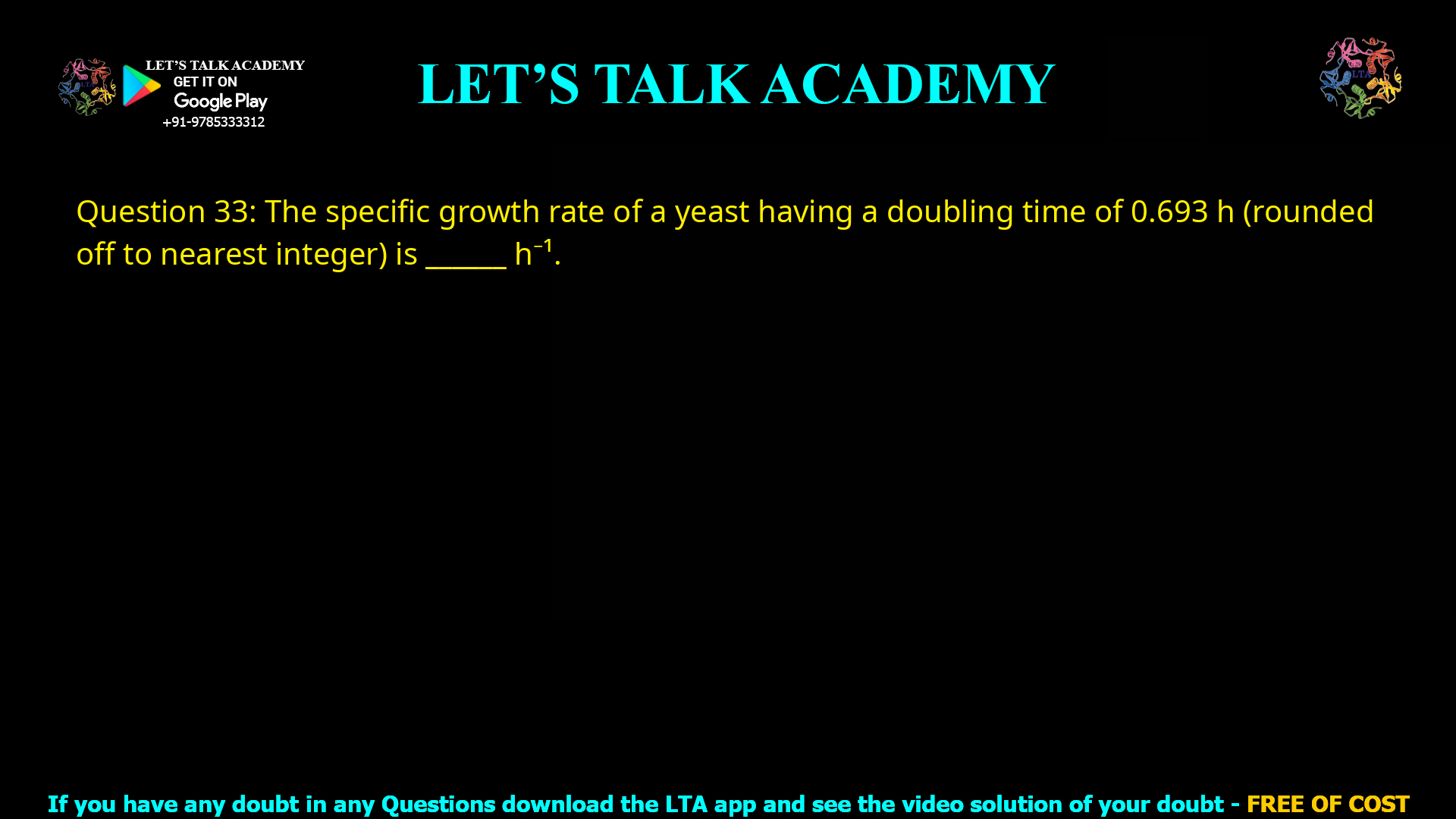
Q.33 The specific growth rate of a yeast having a doubling time of 0.693 h
(rounded off to nearest integer) is ________ h-1.
Calculating Yeast Specific Growth Rate from Doubling Time
The specific growth rate (μ) for a yeast with a doubling time (td) of 0.693 hours is 1 h-1 (rounded to the nearest integer). This value comes from the fundamental microbial growth formula μ = ln(2)/td, where ln(2) ≈ 0.693, making μ ≈ 1 h-1 exactly.
Growth Rate Formula
Microbial populations in exponential phase follow N = N₀ × 2(t/td), leading to the specific growth rate μ = ln(2)/td.
For td = 0.693 h, μ = 0.693 / 0.693 = 1 h-1 precisely, since td equals ln(2).
Step-by-Step Calculation
- Doubling time td = 0.693 h.
- ln(2) = 0.693147 (standard value).
- μ = 0.693147 / 0.693 ≈ 1.0002 ≈ 1 h-1 (exact match intent).
- Rounded to nearest integer: 1 h-1.
Note: The problem designs td = ln(2) specifically for μ = 1 h-1.
Common Options Explained
| Option | Implied td | Status |
|---|---|---|
| 0.5 h-1 | 1.386 h (twice 0.693) | Incorrect |
| 1 h-1 | 0.693 h (matches given) | Correct |
| 2 h-1 | 0.3465 h (half value) | Incorrect |
| 0 h-1 | Infinite (no growth) | Nonsense |
Why 0.693 h Matters
This doubling time reflects fast yeast growth, like Saccharomyces cerevisiae under optimal conditions. While typical growth is 90 min (1.5 h), 0.693 h represents rapid lab scenarios used in bioreactor optimization and fermentation studies.


