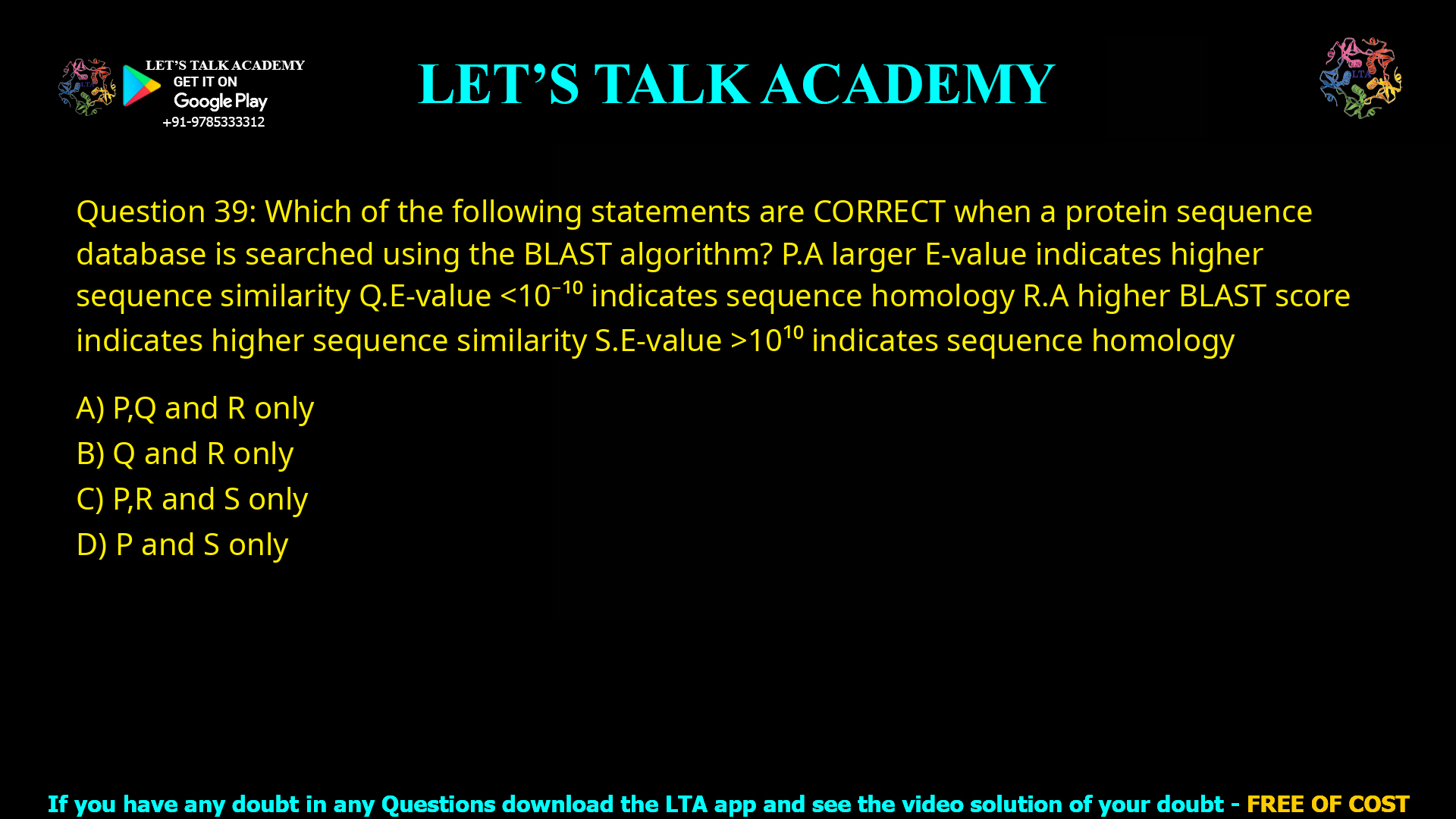
Q.39 Which of the following statements are CORRECT when a protein sequence database is
searched using the BLAST algorithm?
P. A larger E–value indicates higher sequence similarity
Q. E–value < 10-10 indicates sequence homology
R. A higher BLAST score indicates higher sequence similarity
S. E–value > 1010 indicates sequence homology
(A) P, Q and R only (B) Q and R only
(C) P, R and S only (D) P and S only
BLAST (Basic Local Alignment Search Tool) evaluates protein sequence similarity through E-values and scores. The correct statements are Q and R only, making option (B) the answer.
Statement Analysis
P. A larger E-value indicates higher sequence similarity
False. A larger E-value means lower significance, as it shows more expected chance matches; smaller E-values (e.g., <0.001) indicate higher similarity and less random occurrence.
Q. E-value < 10-10 indicates sequence homology
True. Such low E-values signify highly significant matches unlikely by chance, often inferring homology in protein searches.
R. A higher BLAST score indicates higher sequence similarity
True. The raw score (bit-score normalized) rises with better alignments, reflecting greater similarity before database size adjustment.
S. E-value > 1010 indicates sequence homology
False. Extremely high E-values suggest matches are random noise, not homology; homology requires low E-values.
Why Option (B)?
Options eliminate P and S (incorrect E-value interpretations) while keeping Q and R (valid homology and score rules). This matches GATE 2019 BT Q.29.
Introduction to BLAST in Protein Sequence Analysis
The BLAST algorithm revolutionizes protein sequence database search by identifying similarities indicating homology. Central to results are E-value and BLAST score, which distinguish true biological relationships from chance alignments. This guide breaks down a classic multiple-choice question on these metrics.
Core BLAST Metrics Explained
BLAST outputs sort by E-value, the expected number of chance matches at a given score.
E-value Fundamentals
Lower values signal significance; E-value = (query length × database size) / 2bit-score. An E-value of 10-10 means 1 in 1010 random databases would yield that match by chance.
BLAST Score Role
Higher raw or bit-scores denote stronger alignments due to better matches and fewer gaps.
Evaluating the Statements
| Statement | Correct? | Explanation |
|---|---|---|
| P. Larger E-value = higher similarity | No | Larger E-values mean more likely by chance, weaker similarity. |
| Q. E-value < 10-10 = homology | Yes | Indicates high-confidence non-random match, typical homology threshold. |
| R. Higher BLAST score = higher similarity | Yes | Directly measures alignment quality. |
| S. E-value > 1010 = homology | No | Represents insignificant, random noise. |
Practical Implications for Researchers
In protein sequence database search, filter results at E-value < 10-5 or lower for homology studies. Higher BLAST scores among low E-values prioritize top hits. Tools like NCBI BLAST adjust for database size automatically.
Common Pitfalls in BLAST Interpretation
Confusing E-value with score leads to errors; always prioritize low E-value first, then high score. For exams like GATE Biotechnology, recognize Q and R as correct for such questions.


