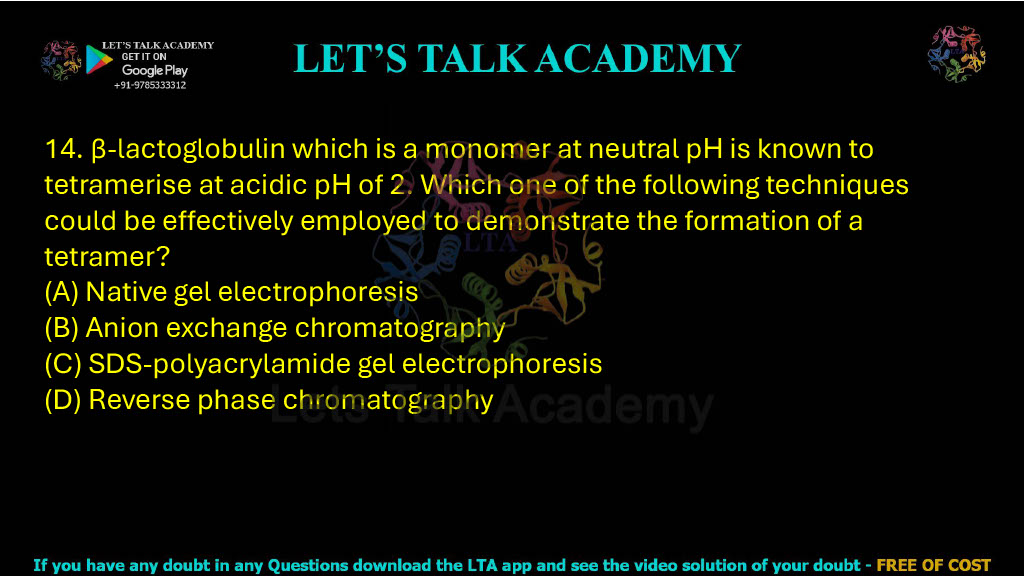
14. β-lactoglobulin which is a monomer at neutral pH is known to tetramerise at acidic pH of 2.
Which one of the following techniques could be effectively employed to demonstrate the formation of a tetramer?
A. Native gel electrophoresis
B. Anion exchange chromatography
C. SDS-polyacrylamide gel electrophoresis
D. Reverse phase chromatography
β-lactoglobulin exists as monomer at neutral pH but forms tetramer at acidic pH 2. Native gel electrophoresis preserves quaternary structure, showing distinct migration shifts between monomer and tetramer forms.
Question Analysis
Key requirement: Technique must preserve native quaternary structure (monomer ↔ tetramer) at different pH. SDS denatures; chromatography may not resolve oligomerization clearly.
Option Analysis
A. Native gel electrophoresis
Correct. Native PAGE maintains native protein complexes at specified pH. Monomer (neutral pH) migrates faster than tetramer (pH 2) due to 4x larger size, clearly demonstrating oligomerization.
B. Anion exchange chromatography
Incorrect. At pH 2, both monomer/tetramer highly positive (pI ~5.2). Binding differences subtle; elution may not resolve oligomer states clearly.
C. SDS-polyacrylamide gel electrophoresis
Wrong. SDS denatures proteins to individual polypeptide chains regardless of pH/quaternary structure. Always shows single monomer band (~18 kDa).
D. Reverse phase chromatography
No. RP-HPLC denatures proteins in organic solvents (acetonitrile/TFA). Cannot preserve native tetramer; separates denatured polypeptides by hydrophobicity.
Correct Answer
A. Native gel electrophoresis
Technique Comparison Matrix
| Technique | Preserves Native Structure? | Detects Tetramer? | pH Control |
|---|---|---|---|
| Native PAGE | Yes | Yes (mobility shift) | Yes |
| Anion Exchange | Partial | Unclear | Buffer-dependent |
| SDS-PAGE | No (denatures) | No | Irrelevant |
| RP-HPLC | No (denatures) | No | Destroyed |
Experimental Design
Lane 1: β-LG neutral pH → MONOMER (fast migration)

Lane 2: β-LG pH 2 → TETRAMER (slow migration, ~1/4 mobility)
Mobility ratio: Tetramer (72 kDa) vs monomer (18 kDa) = ~4x slower migration.
β-Lactoglobulin pH Behavior
-
pH 7 (neutral): Monomer (18 kDa)
-
pH 3.5-5: Dimer/octamer intermediates
-
pH 2 (acidic): Tetramer (72 kDa)
-
pI ~5.2: Minimal charge, maximal oligomerization
GATE Prep Essential
Native vs denaturing techniques:
Native PAGE/Gel Filtration → Quaternary structure (oligomerization)

SDS-PAGE → Polypeptide MW only

Chromatography → Often denatures or ambiguous
Classic pattern: pH-dependent oligomerization → Native PAGE (direct visualization). Complements Q10 (gel filtration + SDS-PAGE subunit stoichiometry).
Pro Tip: β-LG = model protein for pH/heat oligomerization studies. Tetramer at low pH due to exposed hydrophobic patches forming inter-subunit contacts. Perfect “structure preservation” question.


2 Comments
Vanshika Sharma
January 29, 2026Native gel electrophoresis bcz the monomer will move faster and the tetramer which is 4x in size will move slow
Kanica Sunwalka
June 25, 2026native gel – preserve native structure
can detect tetramer by mobility shift