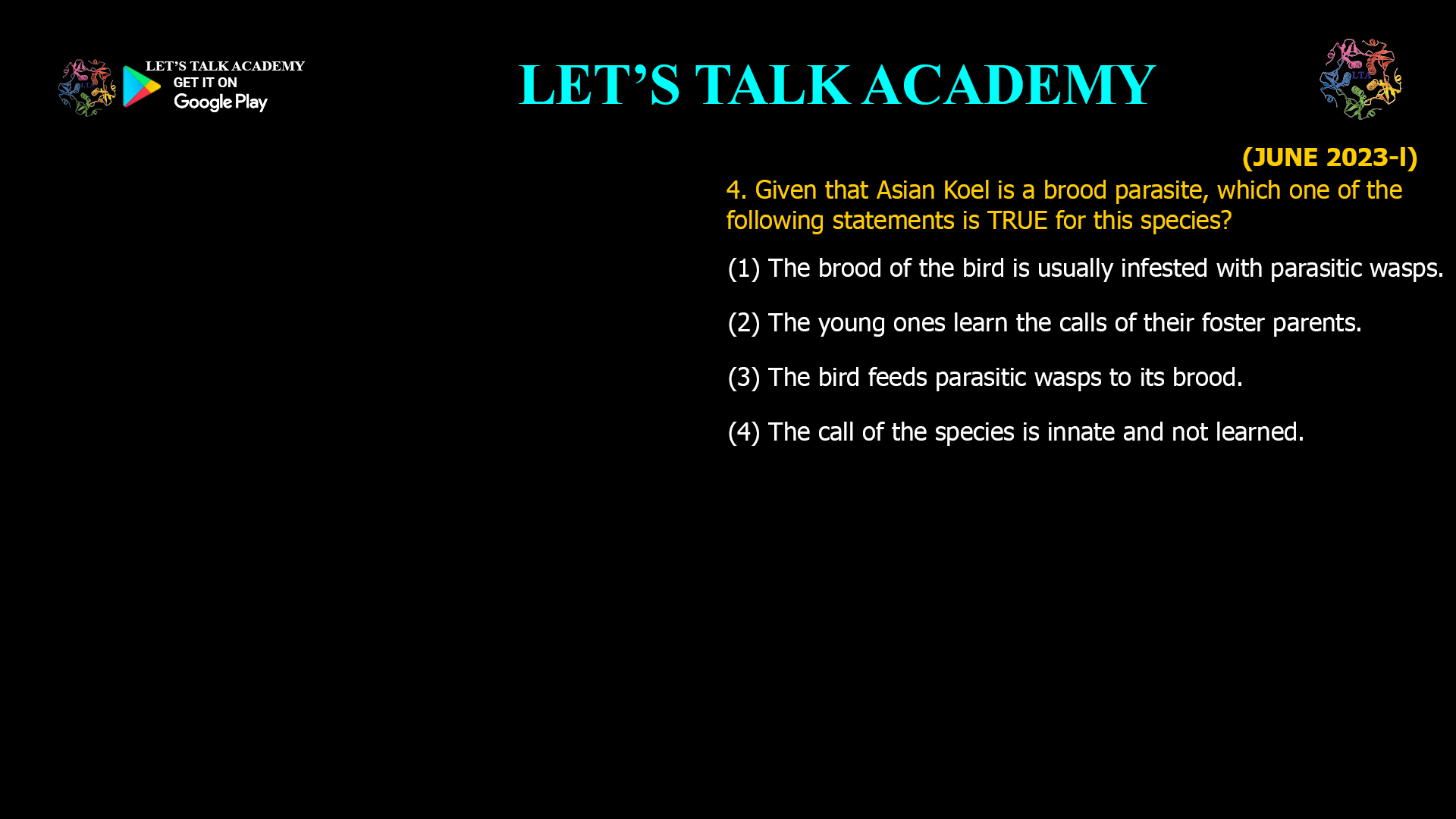
- Given that Asian Koel is a brood parasite, which one of the following statements is TRUE for this species?
(1) The brood of the bird is usually infested with parasitic wasps.
(2) The young ones learn the calls of their foster parents.
(3) The bird feeds parasitic wasps to its brood.
(4) The call of the species is innate and not learned.Brood Parasitism and Vocal Development
Brood parasitism in birds presents a unique challenge for the development of species-specific behaviors, especially vocalizations. Unlike most birds that learn their calls from their biological parents, brood parasites like the Asian Koel are raised by unrelated host species. This raises the question: how do koels develop their characteristic calls?
The Innate Nature of the Asian Koel’s Call
Scientific observations and studies on the Asian Koel indicate that the call of the species is innate and not learned. Despite being raised by foster parents of a different species, young koels grow up to produce the typical koel call, distinct from the calls of their hosts. This strongly suggests that the vocalization is genetically programmed rather than learned through imitation.
Why Is This Important?
-
Species Recognition: Innate calls ensure that adult koels can recognize and attract mates of their own species, which is crucial for reproductive success.
-
Evolutionary Adaptation: The ability to produce species-specific calls without learning from parents is a key adaptation for brood parasites, allowing them to maintain species identity despite being raised by other birds.
Debunking Other Options
-
Infestation with Parasitic Wasps: There is no evidence that Asian Koel broods are typically infested with parasitic wasps.
-
Learning Calls from Foster Parents: Studies show that despite being raised by different species, koels do not mimic their foster parents’ calls.
-
Feeding Parasitic Wasps: The Asian Koel primarily feeds on fruits and berries, not parasitic wasps, and does not feed such insects to its brood.
Conclusion
The Asian Koel’s call is a classic example of an innate behavior—a genetically determined trait that does not require learning from parents or the environment. This adaptation is essential for the survival and reproductive success of brood parasitic birds.
Correct answer: (4) The call of the species is innate and not learned.
-