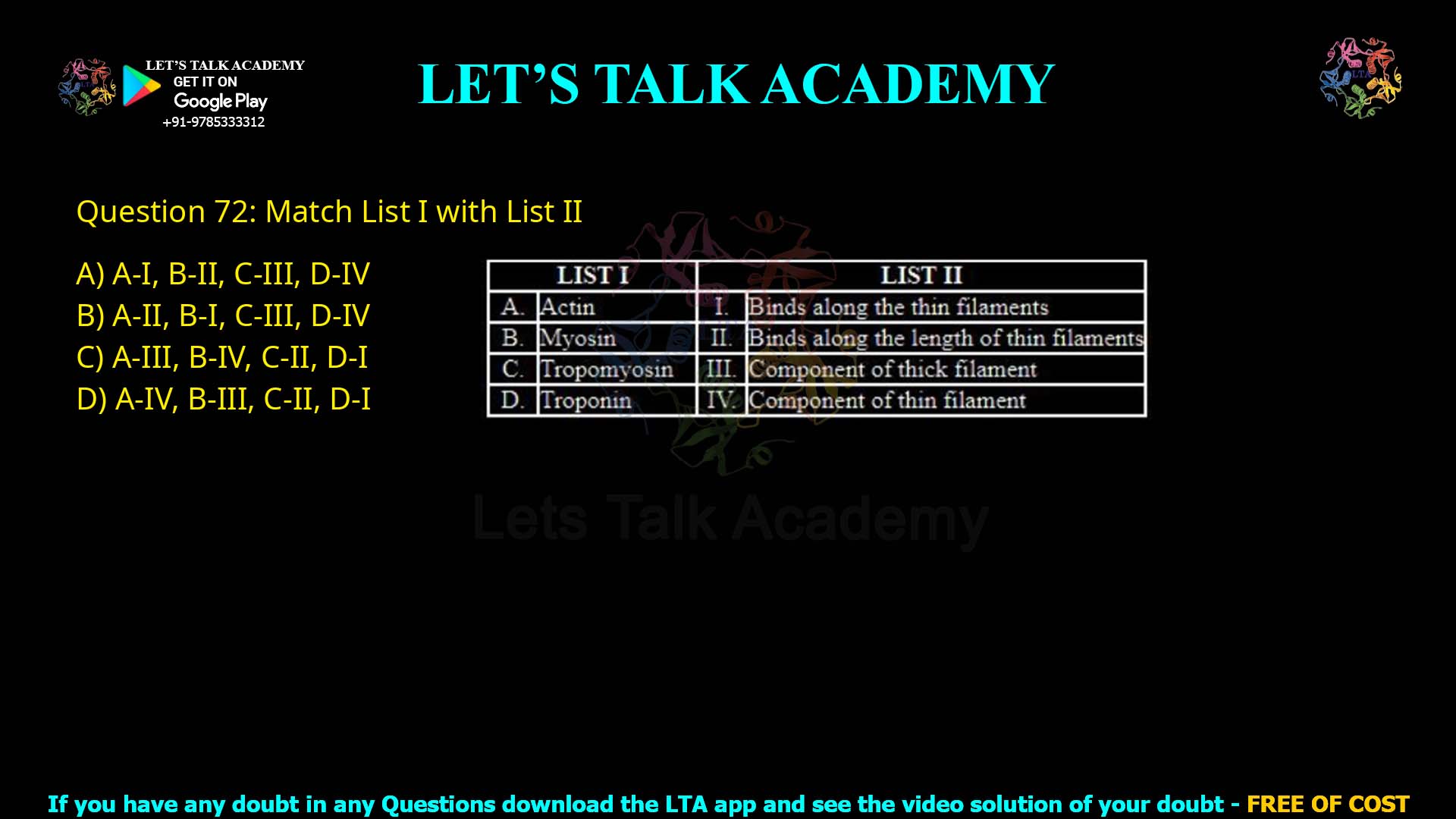
Q.72 Match List I with List II
| LIST I | LIST II |
|---|---|
| A. Actin B. Myosin C. Tropomyosin D. Troponin |
I. Binds along the thin filaments II. Binds along the length of thin filaments III. Component of thick filament IV. Component of thin filament |
Choose the correct answer from the options given below:
- A-I, B-II, C-III, D-IV
- A-II, B-I, C-III, D-IV
- A-III, B-IV, C-II, D-I
- A-IV, B-III, C-II, D-I
Actin and myosin form the core of muscle contraction, with tropomyosin and troponin regulating thin filaments. Correct matches are A-IV (actin: thin filament component), B-III (myosin: thick filament), C-II (tropomyosin: binds length of thin filaments), D-I (troponin: binds thin filaments). Correct Option: A-IV, B-III, C-II, D-I
Actin myosin tropomyosin troponin thin thick filaments are fundamental to muscle contraction and sliding filament theory, key for competitive exams like GATE Life Sciences. This analysis decodes a matching question, verifying each protein’s role in sarcomere structure for precise exam prep.
Actin: Thin Filament Component
Actin forms the globular G-actin monomers polymerizing into F-actin double helices, the backbone of thin filaments in sarcomeres. It provides myosin-binding sites essential for cross-bridge formation during contraction.
Myosin: Thick Filament Component
Myosin comprises hexameric molecules with two heavy chains forming the tail and globular heads; these assemble into bipolar thick filaments. The heads hydrolyze ATP to generate force, pulling thin filaments.
Tropomyosin: Binds Length of Thin Filaments
Tropomyosin polymerizes head-to-tail into elongated cables wrapping along the thin filament groove, sterically blocking myosin heads in relaxed muscle. Calcium signaling shifts its position to expose sites.
Troponin: Binds Along Thin Filaments
Troponin complex (TnC, TnI, TnT) binds periodically along thin filaments; TnT links to tropomyosin, TnI to actin, and TnC to Ca2+, triggering conformational changes for contraction.
Why Other Options Incorrect
Options mismatch roles: e.g., A-I wrongly places actin as binding (actin is thin filament), B-I/II confuse myosin (thick, not thin), and C/D swaps regulatory proteins.


