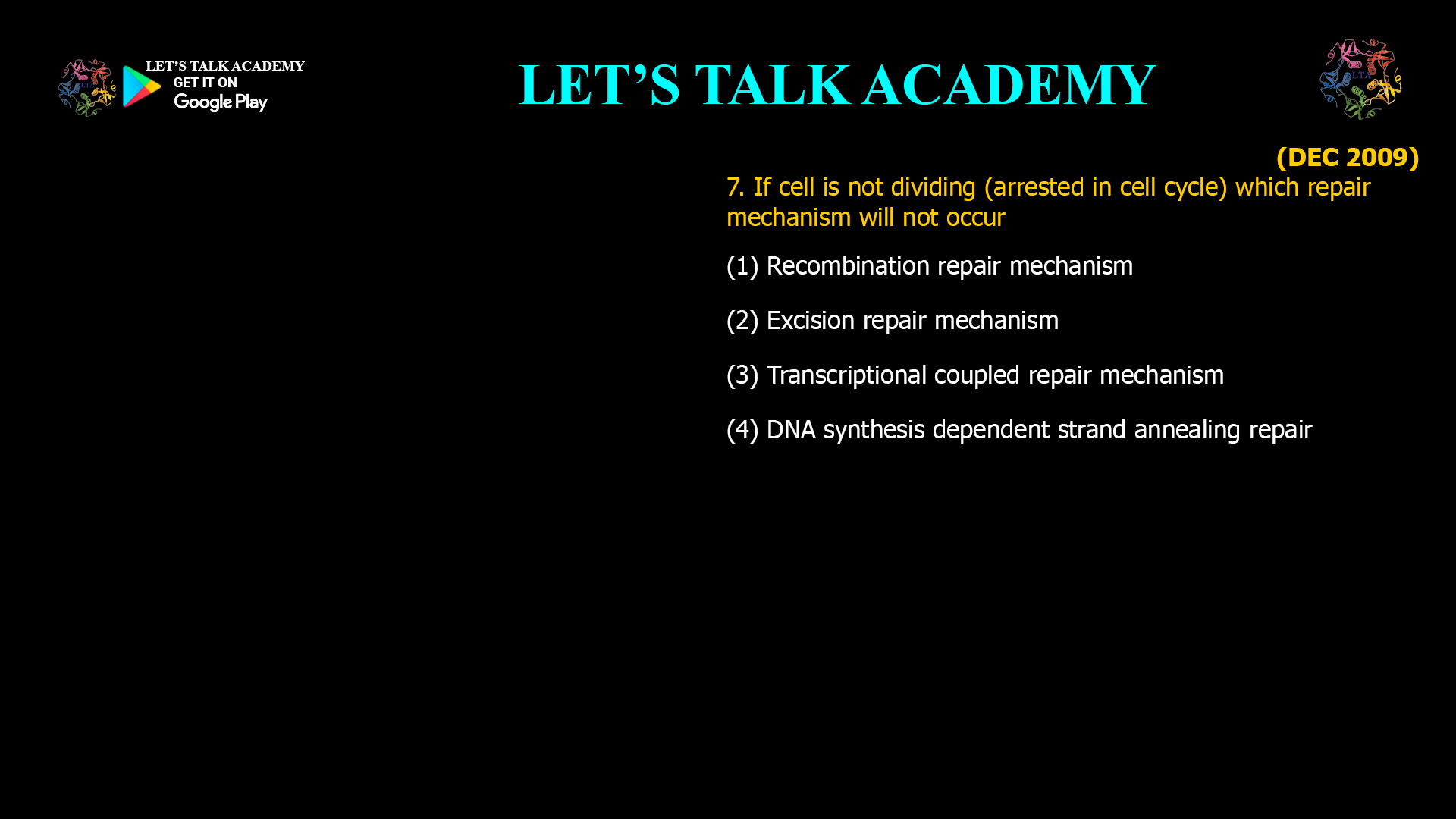
7.If cell is not dividing (arrested in cell cycle) which repair mechanism will not occur
(1) Recombination repair mechanism
(2) Excision repair mechanism
(3) Transcriptional coupled repair mechanism
(4) DNA synthesis dependent strand annealing repair
DNA Repair Mechanisms and the Cell Cycle: Which Repair Pathway Is Blocked When Cells Are Not Dividing?
DNA repair is essential for maintaining genomic stability and preventing mutations that can lead to diseases such as cancer. Different DNA repair mechanisms operate depending on the type of damage and the cell’s stage in the cell cycle. But what happens when a cell is not dividing—arrested in the cell cycle? Which repair mechanisms are still active, and which are blocked? This article explores the relationship between cell cycle arrest and DNA repair, identifies which repair mechanism is specifically inhibited in non-dividing cells, and provides SEO-optimized content with relevant keywords.
Overview of DNA Repair Mechanisms
DNA repair pathways are highly specialized and address a wide range of DNA lesions, from single-base modifications to double-strand breaks (DSBs). The major pathways include:
-
Base Excision Repair (BER): Fixes small, non-helix-distorting base lesions.
-
Nucleotide Excision Repair (NER): Removes bulky helix-distorting lesions, including those caused by UV light.
-
Mismatch Repair (MMR): Corrects mismatches and small insertion/deletion loops that arise during DNA replication.
-
Direct Reversal Repair: Certain enzymes directly reverse specific types of DNA damage (e.g., photolyase for UV-induced pyrimidine dimers).
-
Recombination Repair (Homologous Recombination, HR): Repairs double-strand breaks using a homologous template, typically a sister chromatid.
-
Non-Homologous End Joining (NHEJ): Repairs double-strand breaks by directly ligating the broken ends, often with loss of genetic information.
-
DNA Synthesis Dependent Strand Annealing (SDSA): A variant of HR where DNA synthesis occurs before strand annealing.
The Cell Cycle and DNA Repair
The cell cycle consists of several phases: G1 (gap 1), S (synthesis), G2 (gap 2), and M (mitosis). DNA repair pathways are often coordinated with the cell cycle to ensure efficient and accurate repair:
-
G1 Phase: Cells are preparing for DNA replication. NHEJ is the primary mechanism for repairing double-strand breaks.
-
S and G2 Phases: Cells have replicated their DNA, providing a sister chromatid as a template for homologous recombination (HR) to repair double-strand breaks128.
-
M Phase (Mitosis): DNA repair is generally suppressed to prevent genomic instability.
When cells are not dividing (arrested in the cell cycle, often in G0 or G1), certain repair mechanisms that rely on DNA synthesis or the presence of a sister chromatid are impaired.
Which Repair Mechanism Is Blocked in Non-Dividing Cells?
Let’s analyze each option:
-
(1) Recombination repair mechanism (Homologous Recombination, HR):
-
(2) Excision repair mechanism:
-
Includes: Base excision repair (BER) and nucleotide excision repair (NER).
-
Arrested Cells: These mechanisms do not require DNA replication or a sister chromatid and can function in non-dividing cells.
-
-
(3) Transcriptional coupled repair mechanism:
-
Description: A sub-pathway of NER that repairs lesions in transcribed regions.
-
Arrested Cells: Transcription can occur in arrested cells, so this mechanism is still active.
-
-
(4) DNA synthesis dependent strand annealing repair (SDSA):
-
Description: A variant of HR involving DNA synthesis before strand annealing.
-
Arrested Cells: Requires a sister chromatid (available only after DNA replication), so it is blocked in non-dividing cells.
-
Both (1) and (4) are forms of homologous recombination and require a sister chromatid, which is absent in non-dividing cells. However, the most precise and widely recognized answer is recombination repair mechanism (HR), as it is the classic pathway for high-fidelity repair of double-strand breaks using a homologous template, and it is explicitly blocked in G0/G1.
Note: While SDSA is also blocked, it is a specific variant of HR and is less commonly singled out in standard questions about cell cycle arrest and DNA repair.
The Correct Answer
Option (1): Recombination repair mechanism
This is the most accurate and widely accepted answer, as homologous recombination (recombination repair mechanism) is strictly dependent on the presence of a sister chromatid, which is only available after DNA replication (S/G2 phases)128.
Why Is Homologous Recombination Blocked in Non-Dividing Cells?
Homologous recombination (HR) requires a homologous DNA sequence—usually a sister chromatid—as a template for accurate repair. In non-dividing cells (G0 or G1), DNA has not been replicated, so there is no sister chromatid available. Therefore, HR is not possible in these cells. Instead, cells rely on other repair mechanisms such as NHEJ for double-strand breaks.
Related Keywords for SEO Optimization
-
DNA repair mechanisms
-
Cell cycle and DNA repair
-
Recombination repair mechanism
-
Homologous recombination
-
Excision repair mechanism
-
Base excision repair
-
Nucleotide excision repair
-
Double-strand break repair
-
Non-homologous end joining
-
DNA synthesis dependent strand annealing
-
Transcriptional coupled repair
-
Cell cycle arrest
-
Sister chromatid
-
Genomic stability
-
DNA damage response
-
DNA repair pathways
-
Cell cycle-dependent DNA repair
-
G0 phase and DNA repair
-
G1 phase and DNA repair
Conclusion
When cells are not dividing (arrested in the cell cycle), the recombination repair mechanism (homologous recombination) cannot occur because it requires a sister chromatid as a template, which is only present after DNA replication. Other repair mechanisms, such as excision repair and transcriptional coupled repair, remain active. Therefore, the correct answer is option (1): Recombination repair mechanism


11 Comments
Kirti Agarwal
November 7, 2025Recombination repair machenism
Deepika Sheoran
November 7, 2025Recombination Repair Mechanisms
sakshivijay
November 7, 2025recombination repair mechanism failed when the cells are non dividing
because recombination required sister chromatid as a template which is formed by dna replication
Neelam Sharma
November 7, 2025Recombination Repair Mechanisms
Rishita
November 8, 2025Recombination repair mechanism
Mohd juber Ali
November 8, 2025If cell is not divide (arrested in cell cycle )so no dna replication so no sister chromatids for homologus recombination mechanism require sister chromatids so HR not occur option 1
Dipti Sharma
November 8, 2025recombination repair mechanism (homologous recombination) cannot occur because it requires a sister chromatid as a template.
Anisha Beniwal
November 8, 2025Recombination repair mechanism
Heena Mahlawat
November 9, 2025Recombination repair system
Muskan Yadav
November 12, 2025Option (1): Recombination repair mechanism.
Ankita Pareek
June 6, 2026Recombination repair mechanism cannot occur in non dividing cells because it requires sister chromatids as a template which is only after dna replication.