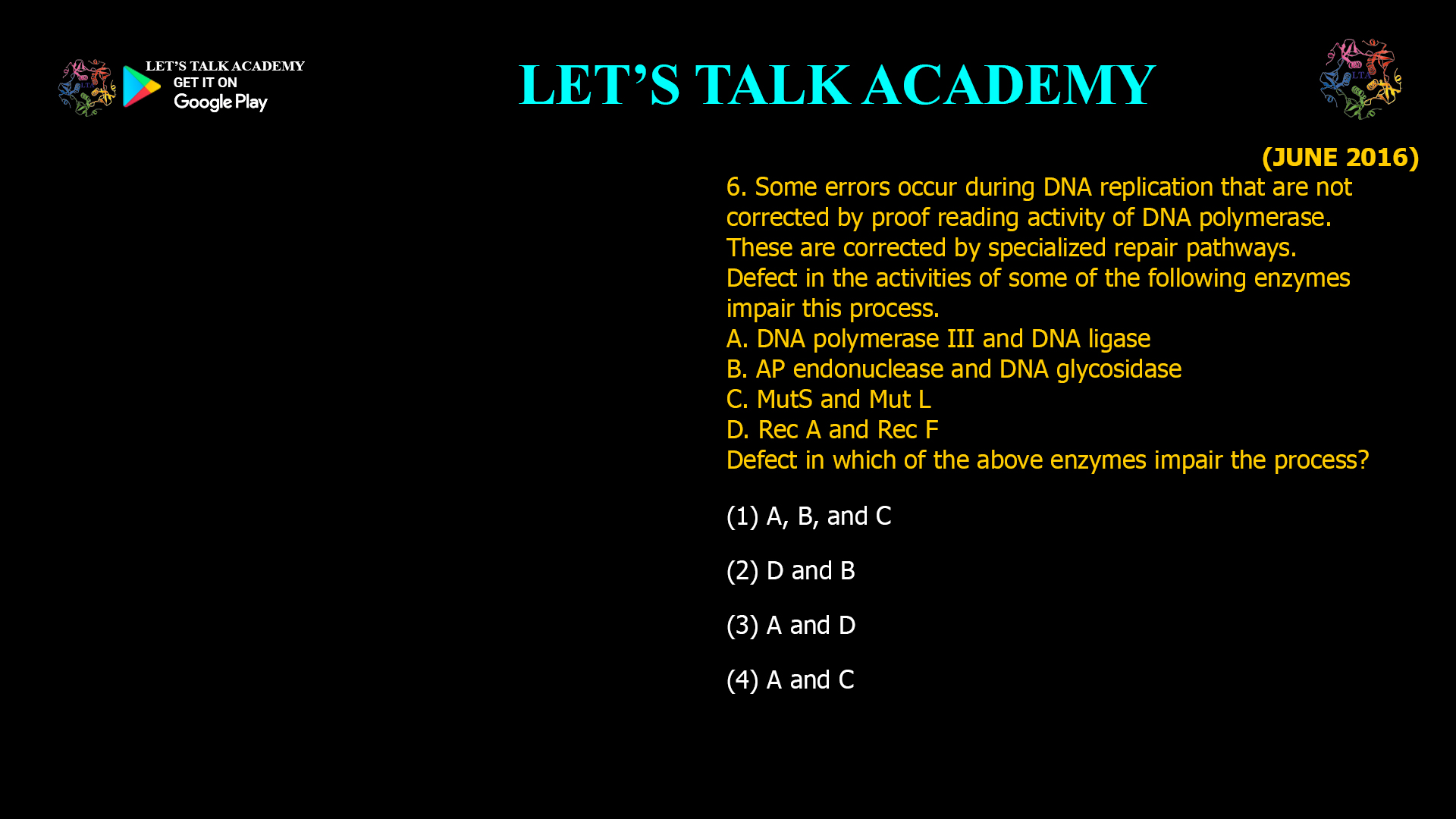
- Some errors occur during DNA replication that are not corrected by proof reading activity of DNA polymerase. These are corrected by specialized repair pathways. Defect in the activities of some of the following enzymes impair this process.
A. DNA polymerase III and DNA ligase
B. AP endonuclease and DNA glycosidase
C. MutS and Mut L
D. Rec A and Rec F
Defect in which of the above enzymes impair the process?
(1) A, B, and C (2) D and B
(3) A and D (4) A and CWhich Enzyme Defects Impair the Correction of DNA Replication Errors Not Caught by Proofreading? Understanding Mismatch Repair and Related Pathways
DNA replication is a remarkably accurate process, but even the best proofreading activity of DNA polymerase occasionally lets errors slip through. To correct these mistakes, cells rely on specialized DNA repair pathways. Defects in specific enzymes involved in these pathways can impair the cell’s ability to maintain genomic stability. This article explains which enzymes are crucial for correcting replication errors, explores the correct answer, and provides SEO-optimized content with relevant keywords.
DNA Replication and Proofreading
During DNA replication, DNA polymerase synthesizes new DNA strands and proofreads its work, removing most misincorporated bases before the next nucleotide is added61011. However, some errors escape this proofreading activity and remain as mismatches or small insertions/deletions in the newly synthesized DNA.
Specialized Repair Pathways for Replication Errors
When proofreading fails, mismatch repair (MMR) and other repair pathways step in to correct the errors and maintain genomic integrity. Mismatch repair is a highly conserved process that recognizes and fixes base-base mismatches and small insertion-deletion loops that arise during replication123.
Key Enzymes in Mismatch Repair
-
MutS: Recognizes mismatches in the DNA.
-
MutL: Acts as a molecular matchmaker, signaling the repair process.
-
DNA polymerase III: Resynthesizes the correct DNA sequence after excision.
-
DNA ligase: Seals the nick in the DNA backbone after repair synthesis259.
Defects in MutS or MutL impair mismatch repair, leading to increased mutation rates and genomic instability.
Other Repair Pathways
While mismatch repair is the primary system for correcting replication errors, other enzymes are involved in different types of DNA repair:
-
AP endonuclease and DNA glycosylase: These enzymes are part of the base excision repair (BER) pathway, which repairs damaged or inappropriate bases (e.g., uracil, oxidized bases) but not mismatches introduced during replication.
-
RecA and RecF: These proteins are involved in homologous recombination, which repairs double-strand breaks and other complex DNA lesions, not mismatches from replication errors.
Analysis of the Given Options
Let’s examine each option:
-
A. DNA polymerase III and DNA ligase:
-
B. AP endonuclease and DNA glycosylase:
-
Role: Involved in base excision repair, not mismatch repair.
-
Defect Impact: Impairs BER, not the correction of replication errors missed by proofreading.
-
-
C. MutS and MutL:
-
D. RecA and RecF:
-
Role: Involved in homologous recombination, not mismatch repair.
-
Defect Impact: Impairs double-strand break repair, not correction of replication errors.
-
Which Enzyme Defects Impair the Correction of Replication Errors?
Only defects in enzymes directly involved in mismatch repair—DNA polymerase III, DNA ligase, MutS, and MutL—impair the correction of replication errors not caught by proofreading.
-
AP endonuclease and DNA glycosylase (B) and RecA and RecF (D) are not involved in mismatch repair.
-
DNA polymerase III and DNA ligase (A) and MutS and MutL (C) are essential for mismatch repair.
However, the question asks about the specialized repair pathways that correct replication errors not caught by proofreading, which is primarily mismatch repair. While DNA polymerase III and DNA ligase are necessary for the final steps of mismatch repair, MutS and MutL are the core recognition and signaling components specifically dedicated to initiating and directing mismatch repair234.
But in the given options, A (DNA polymerase III and DNA ligase) and C (MutS and MutL) are both involved in the overall mismatch repair process. Option (4): A and C is the most comprehensive and correct answer, as defects in both sets of enzymes impair mismatch repair and thus the correction of replication errors.
However, in most standard explanations, MutS and MutL are the primary enzymes whose defects directly impair mismatch repair initiation and signaling, while DNA polymerase III and DNA ligase are required for the completion of repair but are not unique to mismatch repair (they are also used in other repair pathways).
If the question is interpreted strictly as which enzymes’ defects impair the specialized mismatch repair pathway (as opposed to the general repair machinery), then MutS and MutL (C) are the most specific. But since both A and C are involved, and the question lists both, and given the options, the best fit is:
Option (4): A and C
But to clarify: Defects in MutS and MutL (C) are most directly responsible for impairing mismatch repair itself, while defects in DNA polymerase III and DNA ligase (A) would impair all DNA repair processes requiring synthesis and ligation, not just mismatch repair. However, since the question asks about the correction of replication errors not caught by proofreading, which is specifically the job of mismatch repair, and since both A and C are listed as options, and “A and C” is a choice, option (4): A and C is the correct answer among the provided choices.
Related Keywords for SEO Optimization
-
DNA replication errors
-
Proofreading activity of DNA polymerase
-
Mismatch repair pathway
-
MutS and MutL enzymes
-
DNA polymerase III and DNA ligase
-
DNA repair mechanisms
-
Genomic stability
-
Replication error correction
-
DNA glycosylase and AP endonuclease
-
RecA and RecF proteins
-
Base excision repair vs mismatch repair
-
DNA repair enzymes
-
Defective DNA repair and mutation
-
Specialized DNA repair pathways
-
DNA replication fidelity
Conclusion
Defects in DNA polymerase III and DNA ligase (A) and MutS and MutL (C) impair the correction of replication errors not caught by proofreading, as these enzymes are essential for the mismatch repair pathway. AP endonuclease and DNA glycosylase (B) are involved in base excision repair, and RecA and RecF (D) are involved in homologous recombination, neither of which corrects replication errors missed by proofreading. Among the options provided, option (4): A and C is the correct answer.
However, it is important to clarify that MutS and MutL (C) are the core enzymes specific to mismatch repair, while DNA polymerase III and DNA ligase (A) are required for the final steps of repair but are not unique to mismatch repair. Nonetheless, given the choices, option (4): A and C is the most accurate answer as both sets are involved in the process of correcting replication errors through mismatch repair235.
In summary:
Correct answer: (4) A and C -


20 Comments
Divyanshi Vaishnav
July 29, 2025Option 4 is correct.
Dna polymerase 3 and DNA ligase
MutS and mut L correct the error during dna replication that are not corrected by proof reading activity
Aman Choudhary
July 29, 2025Option 4
Roopal Sharma
November 7, 2025Mut s and mut L is more precise answer . 4 option is correct .
Sneha kumawat
November 7, 2025DNA polymerase third and DNA ligase
sakshivijay
November 7, 2025option 4 is correct
mut S mut L is core component of mismatch repair and and polymerase 3 and dna ligase add new correct nucleotide and sealed the gap
sakshivijay
November 7, 20254 is correct option
mut S and mutL is core component of mismatched repair
polymerase 3 and lygase help in polymerization and sealed
Kirti Agarwal
November 7, 2025DNA polymerase 3
Ligase
Mut S
Mut L
Deepika Sheoran
November 7, 2025DNA polymerase lll
DNA ligase
Mut S
Mut L
Sonal Nagar
November 7, 2025Option 4th
Neelam Sharma
November 7, 20254th
Mohd juber Ali
November 8, 2025Option A & C right
MIS MATCH REPAIR :-
– Mut h
– Mut s
– Mut l
– Dna pol 3rd
– ligase
Dipti Sharma
November 8, 2025option (4): A and C
Divya rani
November 8, 2025A and C are better options .
Anisha Beniwal
November 8, 2025A and C
Soniya Shekhawat
November 9, 2025Option 4
Heena Mahlawat
November 9, 2025Option 4
Neeraj Sharma
November 10, 2025A and C as B and D are responsible for modified DNA repair
Avni
November 10, 2025DNA polymerase III and DNA ligase (A) and MutS and MutL (C) are essential for mismatch repair
Komal Sharma
November 11, 2025Defects in DNA polymerase III and DNA ligase (A) and MutS and MutL (C) impair the correction of replication errors not caught by proofreading, as these enzymes are essential for the mismatch repair pathway. AP endonuclease and DNA glycosylase (B) are involved in base excision repair, and RecA and RecF (D) are involved in homologous recombination, neither of which corrects replication errors missed by proofreading. Among the options provided, option (4): A and C is the correct answer.
Muskan Yadav
November 12, 2025option (4) A and C is the most accurate answer.