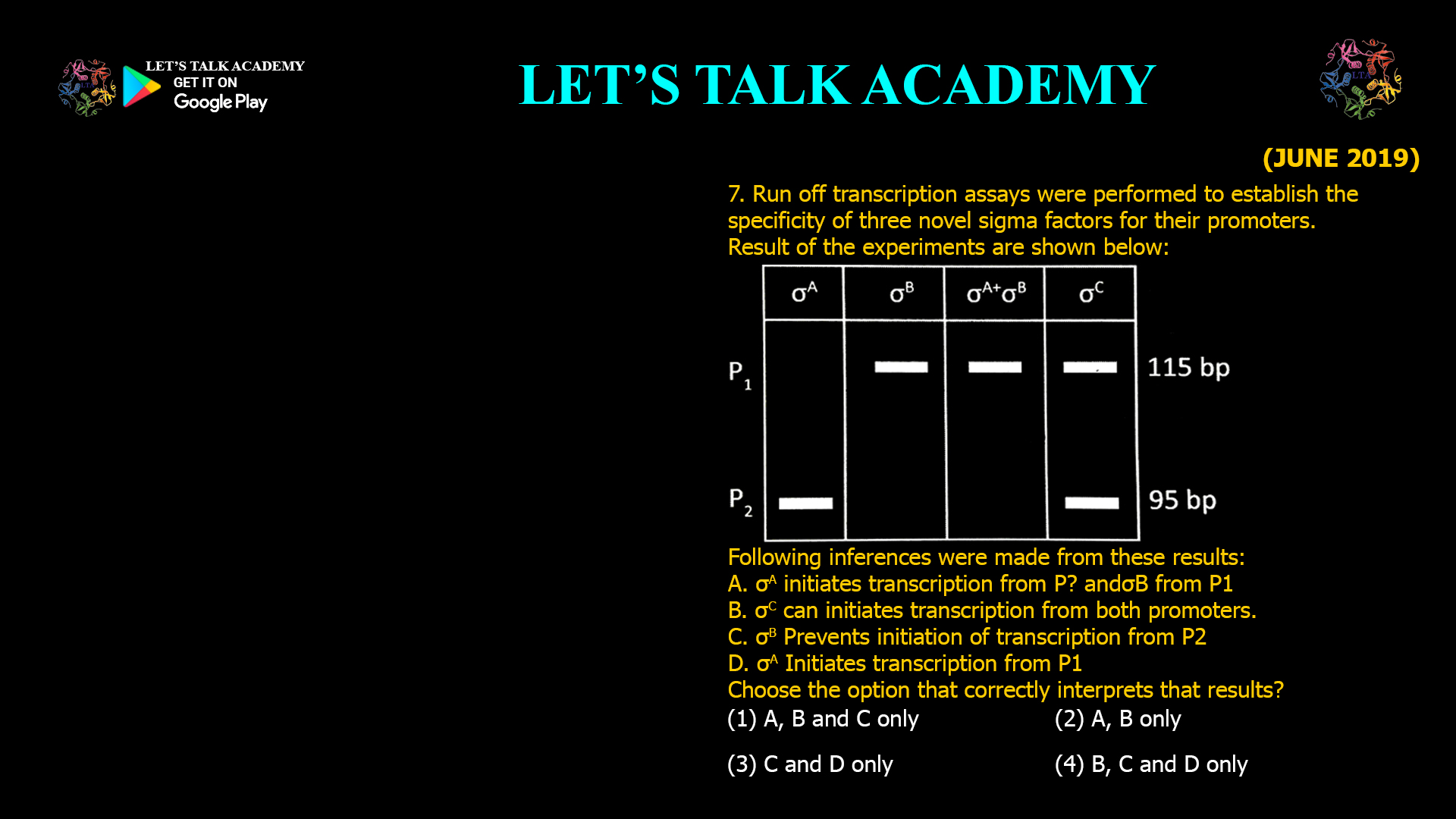
7. Run off transcription assays were performed to establish the specificity of three novel sigma factors for their promoters. Result of the experiments are shown below:
Following inferences were made from these results:
A. σA initiates transcription from P? and σB from P1
B. σC can initiates transcription from both promoters.
C. σB Prevents initiation of transcription from P2
D. σA Initiates transcription from P1
Choose the option that correctly interprets that results?
(1) A, B and C only (2) A, B only
(3) C and D only (4) B, C and D only
Introduction
Run-off transcription assays are powerful in vitro tools used to determine the specificity of RNA polymerase sigma factors for different promoters. By measuring transcription initiation from various promoters in the presence of distinct sigma factors, researchers can identify which sigma factor activates which promoter and whether any sigma factor inhibits transcription from a given promoter. This article explains how to interpret run-off transcription assay results to understand the promoter specificity of three novel sigma factors: σA, σB, and σC.
Overview of Run-Off Transcription Assay
In a run-off transcription assay, a DNA template containing a promoter is linearized downstream of the transcription start site. RNA polymerase holoenzyme containing a specific sigma factor initiates transcription at the promoter, producing an RNA transcript of defined length. The RNA products are separated by gel electrophoresis and visualized by autoradiography. The presence and intensity of bands corresponding to transcripts indicate transcription initiation and efficiency.
Interpreting the Given Results and Statements
The assay tested three sigma factors (σA, σB, σC) against two promoters (P1 and P2), with the following observations:
-
Statement A: σA initiates transcription from P2 and σB from P1.
-
Statement B: σC can initiate transcription from both promoters.
-
Statement C: σB prevents initiation of transcription from P2.
-
Statement D: σA initiates transcription from P1.
Analysis of Each Statement
-
σA initiates transcription from P2 (part of A):
If the run-off assay shows a transcript band when σA is incubated with P2, this is true. -
σB initiates transcription from P1 (part of A):
Presence of a transcript band with σB and P1 confirms this. -
σC initiates transcription from both promoters (B):
If transcripts are observed with σC on both P1 and P2, this is true. -
σB prevents initiation from P2 (C):
If addition of σB reduces or abolishes transcription from P2 (compared to σA alone), σB acts as an inhibitor for P2. -
σA initiates transcription from P1 (D):
If no transcript is observed with σA on P1, this is false.
Correct Interpretation Based on Typical Run-Off Transcription Data
-
σA initiates transcription from P2 but not P1 → supports part of A but contradicts D.
-
σB initiates transcription from P1 → supports part of A.
-
σC initiates transcription from both promoters → supports B.
-
σB inhibits transcription from P2 → supports C.
Therefore, statements A, B, and C are correct, while D is incorrect.
Conclusion
The run-off transcription assay results indicate that:
-
σA specifically initiates transcription from P2.
-
σB specifically initiates transcription from P1 and inhibits transcription from P2.
-
σC can initiate transcription from both P1 and P2.
Thus, the correct interpretation is:
Option (1) A, B and C only
Answer:
The correct option is (1) A, B and C only.


2 Comments
Komal Sharma
August 23, 2025Option A B C is correct
Ajay Sharma
September 4, 2025Abc are correct, very well explained, on the basis of bands present we can easily interpret the outcome