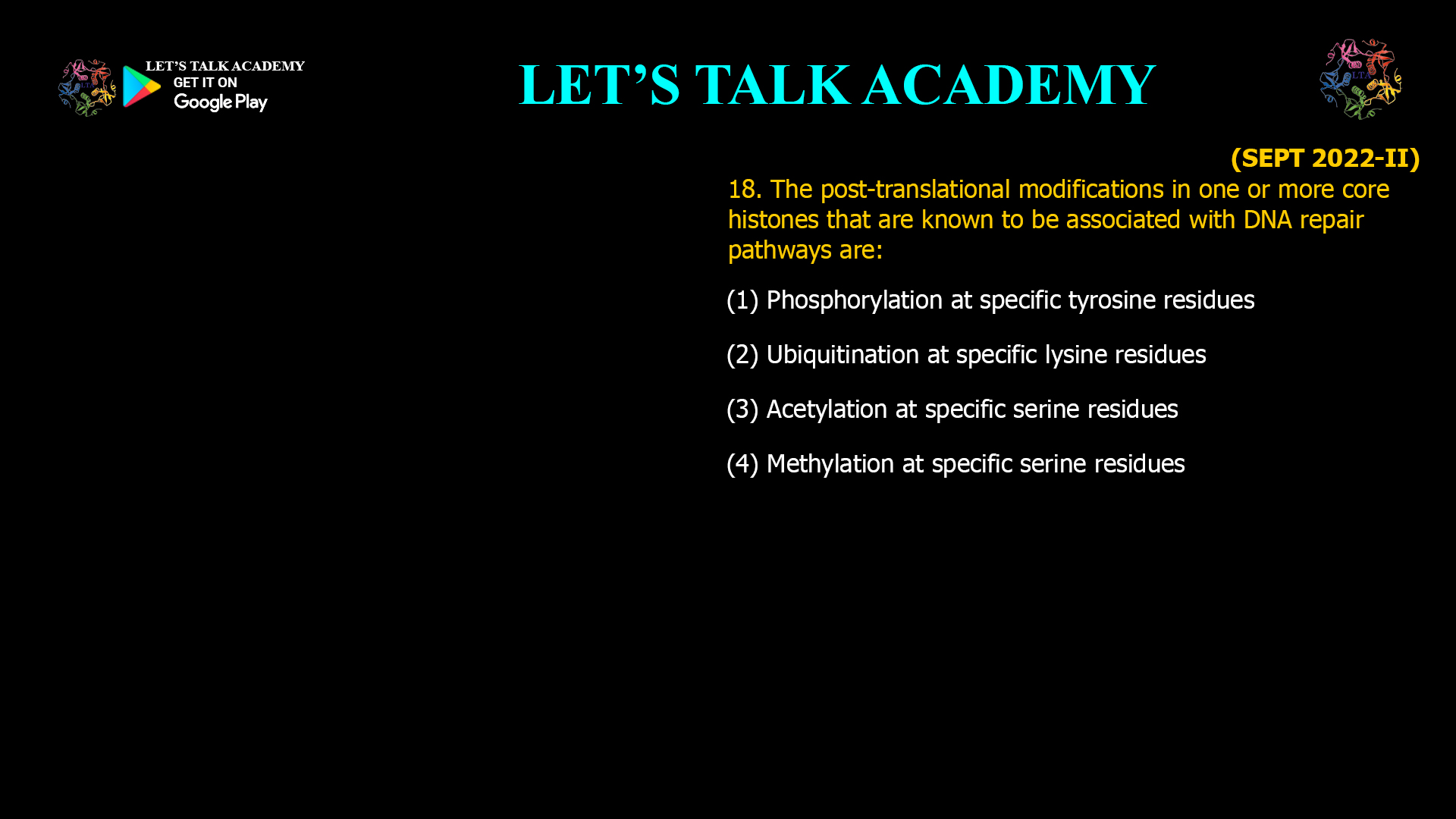
18. The post-translational modifications in one or more core histones that are known to be associated with DNA repair pathways are:
(1) Phosphorylation at specific tyrosine residues
(2) Ubiquitination at specific lysine residues
(3) Acetylation at specific serine residues
(4) Methylation at specific serine residues
Introduction
DNA repair is essential for maintaining genomic integrity, and chromatin structure plays a pivotal role in regulating access to damaged DNA. Post-translational modifications (PTMs) of histones, such as phosphorylation, acetylation, methylation, and ubiquitination, orchestrate the DNA damage response. Among these, ubiquitination of histones at specific lysine residues has emerged as a critical modification that signals DNA damage and recruits repair machinery.
Histone Ubiquitination DNA Repair
Ubiquitination involves the covalent attachment of ubiquitin molecules to lysine residues on histone proteins. This modification alters chromatin structure and serves as a platform for recruiting DNA repair factors.
Key examples include:
-
H2A ubiquitination at lysine 119 (H2AK119ub):
Marks sites of DNA double-strand breaks and facilitates repair protein recruitment. -
H2B ubiquitination at lysine 120 (H2BK120ub):
Regulates chromatin dynamics and is involved in DNA damage signaling.
These ubiquitin marks help relax chromatin, allowing repair proteins to access and process damaged DNA efficiently.
Other Histone Modifications in DNA Repair
While phosphorylation of histone H2AX on serine 139 (γ-H2AX) is a well-known early marker of DNA damage, ubiquitination at lysine residues provides a sustained signal for repair progression. Acetylation and methylation also contribute by modulating chromatin accessibility and recruiting specific repair factors.
Conclusion
Histone ubiquitination at specific lysine residues is a fundamental post-translational modification in DNA repair pathways. It plays a dual role in signaling DNA damage and remodeling chromatin to facilitate efficient repair, thereby preserving genomic stability.
Answer:
(2) Ubiquitination at specific lysine residues


