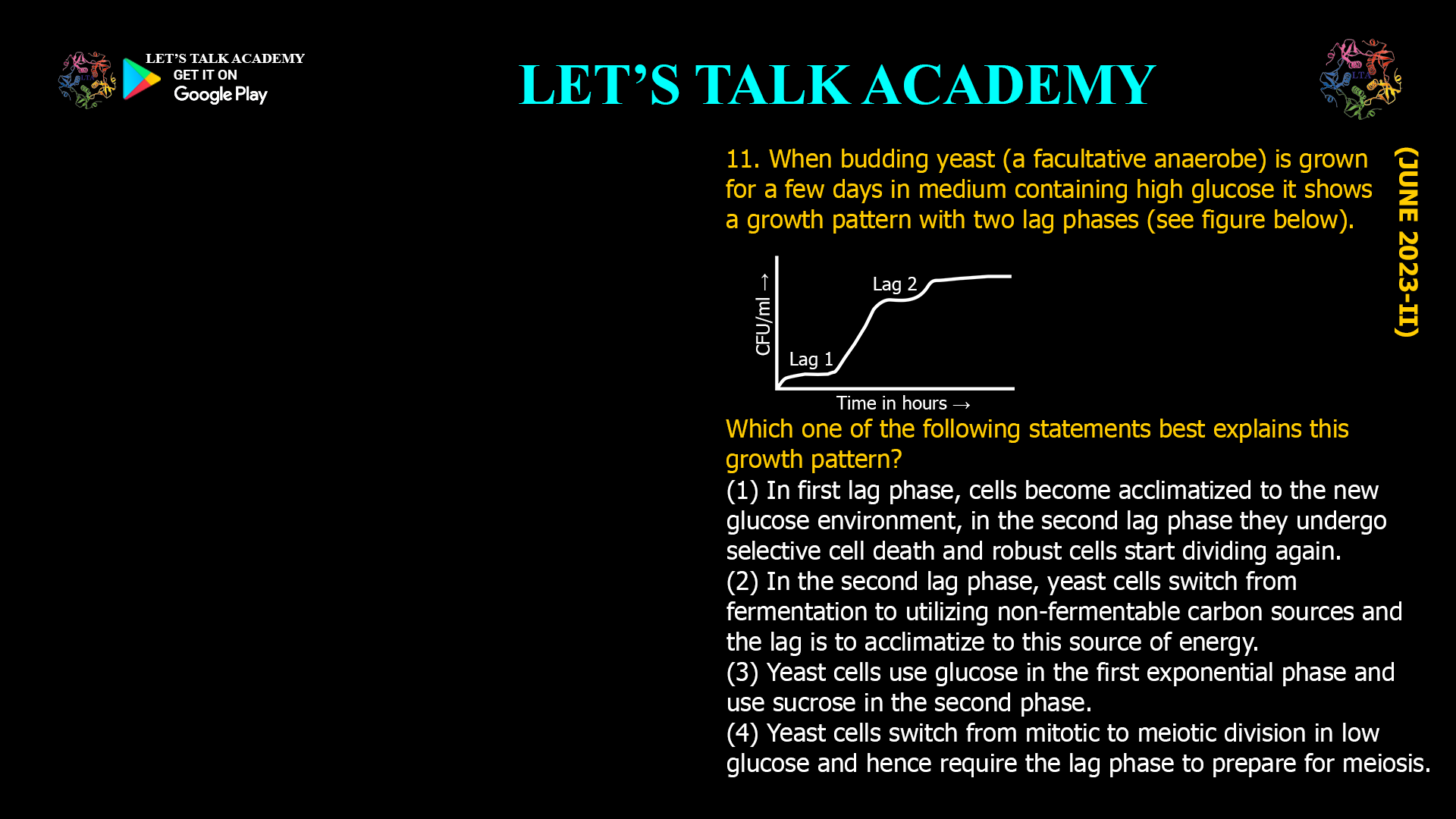
11. When budding yeast (a facultative anaerobe) is grown for a few days in medium containing high glucose it shows a growth pattern with two lag phases (see figure below).
Which one of the following statements best explains this growth pattern?
(1) In first lag phase, cells become acclimatized to the new glucose environment, in the second lag phase they undergo selective cell death and robust cells start dividing again.
(2) In the second lag phase, yeast cells switch from fermentation to utilizing non-fermentable carbon sources and the lag is to acclimatize to this source of energy.
(3) Yeast cells use glucose in the first exponential phase and use sucrose in the second phase.
(4) Yeast cells switch from mitotic to meiotic division in low glucose and hence require the lag phase to prepare for meiosis.
Budding yeast (Saccharomyces cerevisiae) is a classic model organism in molecular biology and is well known for its metabolic flexibility. As a facultative anaerobe, yeast can grow by fermentation or respiration, depending on environmental conditions and available carbon sources. When grown in a medium containing high glucose, yeast often displays a characteristic growth curve with two exponential phases separated by two lag phases. Understanding the reason behind these two lag phases reveals important insights into yeast metabolism and adaptation.
The Growth Pattern: Two Exponential Phases and Two Lag Phases
-
First Exponential Phase: Yeast rapidly grows by fermenting glucose, producing ethanol and carbon dioxide, even in the presence of oxygen (the Crabtree effect).
-
First Lag Phase: A brief pause as cells adjust to changes in the environment, often related to glucose depletion.
-
Second Exponential Phase: Growth resumes as yeast cells switch to utilizing alternative, non-fermentable carbon sources (such as ethanol, acetate, or glycerol) through aerobic respiration.
-
Second Lag Phase: A longer pause as cells reprogram their metabolism to switch from fermentation to respiration.
The Correct Explanation
The two lag phases are directly related to the metabolic switch that yeast undergoes as glucose is exhausted:
-
During the first lag phase, cells may be acclimatizing to the depletion of glucose and the accumulation of fermentation byproducts.
-
The second lag phase is crucial: it represents the period when yeast cells switch from fermentative metabolism (using glucose) to respiratory metabolism (using non-fermentable carbon sources like ethanol). This metabolic shift requires significant changes in gene expression, enzyme production, and cellular machinery, resulting in a temporary halt in growth as the cells acclimatize to the new conditions.
Correct Answer
(2) In the second lag phase, yeast cells switch from fermentation to utilizing non-fermentable carbon sources and the lag is to acclimatize to this source of energy.
Biological Significance
This pattern is a hallmark of yeast’s ability to adapt to changing nutrient environments. The metabolic switch from fermentation to respiration allows yeast to maximize energy extraction from available resources, ensuring survival and continued growth after glucose is depleted.
Summary Table: Yeast Growth Phases in High Glucose
| Phase | Metabolism Type | Carbon Source Used | Growth Rate |
|---|---|---|---|
| First exponential | Fermentation | Glucose | Fast |
| First lag | Transition | Glucose depleting | Pause |
| Second exponential | Respiration | Non-fermentable sources | Moderate |
| Second lag | Transition | Switching metabolism | Pause |
Conclusion
The two lag phases observed in budding yeast grown in high-glucose medium reflect the organism’s metabolic flexibility. The second lag phase, in particular, is due to the metabolic adaptation required for switching from fermentation to the utilization of non-fermentable carbon sources, ensuring efficient use of all available nutrients.
Keywords: budding yeast, two lag phases, high glucose, fermentation, non-fermentable carbon sources, metabolic switch, respiration, yeast growth pattern, diauxic shift, energy metabolism, Saccharomyces


17 Comments
Suman bhakar
June 12, 2025Done sir 👍
Arushi
June 14, 2025Easily explained 👍👍
Kajal
November 3, 2025The correct answer is (2) In the second lag phase, yeast cells switch from fermentation to utilizing non-fermentable carbon sources and the lag is to acclimatize to this source of energy.
Neha Yadav
November 6, 2025In the second lag phase, yeast cells switch from fermentation to utilizing non-fermentable carbon sources and the lag is to acclimatize to this source of energy.
Roopal Sharma
November 6, 2025Second option
Heena Mahlawat
November 6, 2025Option 2
Neeraj Sharma
November 6, 2025In the second lag phase, yeast cells switch from fermentation to utilizing non-fermentable carbon sources and the lag is to acclimatize to this source of energy.
Neelam Sharma
November 6, 2025In the second lag phase, yeast cells switch from fermentation to utilizing non-fermentable carbon sources and the lag is to acclimatize to this source of energy.
Dipti Sharma
November 6, 2025In the second lag phase, yeast cells switch from fermentation to utilizing non-fermentable carbon sources like ethanol.
Sonam Saini
November 8, 2025Answer 3 is Right
Bhawna Choudhary
November 8, 2025Option 2 is correct
Anisha Beniwal
November 8, 2025In the second lag phase, yeast cells switch from fermentation to utilizing non-fermentable carbon sources and the lag is to acclimatize to this source of energy.
Anurag Giri
November 9, 2025Option 2
Mohd juber Ali
November 9, 2025Option 2 is right
Sakshi Kanwar
November 10, 2025In the second lag phase, yeast cells switch from fermentation to utilizing non-fermentable carbon sources and the lag is to acclimatize to this source of energy.
Manisha choudhary
November 12, 2025In the second lag phase, yeast cells switch from fermentation to utilizing non-fermentable carbon sources and the lag is to acclimatize to this source of energy.
Aman Choudhary
November 12, 2025In the second lag phase, yeast cells switch from fermentation to utilizing non-fermentable carbon sources and the lag is to acclimatize to this source of energy.