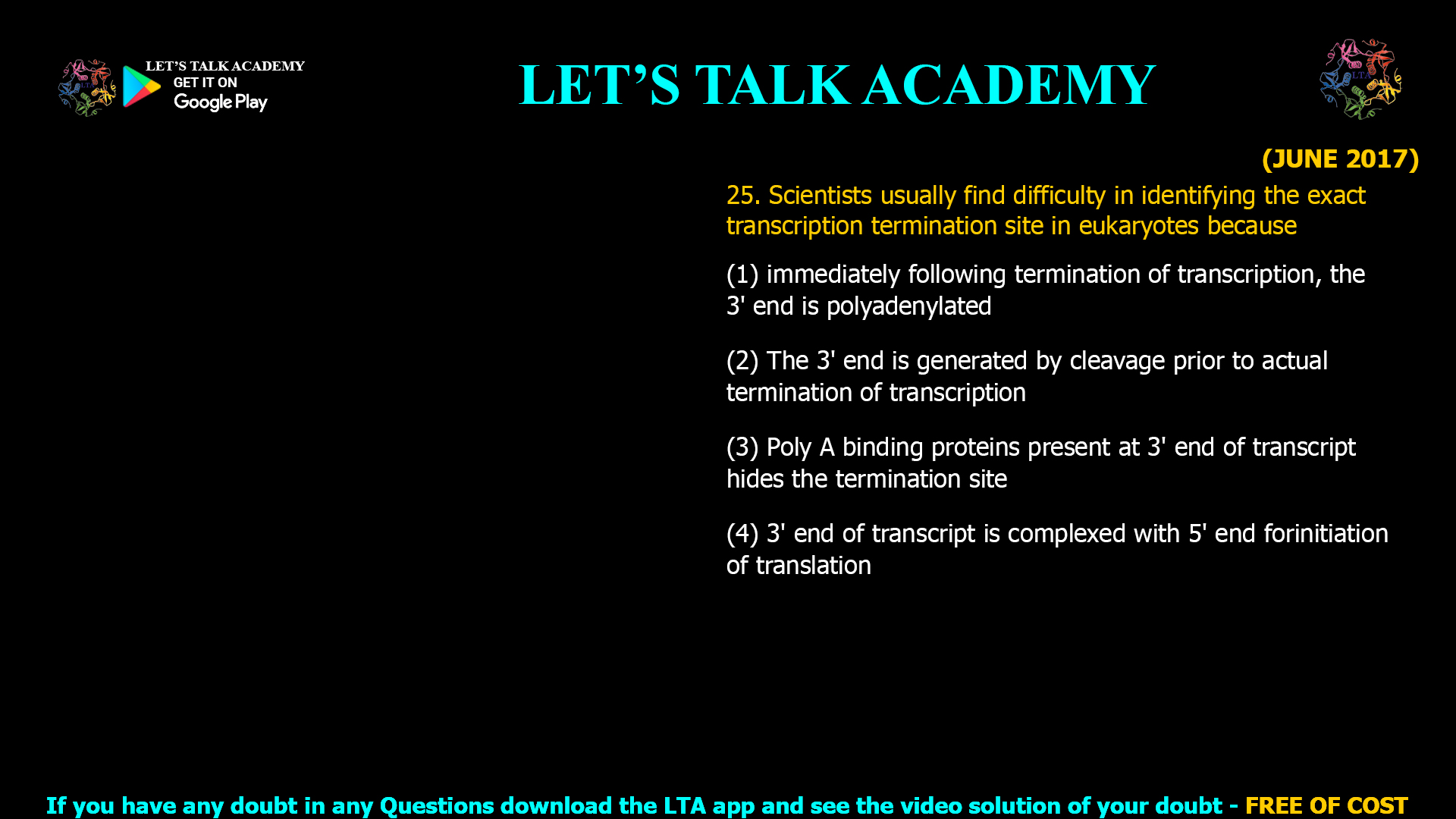
25. Scientists usually find difficulty in identifying the exact transcription termination site in eukaryotes because
(1) immediately following termination of transcription, the 3′ end is polyadenylated
(2) The 3′ end is generated by cleavage prior to actual termination of transcription
(3) Poly A binding proteins present at 3′ end of transcript hides the termination site
(4) 3′ end of transcript is complexed with 5′ end for initiation of translation
Why Identifying the Exact Transcription Termination Site in Eukaryotes Is Difficult
Correct Answer:
(2) The 3′ end is generated by cleavage prior to actual termination of transcription
Detailed Explanation:
In eukaryotic transcription, especially by RNA polymerase II, the process of termination is more complex than in prokaryotes. One key reason why pinpointing the exact termination site is difficult is that the 3′ end of the RNA transcript is not defined by the polymerase stopping transcription at a precise site. Instead, the pre-mRNA is cleaved downstream of the polyadenylation signal, and this cleavage generates the mature 3′ end of the transcript before transcription actually terminates.
-
After cleavage, RNA polymerase II continues to transcribe downstream sequences and eventually disengages from the DNA template at a variable site, which is not sharply defined. This phenomenon is known as the “torpedo model” of termination, where exonucleases xrn-1 degrade the downstream RNA and facilitate polymerase release.
-
The cleavage event and subsequent polyadenylation occur co-transcriptionally and are essential for mRNA stability and export.
-
Because the cleavage site and the polymerase release site are distinct, the exact termination site is heterogeneous and difficult to precisely map.
Why Other Options Are Incorrect:
-
Immediately following termination, the 3′ end is polyadenylated
While polyadenylation occurs, it happens after cleavage and not immediately at the termination site; this does not explain the difficulty in identifying the termination site itself. -
Poly A binding proteins hide the termination site
Poly A binding proteins bind to the polyadenylated tail after cleavage and do not obscure the termination site on the DNA or RNA polymerase. -
3′ end of transcript is complexed with 5′ end for initiation of translation
The 5′ and 3′ ends of mRNA interact during translation initiation, but this does not affect the ability to identify the transcription termination site.
Supporting Information from Research:
-
Transcription termination by RNA polymerase II involves cleavage of the nascent RNA at the polyadenylation site, followed by continued transcription downstream and eventual polymerase release, making the termination site diffuse and hard to define precisely.
-
RNA polymerase III termination depends on short DNA sequences but still involves complex mechanisms, including RNA cleavage, that contribute to difficulty in mapping exact termination points.
Summary Table
| Option | Explanation | Correct/Incorrect |
|---|---|---|
| (1) | 3′ end is polyadenylated immediately after termination | Incorrect |
| (2) | 3′ end is generated by cleavage prior to actual termination | Correct |
| (3) | Poly A binding proteins hide the termination site | Incorrect |
| (4) | 3′ end complexes with 5′ end for translation initiation | Incorrect |
Conclusion
The main reason scientists find it difficult to identify the exact transcription termination site in eukaryotes is that the 3′ end of the transcript is generated by cleavage prior to the actual termination of transcription by RNA polymerase II. This cleavage separates the site of RNA maturation from the site where the polymerase disengages, making the termination site heterogeneous and challenging to pinpoint.


27 Comments
Suman bhakar
June 2, 2025Thanku sir 😍
Lokesh kumawat
June 3, 2025Done
Shreeji Charan
June 3, 2025👍
Pallavi gautam
June 3, 2025Done
Kirti Agarwal
October 29, 2025Statement 3 is correct
Neelam Sharma
October 31, 2025The 3′ end is generated by cleavage prior to actual termination of transcription
Roopal Sharma
November 3, 2025The 3′ end is generated by clevage prior to actual termination of transcription.
Heena Mahlawat
November 3, 2025The 3′ end is generated by cleavage prior to actual termination of transcription
Santosh Saini
November 3, 2025The 3′ end of the transcript is generated by cleavage prior to the actual termination of transcription by RNA polymerase 2
Divya rani
November 3, 20253′ end of the transcript is generated by cleavage prior to the actual termination of transcription by RNA pol ll , it is difficult to identify because 3′ end of transcript is not defined by the polymerase stopping transcription at a precise site. The pre m RNA is cleaved downstream of the polyadenylate signal and this cleavage generate the mature 3’end of transcript before transcription actually terminate.
MOHIT AKHAND
November 3, 2025Done sir ✅
anjani sharma
November 3, 2025The 3′ end of the transcript is generated by cleavage at the polyadenylation site, which occurs before the RNA polymerase actually stops transcribing at a variable downstream location.
Rishita
November 3, 2025The 3’end is generated by the cleavage prior to actual termination of transcription is correct answer
Sakshi yadav
November 3, 2025The 3′ end is generated by cleavage prior to actual termination of transcription
Sonam Saini
November 3, 2025The three prime and is generated by cleavage prior the actual termination of transcription
Sonam Saini
November 3, 2025Right answer is 2
Dipti Sharma
November 3, 2025The 3′ end is generated by cleavage prior to actual termination of transcription ,making termination site diffuse and hard to identify in eukaryotes.
Shivani
November 3, 2025the 3′ end is generated by cleavage prior to the actual termination of transcription by RNA polymerase, making termination site hard to identify
Neha Yadav
November 3, 2025The 3′ end is generated by cleavage prior to actual termination of transcription by RNA polymerase, making termination site hard to identify
Dp
November 4, 2025The 3′ is generated by cleavage prior the actual termination of transcription
Mohd juber Ali
November 4, 20253′ end of the transcript is generate by cleavage the actual termination of transcription by RNA polymerase II.
Anurag Giri
November 4, 2025The corect ans is the 3′ end of the transcript is generated by cleavage prior to the actual termination of transcription by RNA polymerase 2
Bhawna Choudhary
November 4, 2025👍👍
Preeti
November 4, 2025Option 2 is correct The 3′ end is generated by clevage prior to actual termination of transcription
Priyanshi sharma
November 4, 2025Option 3 is correct
Deepika Sheoran
November 4, 2025Option 3 is correct.
Muskan Yadav
November 12, 2025The 3′ end is generated by cleavage prior to actual termination of transcription.