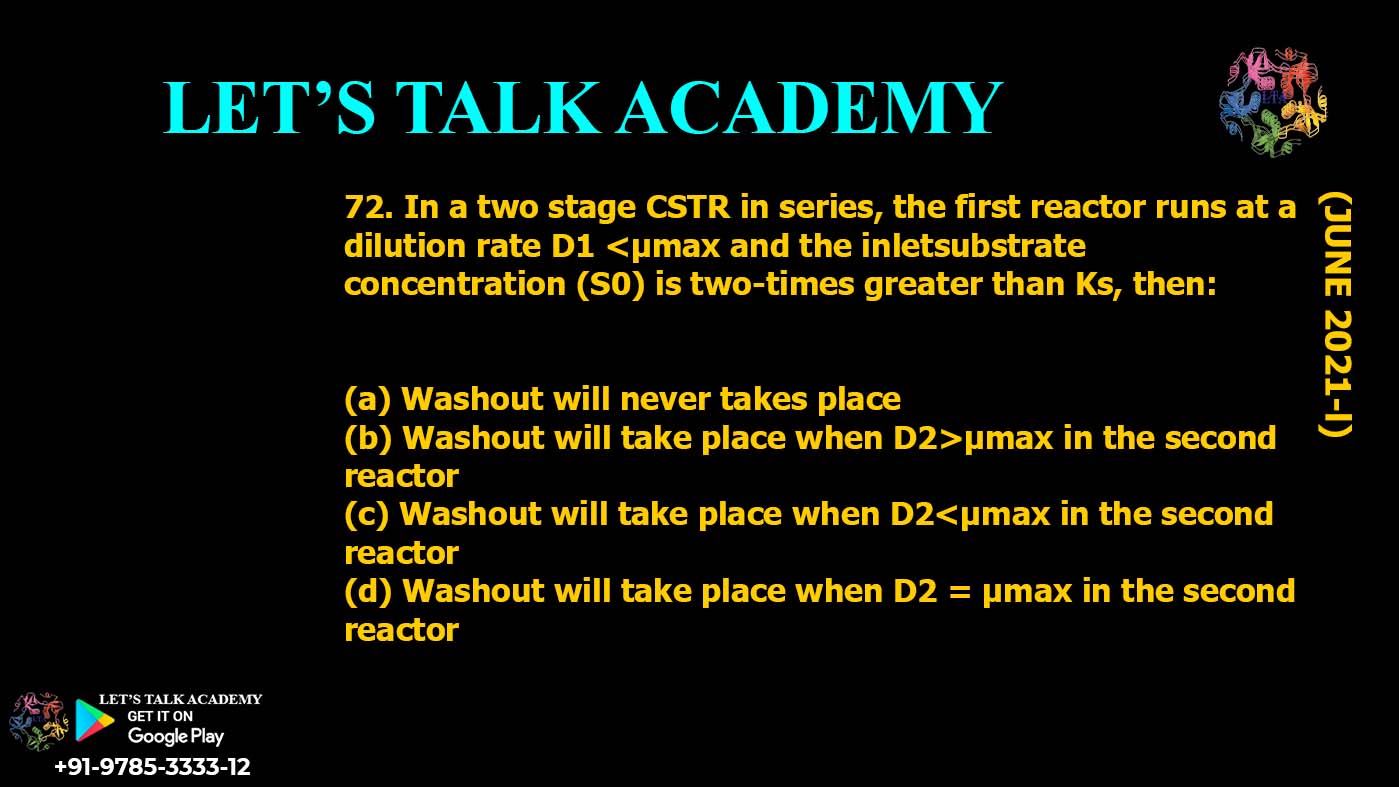
72. In a two stage CSTR in series, the first reactor runs at a dilution rate D1 <µmax and the
inletsubstrate concentration (S0) is two-times greater than Ks, then:
(a) Washout will never takes place
(b) Washout will take place when D2>µmax in the second reactor
(c) Washout will take place when D2<µmax in the second reactor
(d) Washout will take place when D2 = µmax in the second reactor
Understanding Washout Conditions in Two-Stage CSTR Systems
In the design and operation of Continuous Stirred Tank Reactors (CSTR), washout refers to the condition where microbial cells are carried out of the reactor faster than they can grow or multiply, leading to a loss of biomass in the system. This is an important factor to consider, especially when operating CSTRs in series. To understand when washout will occur, we must look at the dilution rate (D), the maximum specific growth rate (µmax), and the half-saturation constant (Ks) for the system.
Correct Answer:
(b) Washout will take place when D2 > µmax in the second reactor
Explanation
In a two-stage CSTR system in series, we have two reactors (R1 and R2) operating in sequence. The conditions described are:
-
D1 < µmax in the first reactor:
This means that the dilution rate in the first reactor is less than the maximum specific growth rate of the microorganisms. Under these conditions, the microbial growth rate is sufficient to keep the biomass within the reactor, avoiding washout. -
S0 is two-times greater than Ks:
The substrate concentration (S0) is sufficiently higher than the half-saturation constant (Ks), which means that the microorganisms will have an adequate amount of substrate available for growth in both reactors.
Now, let’s analyze the options:
-
(a) Washout will never take place:
This is incorrect because washout can still occur, particularly in the second reactor (R2) if conditions are not optimal, even if the first reactor operates within favorable conditions. -
(b) Washout will take place when D2 > µmax in the second reactor:
This is the correct answer. Washout occurs in the second reactor (R2) when the dilution rate (D2) exceeds the maximum specific growth rate (µmax). When the dilution rate is too high in the second reactor, microbial cells are flushed out before they can grow and multiply, leading to washout. -
(c) Washout will take place when D2 < µmax in the second reactor:
This is incorrect because when D2 is less than µmax, microbial cells can grow and replicate faster than they are being washed out, so washout will not occur. -
(d) Washout will take place when D2 = µmax in the second reactor:
This is also incorrect. When D2 equals µmax, the microbial population will be at a steady state, meaning the growth rate matches the washout rate, but it does not result in washout. There will be no loss of biomass at this specific dilution rate.
Conclusion
In a two-stage CSTR system in series, washout is primarily determined by the dilution rate of the second reactor (R2). When D2 exceeds µmax, the microorganisms are flushed out of the second reactor faster than they can grow, leading to washout. Understanding the balance between growth rates and dilution rates is crucial for optimizing reactor design and maintaining system stability.


1 Comment
yogesh sharma
May 7, 2025Done sir ji 👍😄