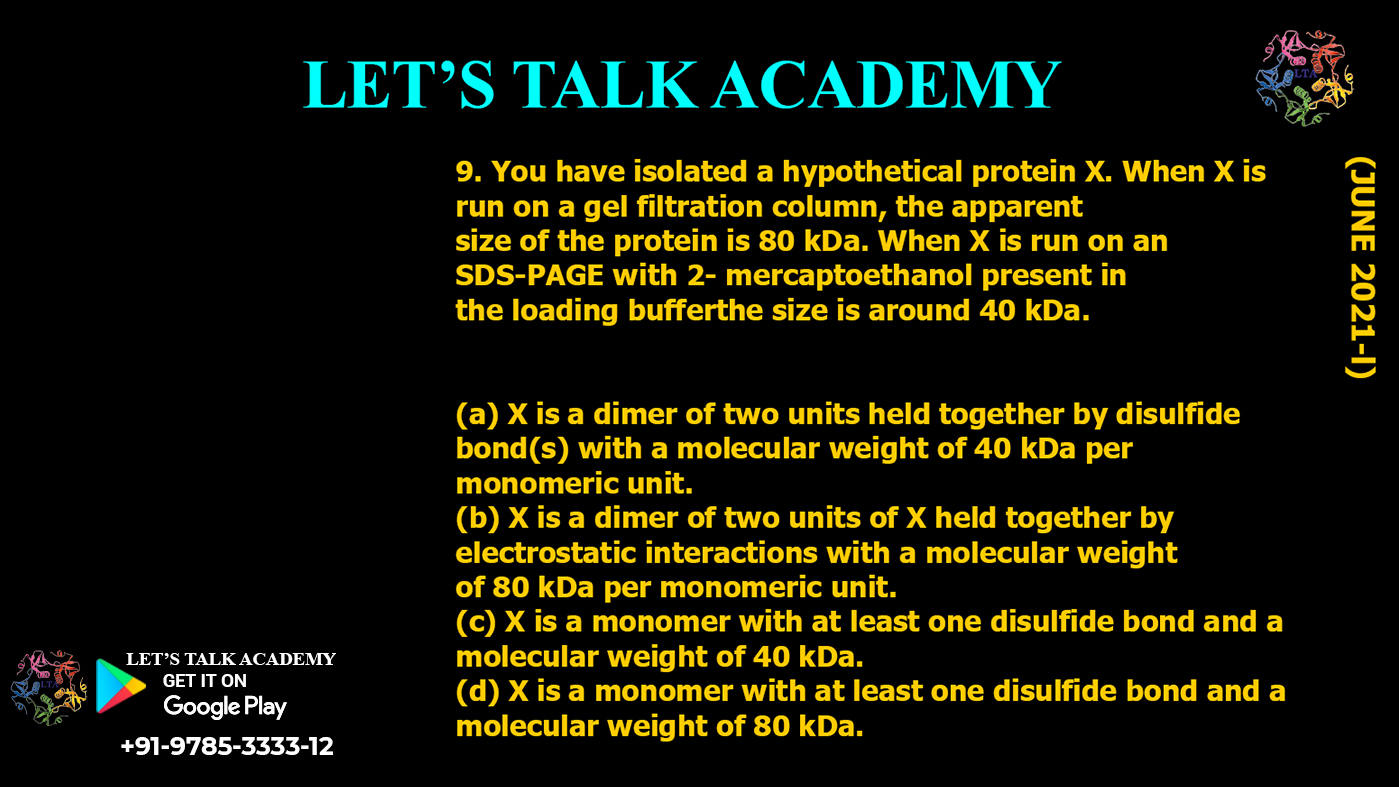
9. You have isolated a hypothetical protein X. When X is run on a gel filtration column, the apparent size of the protein is 80 kDa. When X is run on an SDS-PAGE with 2- mercaptoethanol present in the loading bufferthe size is around 40 kDa.
(a) X is a dimer of two units held together by disulfide bond(s) with a molecular weight of 40 kDa per monomeric unit.
(b) X is a dimer of two units of X held together by electrostatic interactions with a molecular weight
of 80 kDa per monomeric unit.
(c) X is a monomer with at least one disulfide bond and a molecular weight of 40 kDa.
(d) X is a monomer with at least one disulfide bond and a molecular weight of 80 kDa.
Article:
Introduction to Protein X Analysis
Protein analysis plays a critical role in understanding the structure, function, and behavior of proteins in biological systems. Techniques like gel filtration chromatography and SDS-PAGE are frequently used to analyze proteins’ size, structure, and interactions. In this article, we’ll discuss the results obtained from two common protein analysis methods—gel filtration and SDS-PAGE—and how these results help us infer the structure of a hypothetical protein, Protein X.
Methods and Results:
-
Gel Filtration Chromatography: When protein X is run on a gel filtration column, the apparent molecular weight is observed to be 80 kDa. This suggests that in its native form, protein X behaves as a larger molecule. Gel filtration separates proteins based on their size, and this result suggests that protein X might be a dimer, or a complex of two protein subunits.
-
SDS-PAGE: Next, protein X is run on an SDS-PAGE gel in the presence of 2-mercaptoethanol. This reagent breaks disulfide bonds, allowing the protein to denature and separate into its subunits. The gel reveals that protein X shows a size of approximately 40 kDa under these conditions. This suggests that the protein dissociates into two subunits that each weigh about 40 kDa when the disulfide bonds are reduced.
Possible Explanations for the Results:
Given the data from both techniques, we can consider several possible structural scenarios for protein X:
-
(a) X is a dimer of two units held together by disulfide bond(s) with a molecular weight of 40 kDa per monomeric unit:
-
This explanation seems the most likely. The gel filtration result shows an 80 kDa size, indicating that protein X is likely a dimer (two monomers) in its native state. When treated with 2-mercaptoethanol (which breaks disulfide bonds), the dimer dissociates into two 40 kDa monomers, as seen in the SDS-PAGE result. This is a classic scenario where disulfide bonds maintain the dimeric structure.
-
-
(b) X is a dimer of two units of X held together by electrostatic interactions with a molecular weight of 80 kDa per monomeric unit:
-
This explanation does not align with the SDS-PAGE results. If protein X were held together by electrostatic interactions, it would likely not dissociate into two 40 kDa units upon reduction with 2-mercaptoethanol. Electrostatic interactions typically don’t remain stable in SDS-PAGE under reducing conditions, making this scenario less likely.
-
-
(c) X is a monomer with at least one disulfide bond and a molecular weight of 40 kDa:
-
This scenario doesn’t explain the gel filtration result. If protein X were a monomer with a molecular weight of 40 kDa, it would show a size of 40 kDa in both gel filtration and SDS-PAGE. The observed discrepancy suggests that protein X is a dimer, not a monomer.
-
-
(d) X is a monomer with at least one disulfide bond and a molecular weight of 80 kDa:
-
This explanation doesn’t fit the SDS-PAGE result. If protein X were an 80 kDa monomer, it would appear as 80 kDa in both gel filtration and SDS-PAGE. However, the 40 kDa size on SDS-PAGE indicates that the protein is likely dissociating into smaller subunits upon reduction, making this explanation unlikely.
-
Conclusion: The Most Likely Explanation
The most likely explanation for the observed results is:
(a) X is a dimer of two units held together by disulfide bond(s) with a molecular weight of 40 kDa per monomeric unit.
This explanation accounts for both the 80 kDa size observed in gel filtration chromatography (indicating a dimer) and the 40 kDa size observed in SDS-PAGE (indicating the monomeric unit after disulfide bond reduction). The protein is a dimeric protein held together by disulfide bonds, and these bonds are disrupted during SDS-PAGE, leading to the dissociation of the protein into two 40 kDa monomers.
Key Takeaways:
-
Gel filtration chromatography shows the native size of the protein, suggesting protein X is a dimer.
-
SDS-PAGE, in the presence of 2-mercaptoethanol, reveals the monomeric size of the protein, supporting the dimeric nature of protein X.
-
The results suggest that disulfide bonds play a critical role in maintaining the dimeric structure of protein X.
By interpreting these results, researchers can make informed decisions about the protein’s structure, which is essential for understanding its function in cellular processes.


6 Comments
Akshay mahawar
April 26, 2025Done 👍
yogesh sharma
May 8, 2025Done sir
Meera Gurjar
August 31, 2025X is the dimer of two monomeric units held together by sulphide bond with mol Wt is 40kda
Neelam Sharma
September 1, 2025X is a dimer of two units held together by disulfide bond(s) with a molecular weight of 40 kDa per monomeric unit.
Aakansha sharma Sharma
September 1, 2025X is a dimer of two units held together by disulfide bond(s) with a molecular weight of 40 kDa per monomeric unit
Komal Sharma
September 5, 2025X is a dimer of two units held together by disulfide bond(s) with a molecular weight of 40 kDa per monomeric unit.