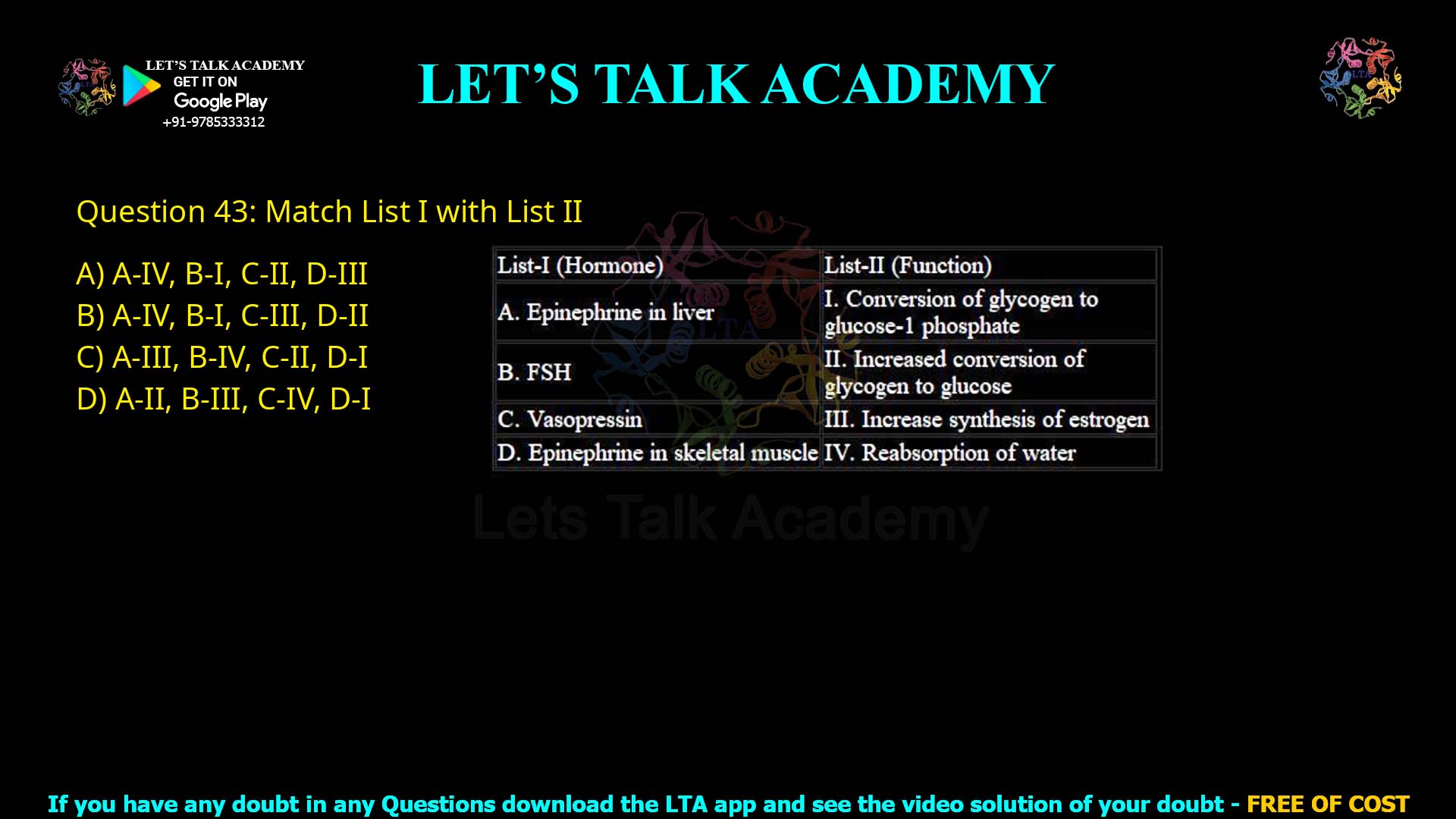
Q43.Match List I with List II
List-I (Hormone)
A. Epinephrine in liver
B. FSH
C. Vasopressin
D. Epinephrine in skeletal muscle
List-II (Function)
I. Conversion of glycogen to glucose-1 phosphate
II. Increased conversion of glycogen to glucose
III. Increase synthesis of estrogen
IV. Reabsorption of water
Choose the correct answer from the options given below:
(A) A-IV, B-I, C-II, D-III
(B) A-IV, B-I, C-III, D-II
(C) A-III, B-IV, C-II, D-I
(D) A-II, B-III, C-IV, D-I
The correct answer is option (D): A-II, B-III, C-IV, D-I. This accurately matches each hormone’s tissue-specific action from List-I to its physiological effect in List-II.
Hormone-Function Matches
-
A. Epinephrine in liver → II. Increased conversion of glycogen to glucose: Epinephrine activates hepatic glycogen phosphorylase via cAMP-PKA pathway, promoting glycogenolysis to release free glucose into blood.
-
B. FSH → III. Increase synthesis of estrogen: Follicle-stimulating hormone stimulates granulosa cells in ovarian follicles to produce aromatase, converting androgens to estrogens.
-
C. Vasopressin → IV. Reabsorption of water: Vasopressin (ADH) increases aquaporin-2 insertion in collecting duct principal cells, enhancing water reabsorption via V2 receptors.
-
D. Epinephrine in skeletal muscle → I. Conversion of glycogen to glucose-1 phosphate: Muscle epinephrine activates phosphorylase to produce G1P (not free glucose, as muscle lacks glucose-6-phosphatase), fueling glycolysis.
Option Analysis
-
(A) A-IV, B-I, C-II, D-III: Incorrect. Epinephrine doesn’t mediate water reabsorption (IV); vasopressin does. FSH doesn’t convert glycogen.
-
(B) A-IV, B-I, C-III, D-II: Incorrect. Same epinephrine error; FSH isn’t glycogen-related.
-
(C) A-III, B-IV, C-II, D-I: Incorrect. Liver epinephrine doesn’t make estrogen (III); FSH/vasopressin swapped.
-
(D) A-II, B-III, C-IV, D-I: Correct, matching tissue-specific biochemistry precisely.
Epinephrine in liver, FSH, vasopressin, and epinephrine in skeletal muscle dominate match List I with List II hormone functions in competitive exams like NEET. This guide decodes tissue-specific actions—glycogen to glucose, estrogen synthesis, water reabsorption—for perfect scoring.
Tissue-Specific Hormone Actions
Epinephrine in liver triggers increased conversion of glycogen to glucose via phosphorylase activation, exporting glucose systemically. FSH drives estrogen synthesis in ovarian granulosa cells through aromatase upregulation. Vasopressin promotes water reabsorption by inserting aquaporins in kidney collecting ducts. Epinephrine in skeletal muscle yields glycogen to glucose-1-phosphate for local ATP production (no G6Pase).
Why Option (D) Dominates
Option (D) A-II, B-III, C-IV, D-I perfectly captures match List I with List II hormone functions nuances—liver releases free glucose, muscle traps G1P, FSH makes estrogen, vasopressin conserves water.
Master this distinction—liver epinephrine serves blood glucose homeostasis, muscle powers contraction.


