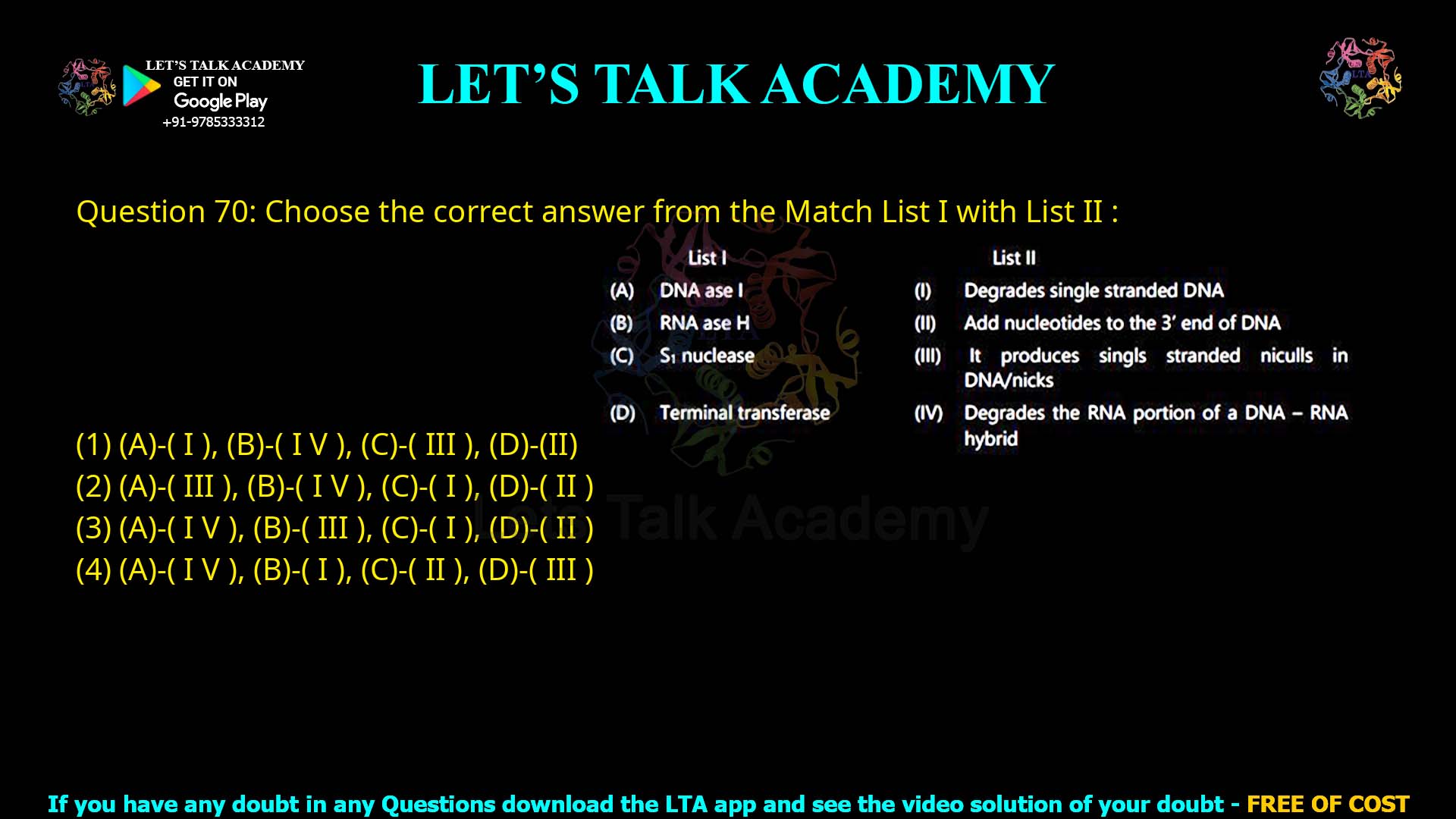
Q.70 Choose the correct answer from the Match List I with List II :
| List I | List II |
|---|---|
| (A) DNA ase I | (I) Degrades single stranded DNA |
| (B) RNA ase H | (II) Add nucleotides to the 3′ end of DNA |
| (C) S₁ nuclease | (III) It produces single stranded nicks in DNA |
| (D) Terminal transferase | (IV) Degrades the RNA portion of a DNA–RNA hybrid |
Choose the correct answer from the options given below:
- (A)-(I), (B)-(IV), (C)-(III), (D)-(II)
- (A)-(III), (B)-(IV), (C)-(I), (D)-(II)
- (A)-(IV), (B)-(III), (C)-(I), (D)-(II)
- (A)-(IV), (B)-(I), (C)-(II), (D)-(III)
The correct answer is option 1: (A)-(I), (B)-(IV), (C)-(III), (D)-(II).
These enzymes are essential in molecular biology for DNA/RNA manipulation, with specific substrate preferences critical for techniques like mapping, hybridization, and cloning.
Enzyme Functions
DNase I primarily degrades single-stranded DNA (ssDNA) and also double-stranded DNA (dsDNA), producing 5′-phospho ends through random endonucleolytic cleavage. RNase H specifically degrades the RNA strand in DNA-RNA hybrids, leaving DNA intact—key for removing RNA primers in replication studies. S1 nuclease targets ssDNA/RNA, producing single-stranded nicks in dsDNA at unpaired regions or opposite existing nicks. Terminal transferase uniquely adds nucleotides to the 3′ end of DNA without a template, used for tailing in cloning.
Option Analysis
-
Option 1: (A)-(I), (B)-(IV), (C)-(III), (D)-(II) – Correct; matches DNase I to ssDNA degradation, RNase H to hybrid RNA removal, S1 to nicks, and transferase to 3′ addition.
-
Option 2: (A)-(III), (B)-(IV), (C)-(I), (D)-(II) – Incorrect; wrongly assigns DNase I to nicks (S1’s role) and S1 to ssDNA degradation primarily.
-
Option 3: (A)-(IV), (B)-(III), (C)-(I), (D)-(II) – Incorrect; mismatches DNase I to RNA hybrids (RNase H) and S1 to ssDNA degradation.
-
Option 4: (A)-(IV), (B)-(I), (C)-(II), (D)-(III) – Incorrect; confuses DNase I with RNase H and terminal transferase roles.
This SEO-optimized guide on DNase I RNase H S1 nuclease terminal transferase matching targets GATE Life Sciences and CSIR NET aspirants in biotechnology. It covers Match List I with List II questions on recombinant DNA enzymes, vital for molecular biology and genetic engineering syllabi.
Key Enzyme Pairings
Standard matches for exam questions:
Enzyme (List I) Function (List II) Molecular Biology Application (A) DNase I (I) Degrades single stranded DNA DNA footprinting, ssDNA removal (B) RNase H (IV) Degrades RNA in DNA–RNA hybrid Primer removal in PCR/cloning (C) S₁ nuclease (III) Produces single stranded nicks Hybrid mapping, ssDNA/RNA detection (D) Terminal transferase (II) Adds nucleotides to 3′ end of DNA Homopolymer tailing for cloning DNase I (from bovine pancreas) cleaves ssDNA/dsDNA randomly in Mg²⁺, insensitive to sequence. RNase H (E. coli/human) hydrolyzes RNA in hybrids, essential for cDNA synthesis cleanup. S1 nuclease (Aspergillus) prefers ss nucleic acids, nicking dsDNA at mismatches. Terminal deoxynucleotidyl transferase (TdT) enables non-templated 3′ extensions for linker addition.
Exam Strategies
-
Differentiate Specificities: DNase I = broad DNA nuclease; S1 = ss-specific; RNase H = hybrid-only.
-
Common Errors: Swapping DNase I/S1 or ignoring terminal transferase’s template-independence.
-
GATE Relevance: Aligns with Unit 5 (Genetic Engineering), practice via past papers for 2-3 marks.
Master DNase I RNase H S1 nuclease terminal transferase matching to excel in competitive exams, enhancing skills in enzymatic tools for Jaipur-based life sciences students.
-


