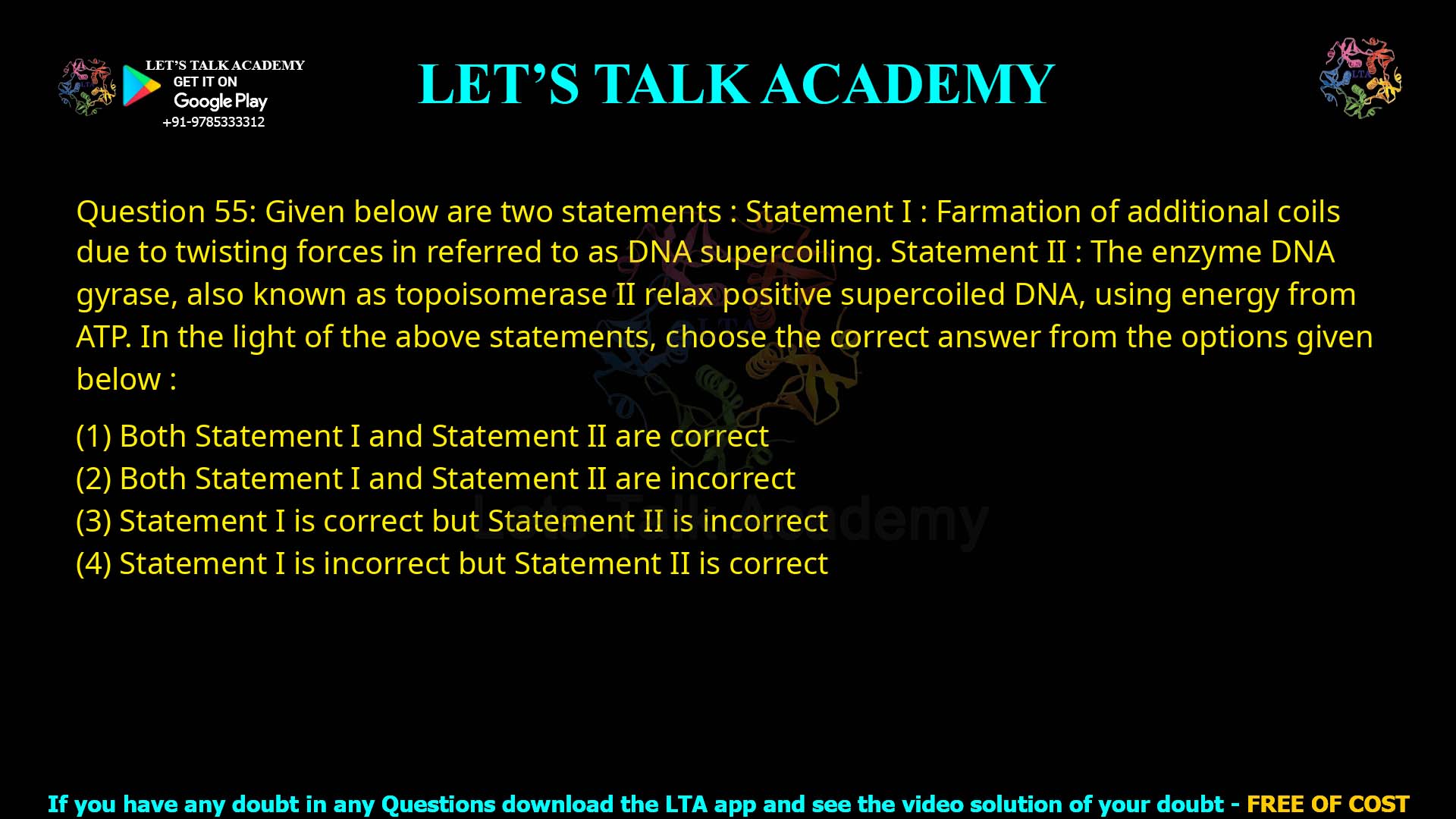
Q.55 Given below are two statements:
Formation of additional coils due to twisting forces is referred to as DNA supercoiling.
The enzyme DNA gyrase, also known as topoisomerase II, relaxes positive supercoiled DNA,
using energy from ATP.
In the light of the above statements, choose the correct answer from the options given below:
- Both Statement I and Statement II are correct
- Both Statement I and Statement II are incorrect
- Statement I is correct but Statement II is incorrect
- Statement I is incorrect but Statement II is correct
Statement I is correct but Statement II is incorrect.
Question Breakdown
This question evaluates understanding of DNA topology. Statement I defines supercoiling accurately, while Statement II misstates DNA gyrase function—it’s the opposite of what’s claimed.
Statement Analysis
Statement I (Correct): DNA supercoiling occurs when the DNA double helix experiences torsional stress from over- or under-winding beyond its relaxed B-form state (10.4 bp/turn). This creates compensatory writhe (interwinding) to relieve twist strain, forming plectonemic supercoils. Negative supercoiling unwinds DNA (facilitates transcription); positive supercoiling overwinds it.
Statement II (Incorrect): DNA gyrase (topoisomerase II) introduces negative supercoils into relaxed/overwound DNA using ATP hydrolysis, not relaxes positive supercoils. It creates a transient double-strand break, passes DNA segments through, and reseals—actively underwinding DNA (ΔLk = -2 per cycle). Topoisomerase I relaxes both positive/negative supercoils without ATP.
Why Other Options Are Wrong
-
Both correct: Statement II factually wrong about gyrase function.
-
Both incorrect: Statement I accurately defines supercoiling via twisting forces.
-
Statement I incorrect, II correct: Reverses both truths; gyrase doesn’t relax positive supercoils.
DNA supercoiling formation due to twisting forces drives bacterial chromosome compaction and gene regulation. This analysis clarifies Statement I (correct): “Formation of additional coils due to twisting forces is referred to as DNA supercoiling” vs Statement II (incorrect): “DNA gyrase relaxes positive supercoiled DNA”—critical for molecular biology competitive exams.
DNA Topology Fundamentals
Lk = Tw + Wr (Linking number = Twist + Writhe). Relaxed DNA: Lk₀ = N/10.4 (N = bp). Supercoiling: σ = (Lk – Lk₀)/Lk₀.
-
Negative supercoiling (σ < 0): Underwinds DNA (-7000 supercoils in E. coli)
-
Positive supercoiling (σ > 0): Overwinds DNA
DNA Gyrase Mechanism (Statement II Error)
textRelaxed DNA → [ATP] → DNA Gyrase → Negatively Supercoiled DNA
(not: Positive → Relaxed)
Gyrase cycle:
-
DNA wraps around gyrase (ATP binding)
-
Double-strand break (tyrosine nucleases)
-
T-segment passes through G-segment
-
Resealing (ΔLk = -2)
Topoisomerase I: Relaxes both (+/-) supercoils, no ATP, single-strand breaks.
Enzyme Function ATP? Supercoiling Change DNA Gyrase (Topo II) Introduces negative Yes ΔLk = -2 Topoisomerase I Relaxes (+/-) No ΔLk → 0 Topoisomerase IV Decatenation Yes Relaxes positive DNA gyrase maintains -6% superhelical density in bacteria, essential for replication/transcription initiation.
-


