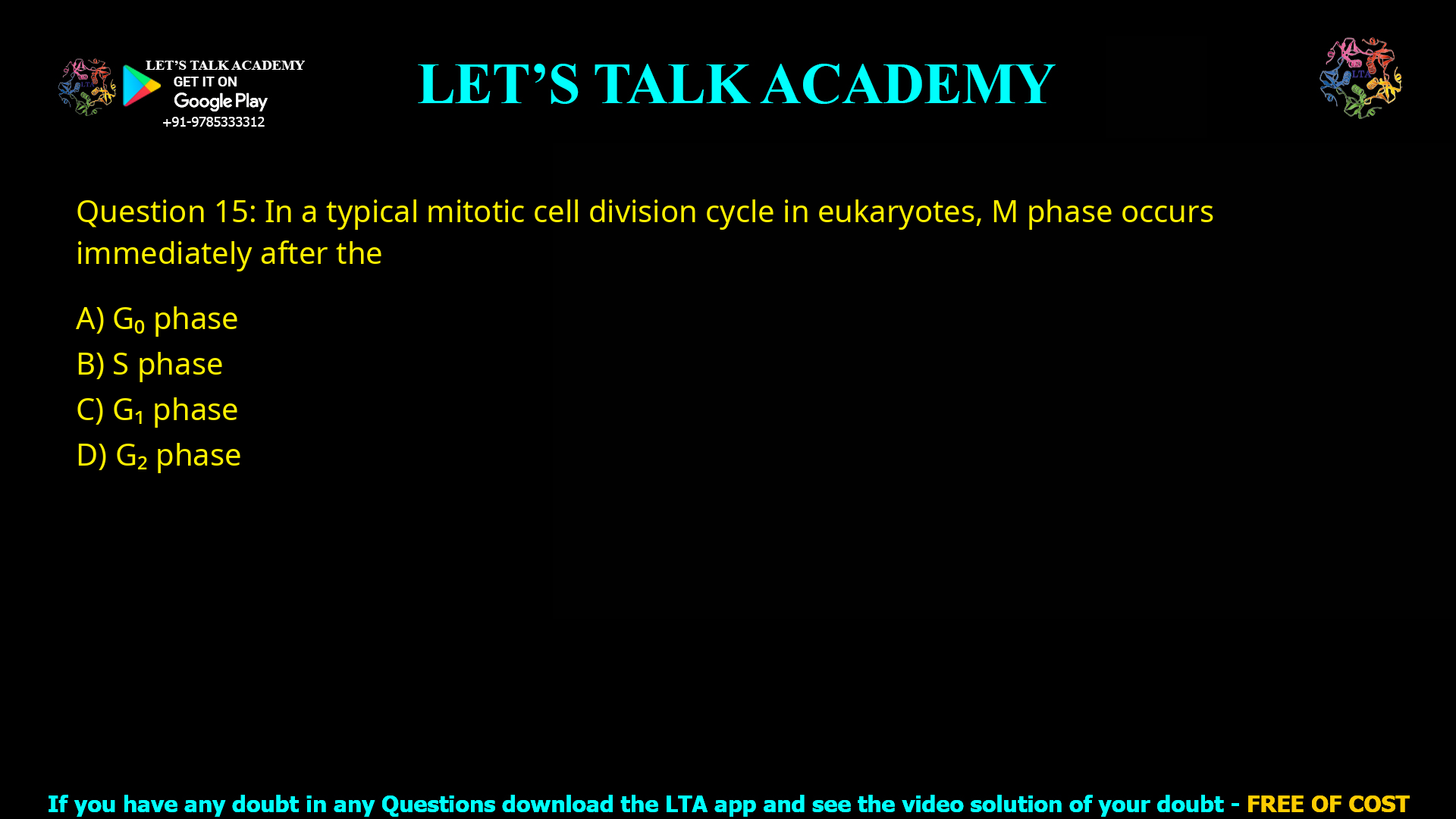
Q.15 In a typical mitotic cell division cycle in eukaryotes, M phase occurs immediately after the
(A) G 0 phase (B) S phase (C) G1 phase (D) G2 phase
The question asks: In a typical mitotic cell division cycle in eukaryotes, M phase occurs immediately after which phase? Let’s break it down step-by-step, explaining the eukaryotic cell cycle and evaluating each option.
Eukaryotic Cell Cycle Overview
Eukaryotic cells follow a cell cycle divided into interphase (preparation) and M phase (division). Interphase includes:
-
G1 phase: Growth and normal functions; cell assesses damage and prepares for DNA replication.
-
S phase: DNA synthesis; chromosomes duplicate.
-
G2 phase: Growth and preparation for mitosis; checks DNA integrity.
-
M phase: Mitosis (nuclear division) + cytokinesis (cytoplasmic division).
The cycle flows as G1 → S → G2 → M. M phase follows G2 phase directly. G0 is a quiescent state outside the cycle.
Option Analysis
-
(A) G0 phase: Incorrect. G0 is a resting phase where cells exit the cycle (e.g., differentiated neurons). Cells in G0 don’t proceed to M phase; they re-enter G1 if stimulated.
-
(B) S phase: Incorrect. S phase duplicates DNA, followed by G2 (gap 2) for further prep. Skipping G2 would risk errors in mitosis.
-
(C) G1 phase: Incorrect. G1 leads to S phase for replication. M phase is much later, after DNA is fully duplicated and checked.
-
(D) G2 phase: Correct. M phase starts right after G2, once the cell confirms readiness (e.g., via cyclin B-CDK1 activation).
Answer: (D) G2 phase.
This sequence ensures accurate chromosome segregation during mitosis, preventing aneuploidy.
In the mitotic cell division cycle in eukaryotes, understanding phase order is crucial for grasping how cells divide accurately. The M phase—encompassing mitosis and cytokinesis—occurs immediately after the G2 phase, marking the transition from preparation to division. This article explores the cell cycle phases, explains why M phase follows G2 phase, and debunks common misconceptions for students and researchers.
What is the Mitotic Cell Division Cycle in Eukaryotes?
The eukaryotic cell cycle drives growth, repair, and reproduction. It splits into interphase (G1, S, G2) for preparation and M phase for division. Key regulators like cyclins and CDKs control progression, with checkpoints ensuring fidelity.
-
G1 phase: Cell grows, synthesizes proteins, and decides to divide or enter G0.
-
S phase: DNA replicates, forming sister chromatids.
-
G2 phase: Cell grows more, repairs DNA, and assembles mitotic machinery.
-
M phase: Chromosomes segregate; daughter cells form.
Disruptions here link to diseases like cancer.
Why Does M Phase Occur Immediately After G2 Phase?
After S phase duplicates DNA, G2 phase verifies integrity and stockpiles energy. The G2/M checkpoint—activated by cyclin B-CDK1—triggers M phase (prophase → metaphase → anaphase → telophase). This prevents mitosis with damaged DNA.
Visualize it like a factory: G1 builds the blueprint, S copies it, G2 inspects, and M assembles ships.
Common MCQ Confusions: Analyzing Other Phases
Students often mix up phases in questions like “M phase occurs immediately after…”:
| Option | Phase | Why Not Before M Phase? |
|---|---|---|
| (A) G0 phase | Resting/quiescent | Cells exit cycle; re-enter via G1, not directly to M. |
| (B) S phase | DNA synthesis | Needs G2 checkpoint post-replication. |
| (C) G1 phase | Initial growth | Too early; precedes DNA duplication. |
| (D) G2 phase | Pre-mitotic prep | Correct—direct precursor to M. |
Checkpoints and Regulation in the Cell Cycle
-
G1/S checkpoint: DNA damage halt.
-
G2/M checkpoint: Ensures replication completion.
-
Mutations (e.g., p53 loss) bypass these, causing uncontrolled mitotic cycles.
For biotech pros, this informs fermentation optimization or cancer therapies targeting CDKs.
Key Takeaways for Mitotic Cell Division Cycle Mastery
-
M phase occurs immediately after G2 phase in eukaryotes.
-
Sequence: G1 → S → G2 → M → (back to G1 or G0).
-
Relevance: Vital for genetics, microbiology, and biochemical engineering.
Mastering the mitotic cell division cycle in eukaryotes boosts exam scores and research. Practice with diagrams or simulations.


1 Comment
Ankita Pareek
April 21, 2026M phase takes place just after the G2 phase