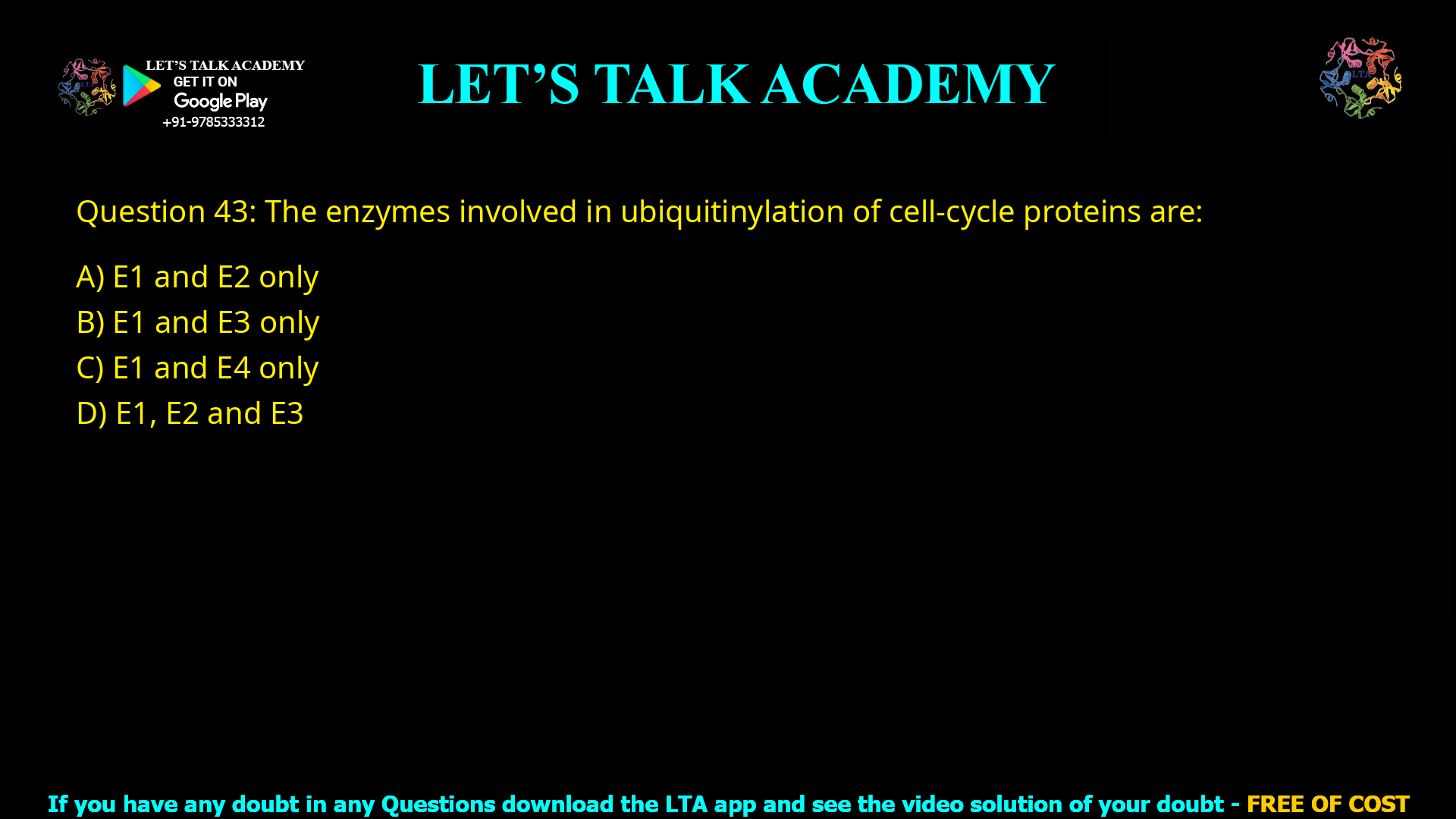
Q.43 The enzymes involved in ubiquitinylation of cell-cycle proteins are
(A) E1 and E2 only
(B) E1 and E3 only
(C) E1 and E4 only
(D) E1, E2 and E3
E1, E2, and E3 Enzymes Drive Ubiquitinylation of Cell-Cycle Proteins
Ubiquitinylation regulates cell-cycle proteins for degradation via the proteasome, ensuring precise progression through phases like G1/S and mitosis. The correct answer is (D) E1, E2, and E3.
Ubiquitination Cascade Overview
Ubiquitinylation attaches ubiquitin to target proteins like cyclins through a three-enzyme cascade. E1 activates ubiquitin using ATP, forming a thioester bond; E2 receives ubiquitin from E1; E3 ligates it to the substrate lysine, conferring specificity for cell-cycle regulators such as cyclin B or p53.
This process ensures polyubiquitin chains target proteins for 26S proteasome degradation, critical for checkpoints.
Option Breakdown
-
(A) E1 and E2 only: Incomplete; E1 activates and E2 conjugates ubiquitin, but lacks E3’s substrate recognition for cell-cycle proteins like cyclin E.
-
(B) E1 and E3 only: Incorrect; E3 requires E2 to transfer ubiquitin, as E3 alone cannot conjugate without the E2 intermediate.
-
(C) E1 and E4 only: Wrong; E4 aids multi-ubiquitin chain extension in specific cases but is not part of the core initiation for cell-cycle ubiquitinylation.
-
(D) E1, E2, and E3: Correct; these three enzymes form the canonical pathway, with hundreds of E3s ensuring specificity for cell-cycle targets.


1 Comment
Ankita Pareek
June 6, 2026E1,E2 and E3 are involved in ubiquitinylation of cell cycle protein