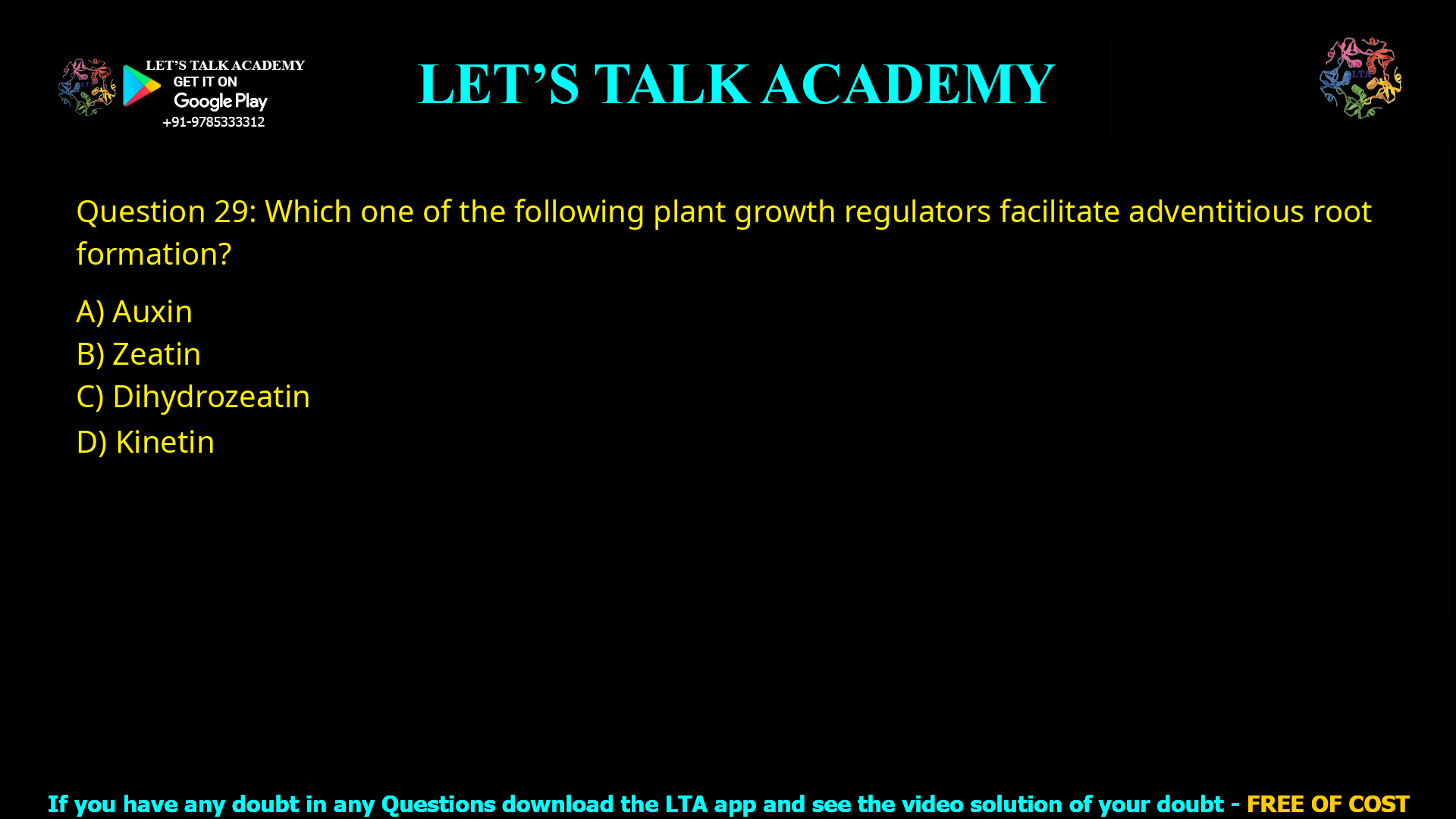
Q.29 Which one of the following plant growth regulators facilitate adventitious root
formation?
(A) Auxin
(B) Zeatin
(C) Dihydrozeatin
(D) Kinetin
Auxin facilitates adventitious root formation in plants. This makes option (A) the correct choice for the question.
Question Breakdown
Adventitious roots develop from non-root tissues like stems or leaves, crucial for plant propagation via cuttings. Among the options, only auxin directly promotes this process by triggering cell division and differentiation at wound sites.
Option Analysis
-
(A) Auxin: Primary regulator of adventitious root initiation; exogenous auxins like IAA or IBA are applied in horticulture to enhance rooting in cuttings. It activates genes like ARF6/8 and WOX11/12 for primordia formation.
-
(B) Zeatin: A cytokinin that promotes cell division and shoot growth; high cytokinin levels inhibit root formation by counteracting auxin effects.
-
(C) Dihydrozeatin: Another cytokinin derivative, similar to zeatin; supports bud break and chlorophyll synthesis but does not induce adventitious roots.
-
(D) Kinetin: Synthetic cytokinin aiding cell division in tissue culture; like other cytokinins, it favors shoots over roots and opposes auxin-driven rooting.
Introduction
Auxin facilitates adventitious root formation, making it essential for vegetative propagation in horticulture and agriculture. Unlike zeatin, dihydrozeatin, or kinetin—which are cytokinins focused on shoot growth—auxin triggers root primordia from stem cuttings. This guide explains each plant growth regulator’s role for students preparing for exams like IIT JAM Biotechnology.
Role of Auxin in Rooting
Auxin, such as indole-3-acetic acid (IAA), accumulates at cutting bases to initiate adventitious roots. It promotes pericycle cell dedifferentiation into founder cells, followed by primordia development. Studies on tomato and Arabidopsis confirm auxin’s control via transporters like PIN1 and response factors ARF6/8.
-
Increases auxin sensitivity in recalcitrant species like apple or walnut.
-
Applied as IBA in commercial rooting powders for 80-90% success rates.
Cytokinins: Zeatin, Dihydrozeatin, Kinetin
Cytokinins like zeatin (from corn), dihydrozeatin (legume-derived), and synthetic kinetin promote cytokinesis but inhibit rooting at high auxin:cytokinin ratios.
-
Zeatin: Enhances shoot multiplication; perturbs rooting in tomato cuttings.
-
Dihydrozeatin: Minor role in hormone balance; no direct root promotion.
-
Kinetin: Used in callus cultures; blocks auxin-mediated root initiation.
The auxin:cytokinin balance dictates organogenesis—roots favor high auxin.
Practical Applications
In plant tissue culture, auxin facilitates adventitious root formation for clonal propagation of elite varieties. Combine with wounding or darkness for optimal results. For competitive exams, remember: auxin = roots, cytokinins = shoots.
| Regulator | Primary Function | Effect on Adventitious Roots | Example Use |
|---|---|---|---|
| Auxin | Root initiation | Promotes strongly | Cuttings rooting |
| Zeatin | Shoot growth | Inhibits | Micropropagation |
| Dihydrozeatin | Cell division | Neutral/minor | Legume cultures |
| Kinetin | Bud break | Inhibits | Callus induction |


