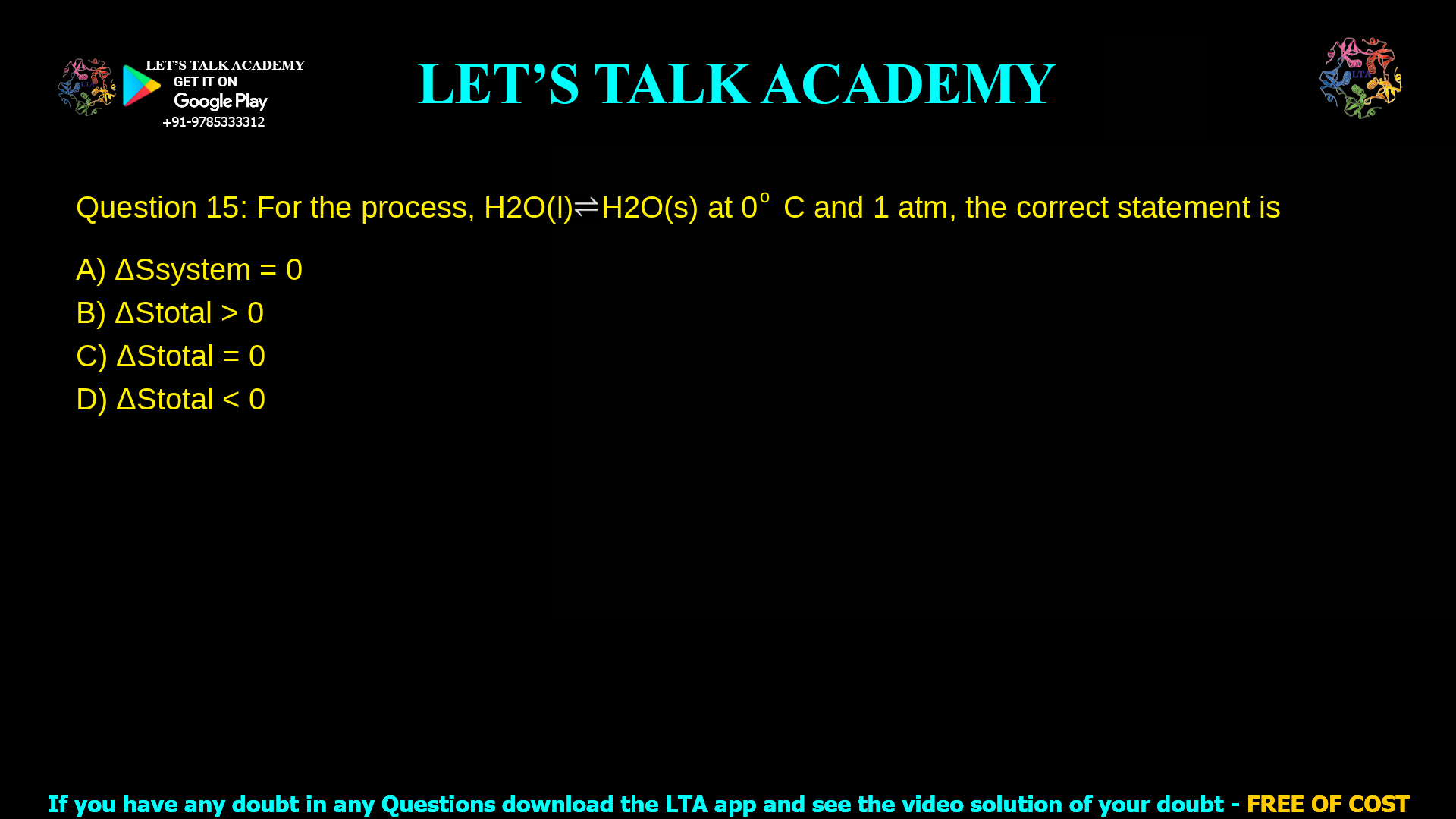
Q.15 For the process, H2O(l) ⇌ H2O(s) at 0 o
C and 1 atm, the correct statement is
(A) ΔSsystem = 0 (B) ΔStotal > 0 (C) ΔStotal = 0 (D) ΔStotal < 0
The process H₂O(l) ⇌ H₂O(s) at 0°C and 1 atm represents the equilibrium between liquid water and ice at the freezing point. The correct answer is (C) ΔS_total = 0, as this condition defines a reversible equilibrium where total entropy remains unchanged.
Core Concept
At 0°C (273 K) and 1 atm, water and ice coexist in equilibrium, making the process reversible. Gibbs free energy change is zero (ΔG = 0 = ΔH – TΔS), so ΔH = TΔS_system. Freezing releases heat (ΔH < 0, ΔS_system < 0), but surroundings gain entropy (ΔS_surroundings = -ΔH/T > 0), yielding ΔS_total = ΔS_system + ΔS_surroundings = 0.
Option Analysis
-
(A) ΔS_system = 0: Incorrect. Liquid water has higher disorder than ice; freezing decreases system entropy (ΔS_system < 0).
-
(B) ΔS_total > 0: Incorrect. Equilibrium processes have ΔS_total = 0, not greater, distinguishing them from spontaneous ones.
-
(C) ΔS_total = 0: Correct. Forward and reverse rates equalize, with opposing entropy changes balancing perfectly.
-
(D) ΔS_total < 0: Incorrect. This violates the second law, as no real process decreases total entropy.
Exam Tips
Recognize phase equilibria at transition points always yield ΔS_total = 0. Contrast with irreversible freezing below 0°C (ΔS_total > 0).


