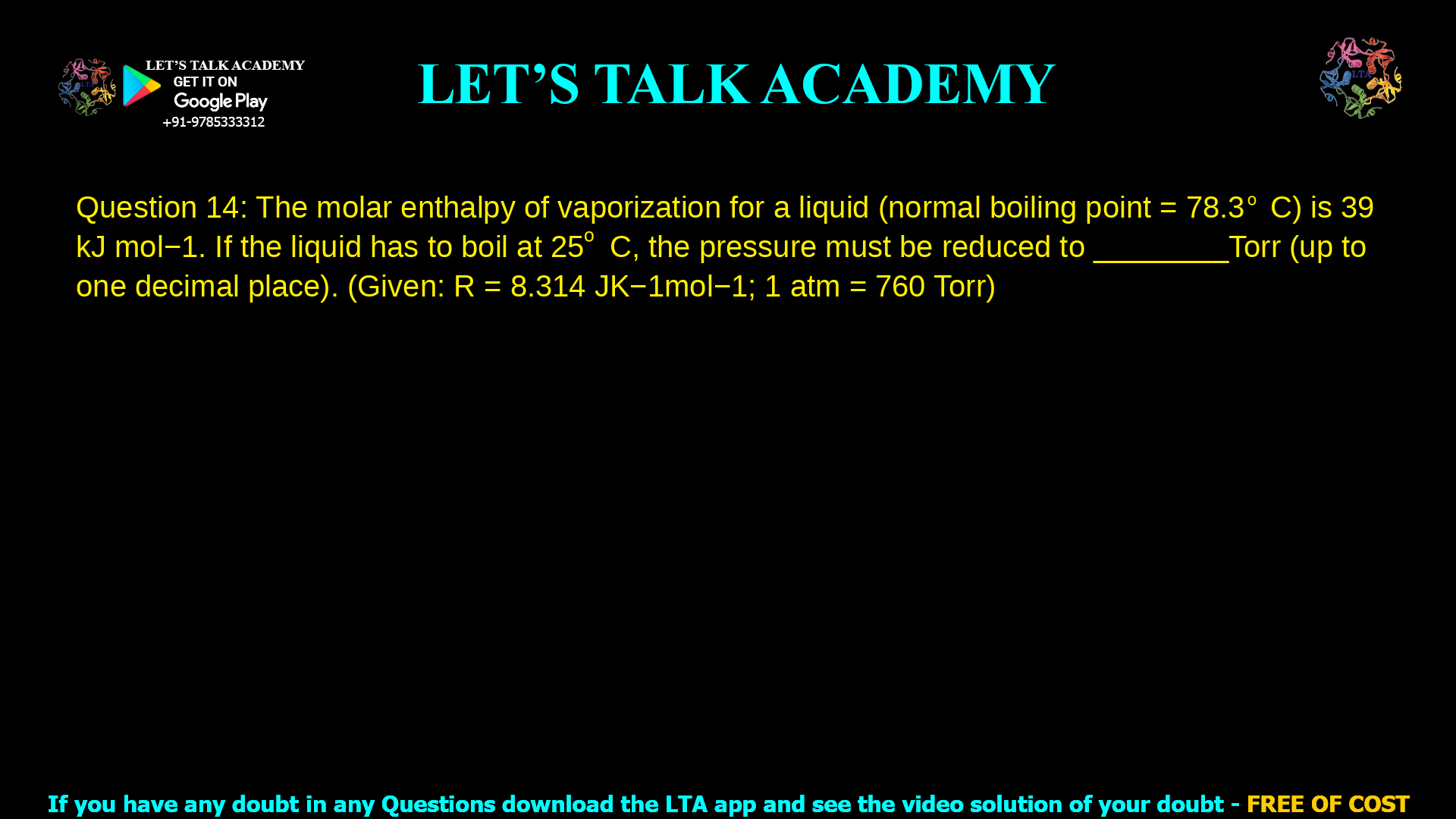
Q.14 The molar enthalpy of vaporization for a liquid (normal boiling point = 78.3 oC is 39 kJ mol−1. If the liquid has to boil at 25 oC, the pressure must be reduced to ________Torr (up to one decimal place).
(Given: R = 8.314 JK−1 mol−1; 1 atm = 760 Torr)
85.5 Torr. This value is obtained using the
Clausius–Clapeyron equation, which relates vapor pressure, temperature,
and molar enthalpy of vaporization.
Problem Breakdown
The liquid boils normally at 78.3°C (351.45 K) under
760 Torr, where its vapor pressure equals atmospheric pressure.
To make the liquid boil at a lower temperature of
25°C (298.15 K), the external pressure must be reduced.
Given data:
- Normal boiling point, T1 = 78.3°C = 351.45 K
- Required temperature, T2 = 25°C = 298.15 K
- Normal pressure, P1 = 760 Torr
- ΔHvap = 39 kJ/mol = 39,000 J/mol
- R = 8.314 J·K−1·mol−1
Step-by-Step Solution
The Clausius–Clapeyron equation is:
ln(P2/P1) =
−(ΔHvap/R)
(1/T2 − 1/T1)
Substitute known values:
- P1 = 760 Torr
- T1 = 351.45 K
- T2 = 298.15 K
Calculate temperature term:
1/T2 − 1/T1 =
0.003353 − 0.002846 =
0.000507 K−1
Calculate ΔHvap/R:
39,000 / 8.314 ≈ 4,690 K
Substitute into equation:
ln(P2/760) = −4,690 × 0.000507 ≈ −2.378
Exponentiating both sides:
P2/760 = e−2.378 ≈ 0.1125
Therefore:
P2 ≈ 85.5 Torr
Why This Approach Works
The Clausius–Clapeyron equation assumes constant ΔHvap and ideal gas behavior,
which is a valid approximation for many liquids near their boiling points.
Lower temperatures reduce vapor pressure exponentially, requiring a
vacuum (reduced pressure) to induce boiling.
For ethanol-like liquids with a normal boiling point near 78°C,
a pressure of approximately 85.5 Torr allows boiling at room temperature.
Common Mistakes in Exam Options
- Using °C instead of Kelvin: Leads to large numerical errors.
- Not converting kJ to J: Forgetting ×1000 gives unrealistically high pressures.
- Swapping T1 and T2: Predicts pressure greater than 760 Torr.
- Wrong gas constant: Using 0.0821 without unit conversion distorts results by ~10×.
When calculated correctly, the pressure required remains
85.5 Torr, accurate to one decimal place.


