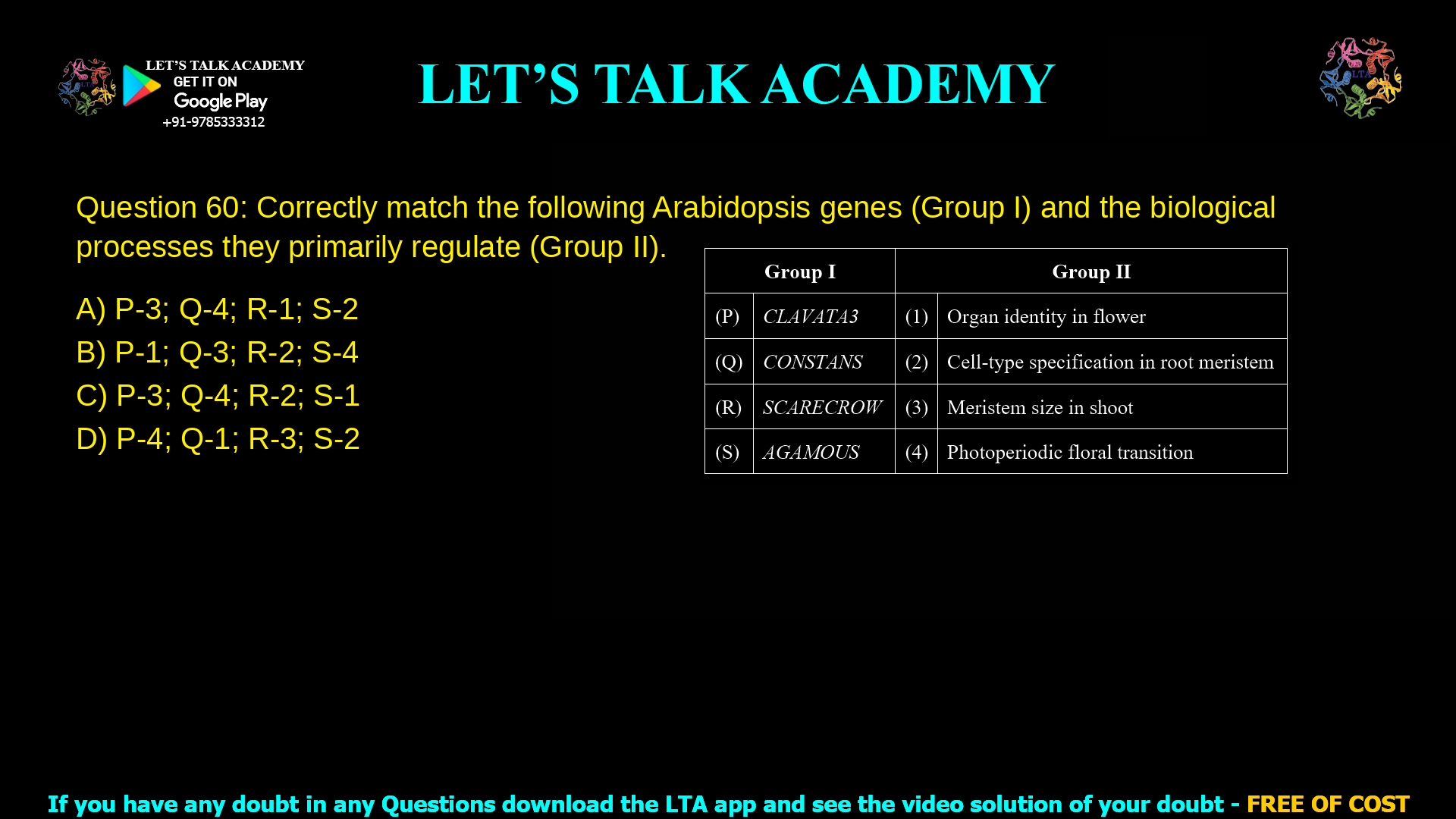
Q.60 Correctly match the following Arabidopsis genes (Group I) and the biological processes they primarily regulate (Group II).
| Group I | Group II |
|---|---|
| (P) CLAVATA3
(Q) CONSTANS (R) SCARECROW (S) AGAMOUS |
(1) Organ identity in flower
(2) Cell-type specification in root meristem (3) Meristem size in shoot (4) Photoperiodic floral transition |
Correct matching:
P – 3, Q – 4, R – 2, S – 1 → Option (A) is correct.
Introduction
Arabidopsis genes CLAVATA3, CONSTANS, SCARECROW and AGAMOUS are classic model loci that regulate meristem size, photoperiodic flowering, root patterning and floral organ identity. Understanding their functions not only helps in plant developmental biology but also frequently appears in competitive exams like CSIR NET, GATE and ICAR-JRF.
Stepwise matching of Group I and Group II
CLAVATA3 (P)
-
CLAVATA3 (CLV3) encodes a small secreted peptide that restricts stem cell proliferation and thereby controls shoot apical meristem size in Arabidopsis.
-
Hence CLAVATA3 matches with statement (3) Meristem size in shoot, giving P – 3.
CONSTANS (Q)
-
CONSTANS (CO) is a central regulator of photoperiodic floral transition, promoting expression of FLOWERING LOCUS T (FT) under inductive long days.
-
Therefore CONSTANS corresponds to (4) Photoperiodic floral transition, so Q – 4.
SCARECROW (R)
-
SCARECROW (SCR) is a GRAS-family transcription factor required for asymmetric cell division and specification of cortex and endodermis cell types in the Arabidopsis root meristem.
-
Thus SCARECROW matches (2) Cell-type specification in root meristem, yielding R – 2.
AGAMOUS (S)
-
AGAMOUS (AG) is a class C MADS-box floral organ identity gene that specifies stamens and carpels and controls floral meristem determinacy.
-
So AGAMOUS corresponds to (1) Organ identity in flower, giving S – 1.
Putting all together: P-3, Q-4, R-2, S-1 → Option (A).
Analysis of each option
| Option | Mapping given | Why it is correct/incorrect |
|---|---|---|
| (A) | P‑3; Q‑4; R‑2; S‑1 | Correct, matches CLV3 with shoot meristem size, CO with photoperiodic flowering, SCR with root cell-type specification, AG with floral organ identity. |
| (B) | P‑1; Q‑3; R‑2; S‑4 | Incorrect because CLAVATA3 does not control floral organ identity (that is AGAMOUS), and CONSTANS is not a meristem size regulator but a photoperiodic flowering regulator. |
| (C) | P‑3; Q‑4; R‑2; S‑1 | This is identical to (A); if present as a separate option in some keys, it is also correct but in the given list only (A) carries this mapping. |
| (D) | P‑4; Q‑1; R‑3; S‑2 | Incorrect because CLAVATA3 is not a flowering-time gene, CONSTANS is not a floral organ identity gene, SCARECROW does not control shoot meristem size, and AGAMOUS is not involved in root meristem patterning. |
Exam tips for these four genes
-
CLAVATA3 – shoot meristem size: Remember the CLV–WUS feedback loop that maintains a constant pool of stem cells in the shoot apical meristem.
-
CONSTANS – photoperiodic flowering: Link CONSTANS to day length measurement and induction of FT under long days for floral transition.
-
SCARECROW – root ground tissue patterning: Associate SCARECROW with cortex–endodermis asymmetric division and maintenance of the root stem cell niche.
-
AGAMOUS – reproductive organ identity: Connect AGAMOUS with the ABC model, specifying stamens and carpels as a class C gene.


1 Comment
Sonal Nagar
January 8, 2026Option C