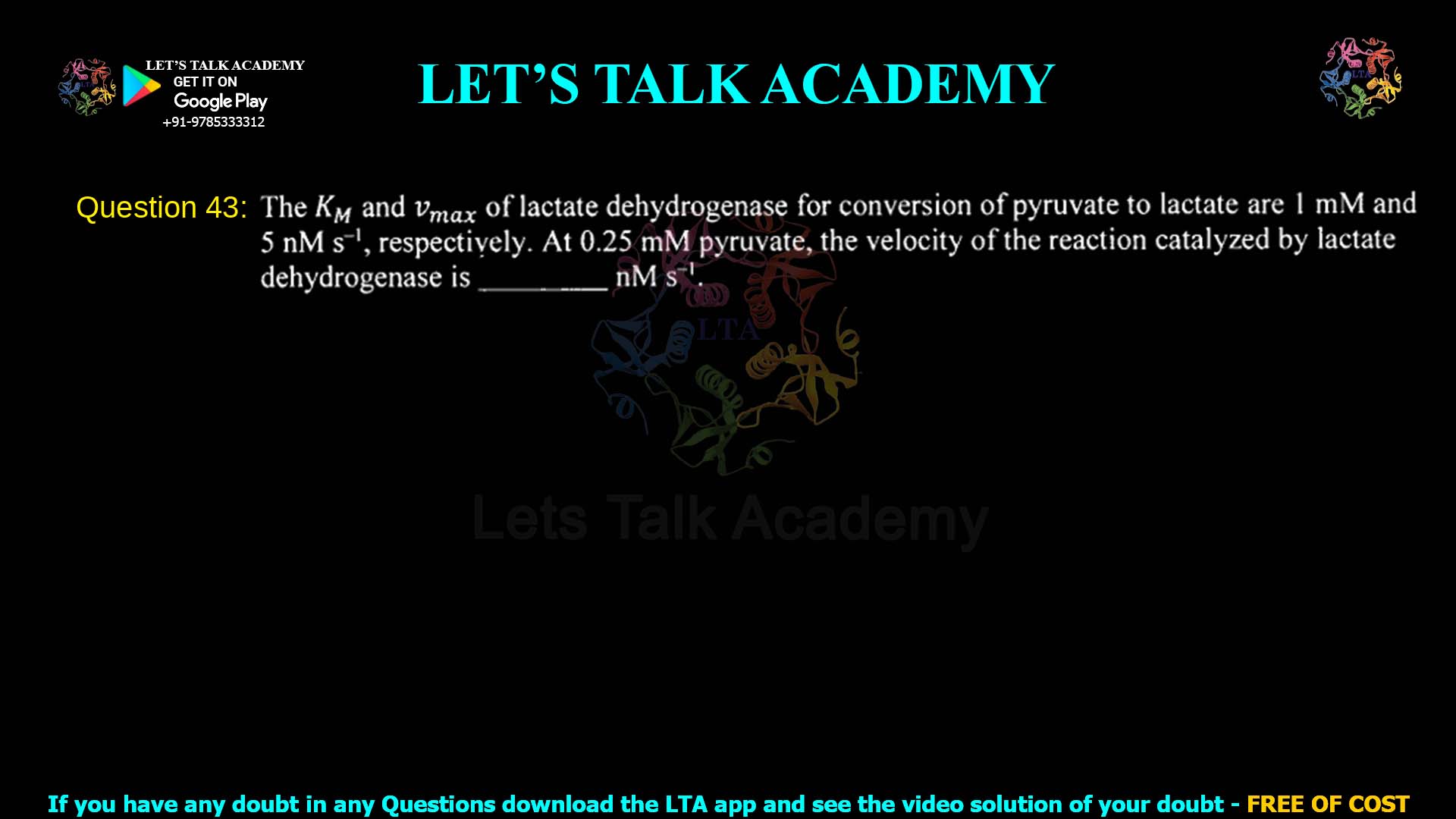
Q.43 The Kₘ and Vmax of lactate dehydrogenase for conversion of pyruvate to lactate are 1 mM and 5 pM s⁻¹, respectively. At 0.25 mM pyruvate, the velocity of the reaction catalyzed by lactate dehydrogenase is ______ pM s⁻¹.
Key Result: Using the Michaelis-Menten equation, the velocity of the reaction catalyzed by lactate dehydrogenase at 0.25 mM pyruvate is 1 nM s-1.
Problem Restatement
The question states that the Km and Vmax of lactate dehydrogenase for conversion of pyruvate to lactate are:
- Km = 1 mM
- Vmax = 5 nM s-1
At a substrate concentration of:
[S] = 0.25 mM pyruvate
We are asked to calculate the velocity (v) of the reaction catalyzed by lactate dehydrogenase in nM s-1.
Step-by-Step Solution (Michaelis-Menten)
For a simple enzyme obeying Michaelis-Menten kinetics, the initial velocity v is given by the Michaelis-Menten equation:
Substitute the Given Values
$$K_m = 1 \, \text{mM}$$
$$[S] = 0.25 \, \text{mM}$$
Final Answer: The velocity v = 1 nM s-1.
Multiple Choice Tip: Because only one numerical value can satisfy the Michaelis-Menten equation with the given parameters, any multiple-choice option equal to 1 nM s-1 would be the correct one.
Conceptual explanation (for “every option” style reasoning)
Typical CSIR‑NET style options for such a question might look like:
-
(A) 0.5 nM s⁻¹
-
(B) 1.0 nM s⁻¹
-
(C) 2.5 nM s⁻¹
-
(D) 5.0 nM s⁻¹
Even though the original image does not show the options clearly, the reasoning for each typical option is:
-
Option like 5.0 nM s⁻¹ (Vmax itself)
-
This would be correct only if [S] ≫ Km, where the enzyme is saturated and v ≈ Vmax.
-
Here [S] = 0.25 mM, which is less than Km (1 mM), so the enzyme is far from saturation, and velocity must be less than Vmax, not equal to it.
-
-
Option like 2.5 nM s⁻¹ (= 0.5 × Vmax)
-
v = Vmax/2 occurs when [S] = Km.
-
Here [S] = 0.25 mM, but Km = 1 mM, so [S] ≠ Km and v cannot be Vmax/2.
-
-
Option like 0.5 nM s⁻¹
-
This would correspond to a situation where [S] is much smaller relative to Km such that v ≈ (Vmax/Km)[S].
-
For [S] = 0.25 mM and Km = 1 mM, the exact calculation gives v = 1 nM s⁻¹, so 0.5 nM s⁻¹ is too low.
-
-
Option like 1.0 nM s⁻¹
-
This matches the exact result obtained from the Michaelis–Menten formula and is therefore the correct choice.
-
Thus, any option equal to 1 nM s⁻¹ correctly reflects the kinetics of lactate dehydrogenase at 0.25 mM pyruvate.
SEO‑optimized introduction
Solving a lactate dehydrogenase Km and Vmax problem is a common task in CSIR‑NET and other competitive exams on enzyme kinetics. Understanding how to apply the Michaelis–Menten equation to calculate reaction velocity at a defined pyruvate concentration, such as 0.25 mM, helps in mastering both theoretical and numerical questions in biochemistry.


