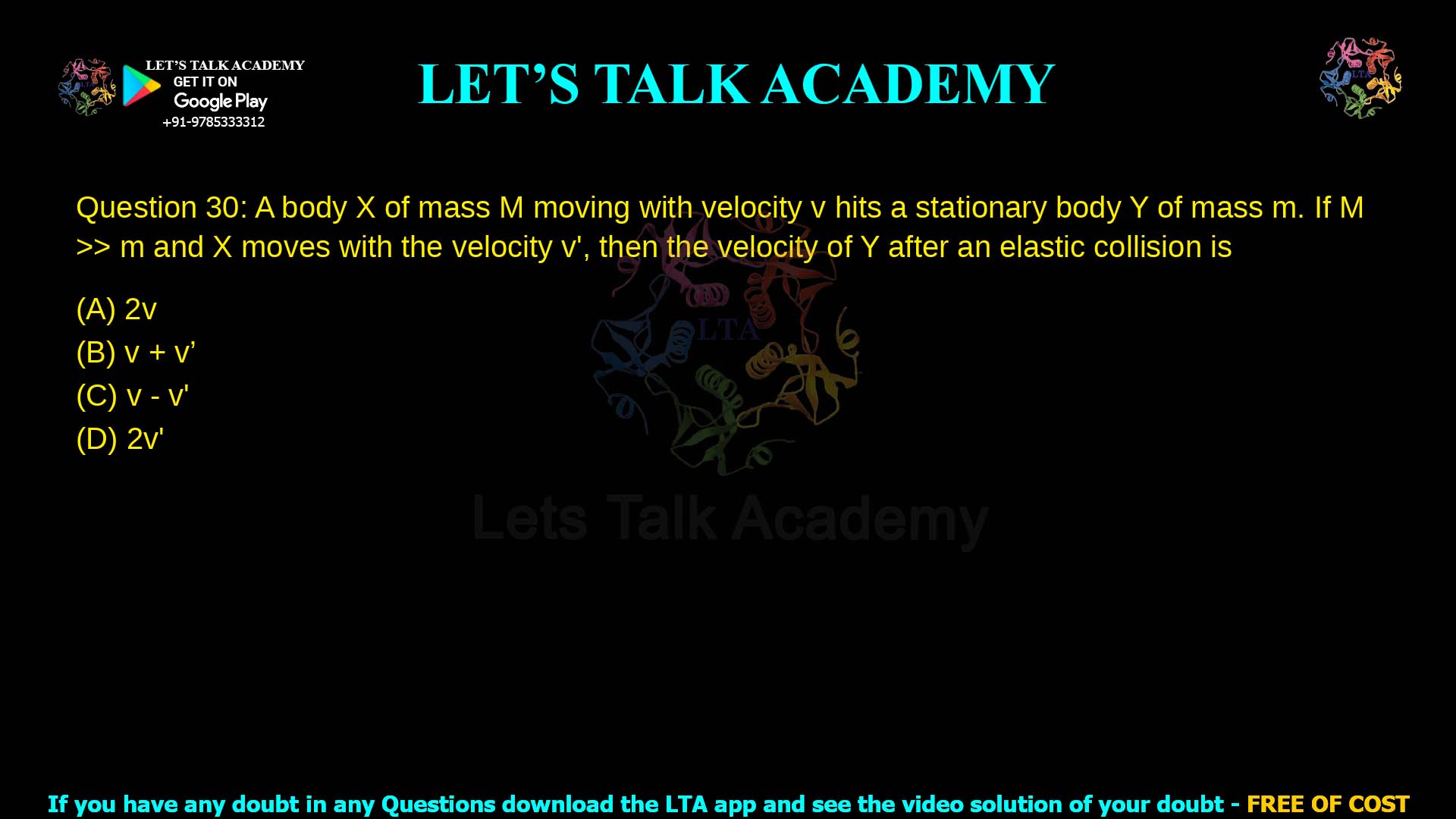
Q.30 A body X of mass M moving with velocity v hits a stationary body Y of mass m. If M≫m and X moves with the velocity v′, then the velocity of Y after an elastic collision is
(A) 2v
(B) v+v′
(C) v−v′
(D) 2v′
Problem Setup
A body XX of mass M moving with velocity v hits a stationary body YY of mass m, where M ≫ m. After collision, XX moves with velocity v’. Find the velocity of YY.
• Momentum: \(M v = M v’ + m v_y\)
• Kinetic Energy: \(\frac{1}{2} M v^2 = \frac{1}{2} M {v’}^2 + \frac{1}{2} m v_y^2\)
• Relative velocity reversal: \(v_y – v’ = v – 0 \implies v_y = v + v’\)
Detailed Solution
From conservation of momentum: \(Mv = Mv’ + m v_y \implies v_y = \frac{M(v-v’)}{m}\).
However, the most direct approach uses relative velocity reversal, which holds exactly for elastic collisions regardless of mass ratio: \(v_y = v + v’\).
When \(M \gg m\), the heavy mass behaves like a “moving wall,” doubling the light mass’s velocity relative to the wall’s speed.
Option Analysis
| Option | Expression | When Valid? | Why Wrong Here? |
|---|---|---|---|
| (A) | \(2v\) | \(v’ \approx v\) (heavy mass unchanged) | Ignores given \(v’\) |
| (B) | \(v + v’\) | General elastic collision | Correct[web:32] |
| (C) | \(v – v’\) | Heavy body’s speed loss | Not target velocity |
| (D) | \(2v’\) | N/A | No physical basis |
SEO Article Content
In elastic collisions where a heavy body of mass M (moving at velocity v) strikes a stationary light body of mass m (M ≫ m) and emerges with velocity v’, the light body’s post-collision velocity is v + v’. This scenario is crucial for competitive exams like JEE Main, NEET, and CSIR NET physics sections on momentum conservation.
Core Concept
Elastic collisions conserve both momentum and kinetic energy. The relative velocity reverses exactly: \(v_y = v + v’\). For \(M \gg m\), if \(v’ \approx v\), then \(v_y \approx 2v\).
Derivation Steps
- Momentum: \(Mv = Mv’ + m v_y \implies v_y = v + v’ – \frac{m}{M}(v-v’) \approx v + v’\) (since \(\frac{m}{M} \approx 0\))
- Relative velocity: Approach speed = Separation speed
Exam Practice Example
\(v_y = v + v’ = 10 + 9 = 19\) m/s
This elastic collision M >> m case appears frequently in entrance exams, emphasizing relative velocity over mass ratio approximations.


