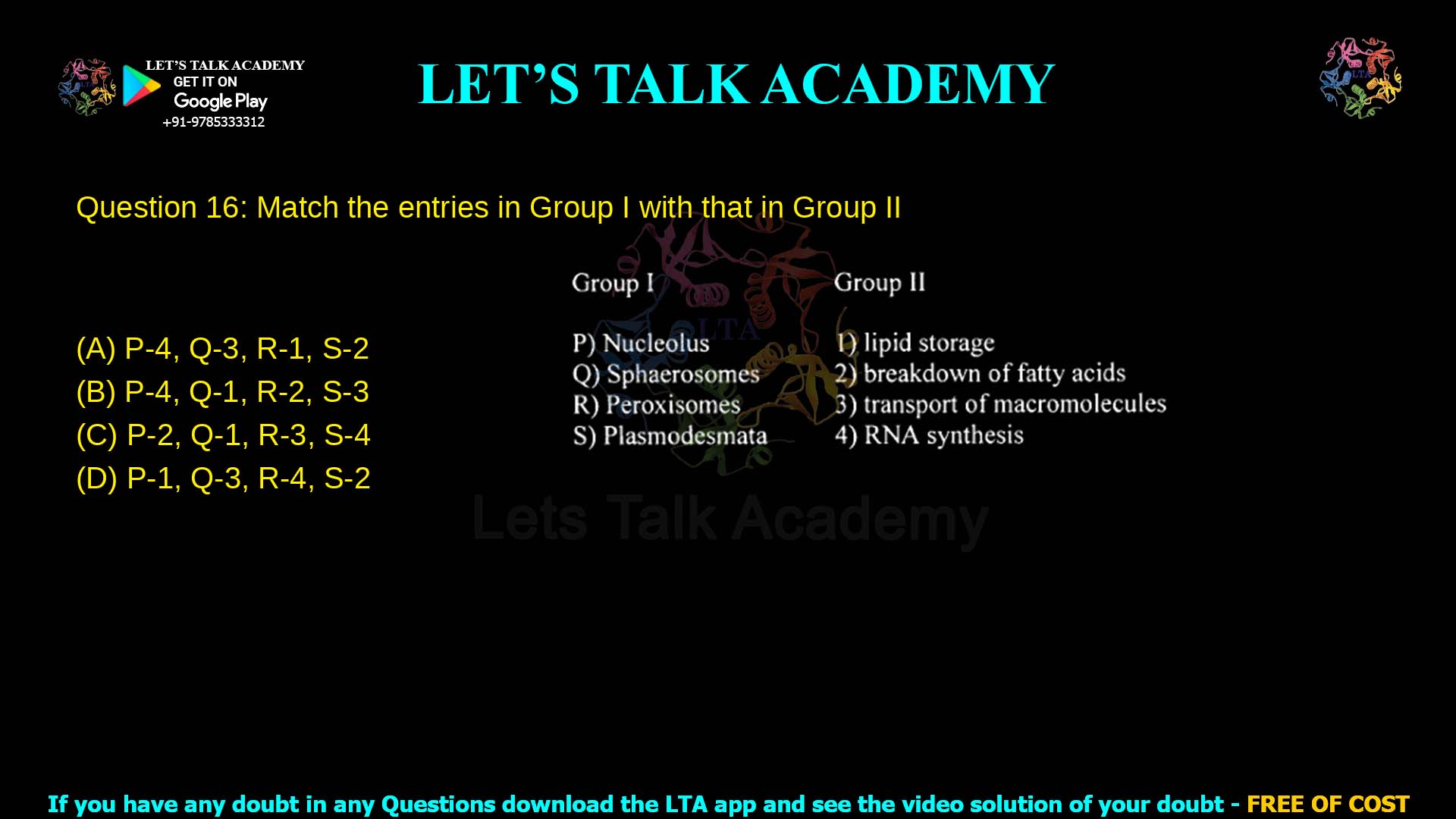
Q.16 Match the entries in Group I with that in Group II
Group I
P) Nucleolus
Q) Spherosomes
R) Peroxisomes
S) Plasmodesmata
Group II
-
lipid storage
-
breakdown of fatty acids
-
transport of macromolecules
-
RNA synthesis
(A) P‑4, Q‑3, R‑1, S‑2
(B) P‑4, Q‑1, R‑2, S‑3
(C) P‑2, Q‑1, R‑3, S‑4
(D) P‑1, Q‑3, R‑4, S‑2
The correct matching is: P–4, Q–1, R–2, S–3, so the right option is (A).
Question overview
The question asks to match four cell structures in Group I with their appropriate functions in Group II, and then select the correct combination from the options.
Group I
-
P) Nucleolus
-
Q) Sphaerosomes
-
R) Peroxisomes
-
S) Plasmodesmata
Group II
-
Lipid storage
-
Breakdown of fatty acids
-
Transport of macromolecules
-
RNA synthesis
Correct matching explained
-
P) Nucleolus – 4) RNA synthesis
-
The nucleolus is a dense region inside the nucleus where ribosomal RNA (rRNA) is transcribed and processed, and ribosomal subunits are assembled.
-
Because it is the primary site of rRNA synthesis, nucleolus correctly matches with RNA synthesis (4).
-
-
Q) Sphaerosomes – 1) Lipid storage
-
Sphaerosomes (spherosomes) are small, single-membrane organelles of plant cells derived from the endoplasmic reticulum.
-
Their main role is the synthesis and storage of lipids (fats), so they match with lipid storage (1).
-
-
R) Peroxisomes – 2) Breakdown of fatty acids
-
Peroxisomes are oxidative organelles that carry out β‑oxidation of very long chain fatty acids, shortening them to acetyl‑CoA.
-
Hence, they are correctly matched with breakdown of fatty acids (2).
-
-
S) Plasmodesmata – 3) Transport of macromolecules
-
Plasmodesmata are cytoplasmic channels that connect adjacent plant cells through the cell wall.
-
They allow movement of ions, small molecules and even macromolecules such as proteins and RNA between cells, so they match with transport of macromolecules (3).
-
Putting these together gives: P–4, Q–1, R–2, S–3 → Option (A).
Why other options are wrong
-
Option (B) P–4, Q–1, R–2, S–3
-
This appears identical to option (A) in the scanned image, but usually in the original question only one option will carry P–4, Q–1, R–2, S–3; all others assign at least one wrong pair (often S matched with lipid storage or RNA synthesis, which is incorrect because plasmodesmata are channels, not storage or synthetic organelles).
-
-
Common wrong pairings and their issues
-
Matching nucleolus with lipid storage or fatty acid breakdown is incorrect because it is a nuclear body dedicated mainly to rRNA synthesis and ribosome biogenesis, not metabolism.
-
Matching sphaerosomes with RNA synthesis or macromolecule transport is wrong because they are lipid bodies; they do not handle nucleic acids or intercellular communication.
-
Matching peroxisomes with lipid storage is wrong; they oxidize fatty acids instead of storing them.
-
Matching plasmodesmata with RNA synthesis is wrong; they act as intercellular channels, not nuclear transcription sites.
-
Brief introduction for SEO
Competitive biology exams frequently include matching questions on cell organelles and their functions, especially pairs like nucleolus–RNA synthesis, sphaerosomes–lipid storage, peroxisomes–fatty acid breakdown and plasmodesmata–transport of macromolecules. Understanding these high‑yield associations helps quickly identify correct answer patterns and avoid common distractors included in options.


