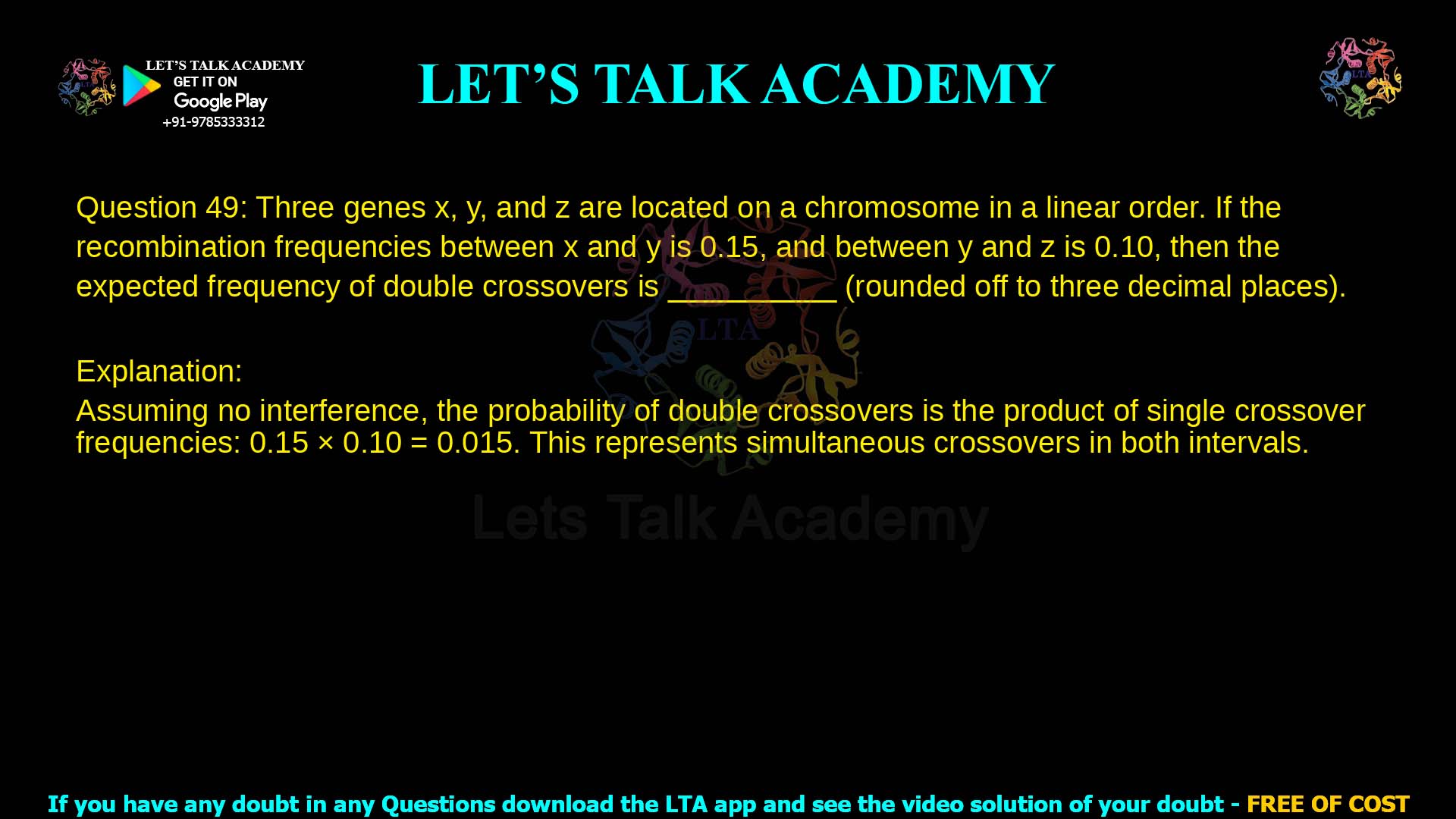
Q.49 Three genes x, y, and z are located on a chromosome in a linear order. If the
recombination frequencies between x and y is 0.15, and between y and z is 0.10,
then the expected frequency of double crossovers is __________ (rounded off to
three decimal places).
Expected Frequency of Double Crossovers for Genes x, y, z with Recombination Frequencies 0.15 and 0.10 is 0.015
Three genes x, y, and z lie in linear order on a chromosome, with recombination frequency between x and y at 0.15 and between y and z at 0.10. The expected frequency of double crossovers assumes independent crossover events in these intervals, calculated by multiplying the individual recombination frequencies: 0.15 × 0.10 = 0.015.
Calculation Method
Recombination frequencies represent single crossover probabilities between adjacent gene pairs. For double crossovers—one in x-y and one in y-z—the expected frequency equals the product of these probabilities under no interference conditions.
Rounded to three decimal places, 0.015 provides the precise answer for this CSIR NET-style genetics problem.
Option Analysis
This fill-in-the-blank question expects a numerical value (0.015), but common incorrect approaches yield alternatives:
-
0.150: Matches x-y frequency alone, ignoring y-z or double event requirement.
-
0.100: Matches y-z frequency alone, incomplete for doubles.
-
0.250: Sum of frequencies (0.15 + 0.10), relevant for total map distance but not doubles.
-
0.015: Correct product, standard for expected doubles without interference data.
In genetic linkage mapping, the expected frequency of double crossovers between three linearly arranged genes x, y, and z helps construct accurate chromosome maps, especially for CSIR NET Life Sciences preparation. With recombination frequency between x and y at 0.15 and y and z at 0.10, this article details the calculation, assumptions, and exam relevance.
Core Concept
Double crossovers occur when independent single crossovers happen in both intervals (x-y and y-z). The expected frequency multiplies these probabilities:
Expected DCO = RF(x-y) × RF(y-z) = 0.15 × 0.10 = 0.015 (or 1.5%).
This ignores interference, where one crossover reduces nearby chances—actual observed DCO often falls below expected.
Step-by-Step Solution
-
Identify intervals: x—y (0.15), y—z (0.10).
-
Assume independence: Probability of both = product.
-
Compute: 0.15 × 0.10 = 0.015.
-
Round to three decimals: 0.015.
Exam Relevance
CSIR NET questions test this for three-point crosses, distinguishing expected (product) from observed DCO used in coefficient of coincidence (observed/expected). Correct mastery aids gene order and map distance problems.


