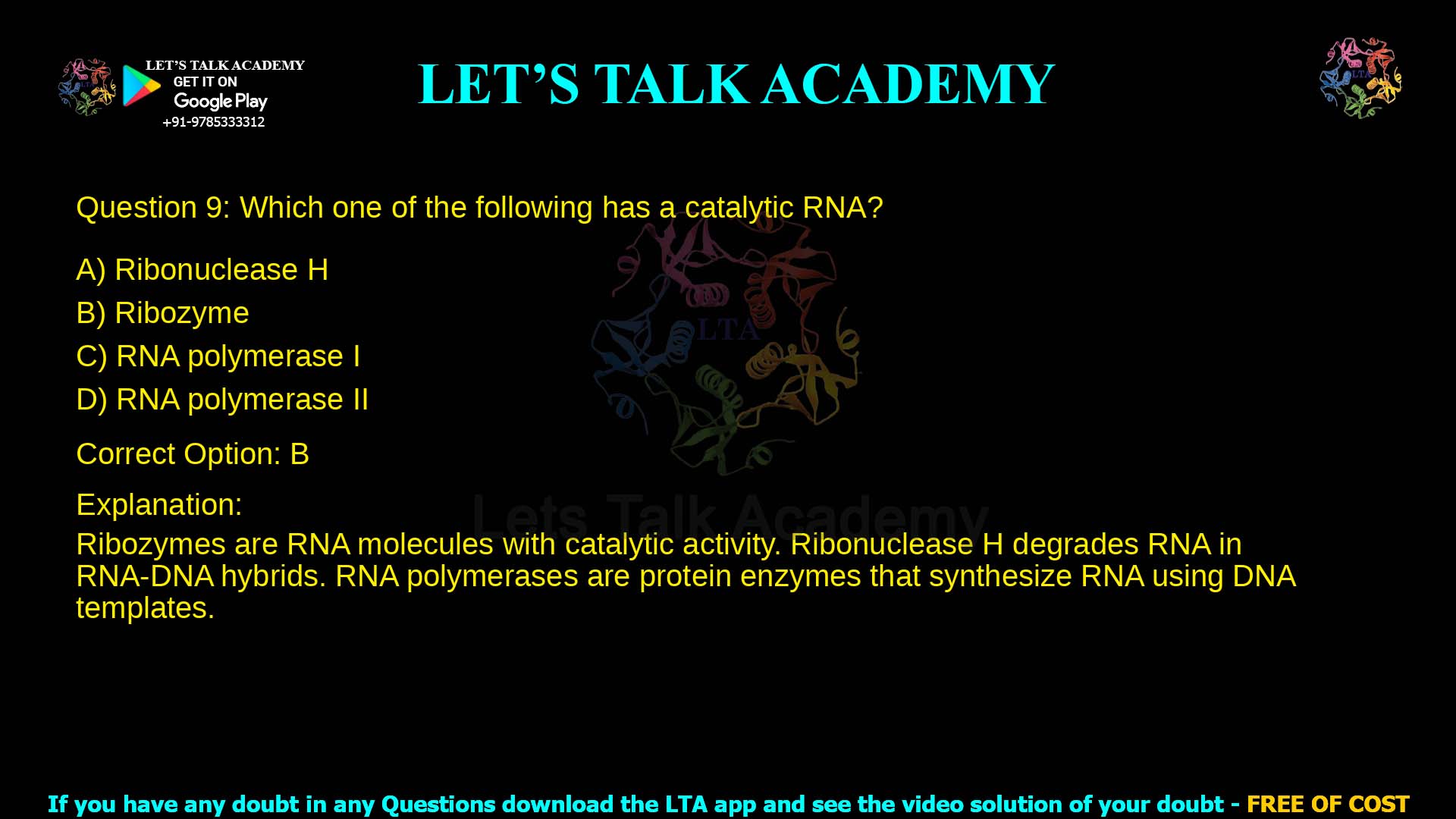
Q.9 Which one of the following has a catalytic RNA?
(A) Ribonuclease H
(B) Ribozyme
(C) RNA polymerase I
(D) RNA polymerase II
The correct answer is (B) Ribozyme.
Ribozyme is the RNA molecule that possesses catalytic activity, functioning like an enzyme to accelerate biochemical reactions such as RNA splicing and peptide bond formation in ribosomes.
Option Analysis
(A) Ribonuclease H
Ribonuclease H (RNase H) is a protein enzyme that cleaves RNA in RNA-DNA hybrids during DNA replication and repair, relying on a DEDD motif and metal ions like Mg²⁺ for catalysis. It does not involve catalytic RNA; the active site consists of amino acid residues in the protein structure.
(B) Ribozyme
Ribozymes are RNA molecules with enzymatic activity, catalyzing reactions like self-splicing of introns or phosphodiester bond hydrolysis through specific tertiary structures and often Mg²⁺ ions. Their discovery revolutionized biology by supporting the RNA world hypothesis, where RNA served both genetic and catalytic roles.
(C) RNA Polymerase I
RNA polymerase I (Pol I) is a multi-subunit protein complex that transcribes rRNA genes, with catalytic activity in its core subunits like RPA194, RPA135, and RPA12—all proteins. No RNA component performs catalysis in Pol I.
(D) RNA Polymerase II
RNA polymerase II (Pol II) synthesizes mRNA as a large protein complex with a catalytic core involving metal ions and specific residues like His1085 for nucleotide addition. Its mechanism follows two-metal-ion catalysis, but the active site is protein-based, not RNA.
Catalytic RNA, also known as ribozyme, represents a groundbreaking concept in molecular biology where RNA molecules act as enzymes. This phenomenon challenges the traditional protein-only view of catalysis and is crucial for CSIR NET Life Sciences aspirants studying molecular biology and biotechnology.
What is Catalytic RNA?
Catalytic RNA refers to ribozymes—RNA molecules that catalyze specific biochemical reactions, such as phosphodiester bond cleavage or ligation. Natural examples include the ribosome’s peptidyl transferase center (rRNA) and self-splicing introns, often requiring Mg²⁺ for activity.
Ribozyme vs. Other Options
-
Ribonuclease H: Protein enzyme degrading RNA in hybrids; no RNA catalysis.
-
RNA Polymerase I/II: Protein complexes for transcription; catalytic cores are polypeptide-based.
| Feature | Ribozyme (Catalytic RNA) | Ribonuclease H | RNA Pol I/II |
|---|---|---|---|
| Nature | RNA molecule | Protein | Protein complex |
| Catalytic Mechanism | RNA tertiary structure + Mg²⁺ | DEDD motif + metals | Two-metal-ion (protein active site) |
| Key Function | RNA splicing, peptide bonds | RNA/DNA hybrid cleavage | rRNA/mRNA synthesis |
Significance for CSIR NET
Understanding catalytic RNA supports the RNA world hypothesis and appears in questions on enzyme kinetics, ribosomes, and genetic engineering. Ribozymes enable applications in biotechnology, like RNA-based therapeutics. Focus on ribozyme as the direct answer for “which has catalytic RNA” in MCQs.


1 Comment
Vanshika Sharma
December 30, 2025ribozymes are RNA molecules with catalytic activity.