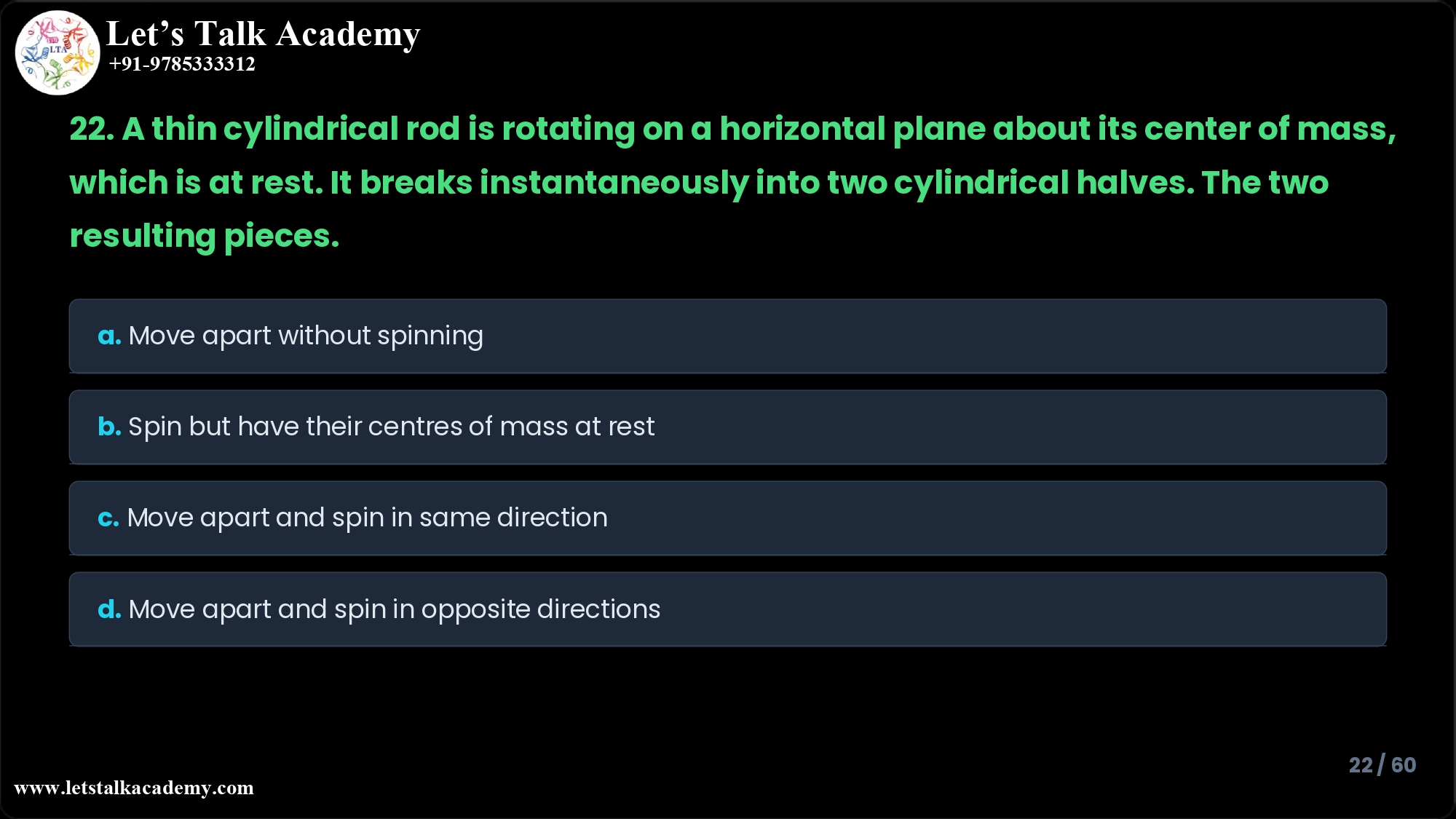
22. A thin cylindrical rod is rotating on a horizontal plane about its center of mass, which
is at rest. It breaks instantaneously into two cylindrical halves. The two resulting pieces
a. Move apart without spinning.
b. Spin but have their centres of mass at rest.
c. Move apart and spin in the same direction as the original rod.
d. Move apart and spin in opposite directions.
Rotating Rod Breaking into Two Halves
A thin cylindrical rod rotates on a horizontal plane about its stationary center of mass (CM)
and breaks instantly into two identical cylindrical halves.
The correct answer is option (d): Move apart and spin in opposite directions.
Core Physics Principles
No external forces act on the system, so the overall CM remains at rest after the break.
By linear momentum conservation, the two halves (each of mass m/2)
move in opposite directions with equal speeds v,
typically tangential to the original rotation.
Since no external torque acts about the original CM, total angular momentum is conserved.
Originally, the total angular momentum is
Iω = (1/12)mL2ω (directed along the z-axis).
Option Analysis
- (a) Move apart without spinning: Incorrect. Each half retains rotational motion
from the original velocity distribution; pure translation would violate angular momentum conservation. - (b) Spin but have their centres of mass at rest: Incorrect.
The halves acquire linear velocities at their CMs (originally at ±L/4), causing separation;
their CMs cannot remain fixed. - (c) Move apart and spin in the same direction as the original rod: Incorrect.
A symmetric break requires opposite spins to preserve the overall angular momentum vector;
same-direction spin would result in a mismatch of total L. - (d) Move apart and spin in opposite directions: Correct.
The right half’s CM moves outward with tangential
v = ω(L/4);
its orbital angular momentum
(m/2)(L/4)v aligns with the original,
while its spin ω′ opposes it.
The left half behaves symmetrically in the opposite sense.
Total angular momentum becomes:
2 [ (1/12)(m/2)(L/2)2ω′ + (m/2)(L/4)2ω ] = (1/12)mL2ω,
which remains consistent with angular momentum conservation.


