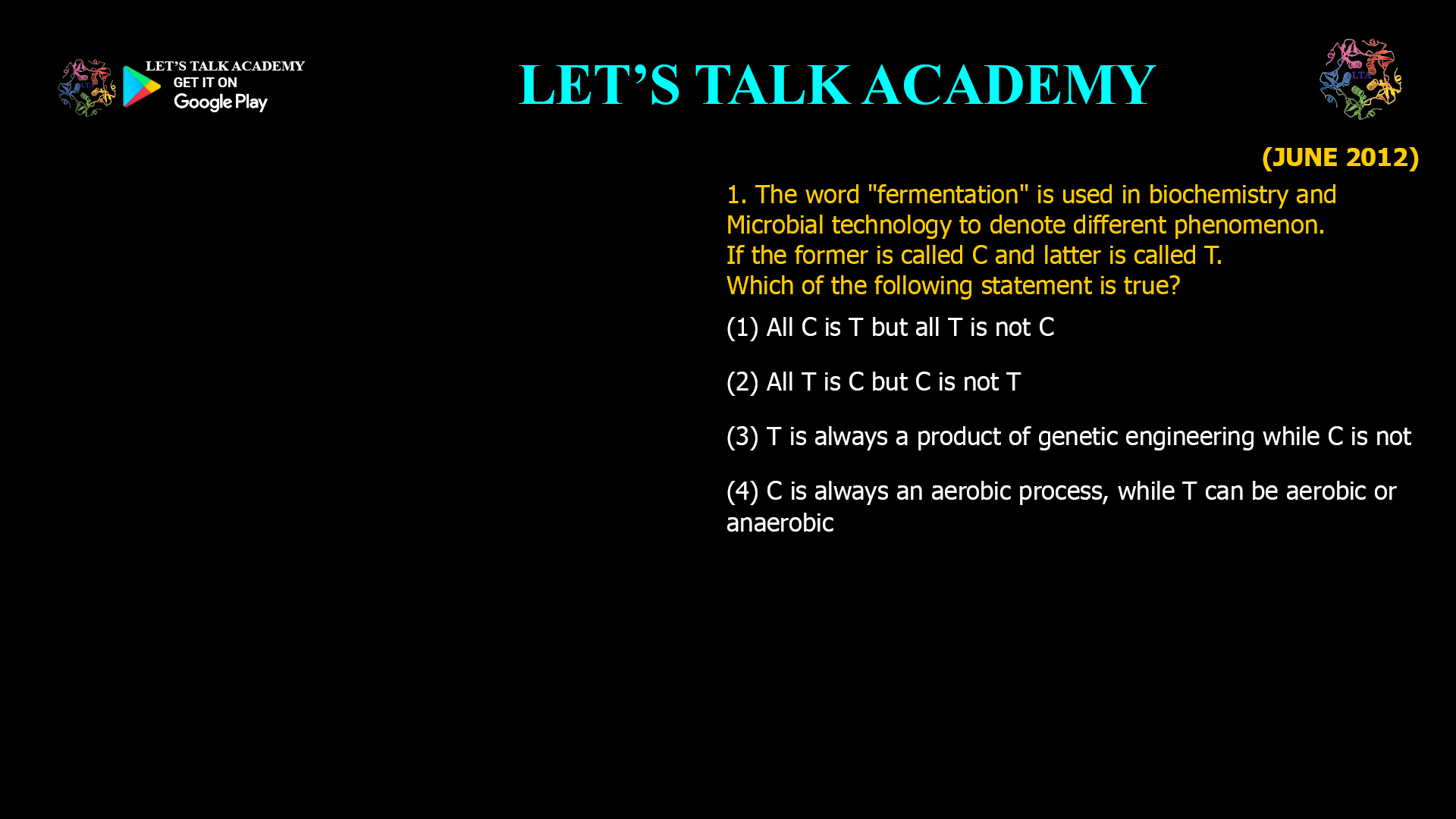
- The word “fermentation” is used in biochemistry and Microbial technology to denote different phenomenon. If the former is called C and latter is called T. Which of the following statement is true?
(1) All C is T but all T is not C
(2) All T is C but C is not T
(3) T is always a product of genetic engineering while C is not
(4) C is always an aerobic process, while T can be aerobic or anaerobicCorrect answer: (2) All T is C but C is not T
Here,
-
C = “fermentation” in biochemistry → an anaerobic metabolic pathway where organic compounds (like sugars) are partially oxidized to generate ATP without using oxygen as terminal electron acceptor.
-
T = “fermentation” in microbial technology → any large-scale microbial cultivation process in bioreactors to produce products (antibiotics, enzymes, organic acids, etc.), which can be aerobic or anaerobic.
So:
-
Every T is a kind of fermentation in the biochemical sense (it relies on microbial metabolic pathways called fermentation or related energy-yielding processes).
-
But not every biochemical fermentation (C) is a full technological, industrial “fermentation process” (T) in a bioreactor context.
Why each option:
-
All C is T but all T is not C – Wrong. Many biochemical fermentations (e.g., yeast fermentation in a rotting fruit) are not industrial/technological processes. So all C is not T.
-
All T is C but C is not T – Correct. Every technological fermentation relies on underlying biochemical fermentation pathways, but biochemical fermentation can occur outside controlled industrial setups.
-
T is always a product of genetic engineering while C is not – Wrong. Traditional fermentations (beer, wine, yogurt, antibiotics) existed long before genetic engineering; GE is optional, not defining.
-
C is always an aerobic process, while T can be aerobic or anaerobic – Wrong. Biochemical “fermentation” is classically defined as anaerobic; calling it “always aerobic” is the opposite of correct.
-