
3. Column X lists evolutionary ideas and scientists who proposed them, and Column Y lists the description of these ideas.
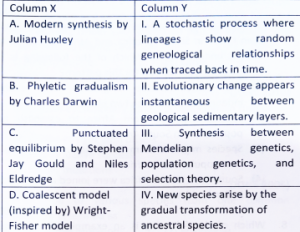
Which one of the following options represents all correct matches between Column X and Column Y?
(1) A-iii, B-iv, C-ii, D-l (2) A- i, B-ii, C-iv, D-iii
(3) A-ii, B-iv, C-iii, D-l (4) A-iv, B-i, C-ii, D-iii
Introduction
Understanding evolution requires not only grasping the mechanisms but also knowing the scientists who proposed them and the precise descriptions of their ideas. In exams and competitive tests, you may encounter questions where you must match evolutionary ideas and their proponents (Column X) with the correct descriptions (Column Y). This article provides a clear, detailed guide to help you make all the correct matches, ensuring conceptual clarity and academic success.
The Major Evolutionary Ideas and Their Proponents
Let’s start by reviewing the most influential evolutionary mechanisms and the scientists associated with them:
| Scientist/Idea | Description (Concept) |
|---|---|
| Charles Darwin | Natural selection as the main mechanism of evolution |
| Alfred Russel Wallace | Co-proposed natural selection alongside Darwin |
| Motoo Kimura | Neutral theory of molecular evolution |
| Evolutionary Developmental Biology (Evo-Devo) | Changes in body plans through gene regulation |
Descriptions of Key Evolutionary Mechanisms
1. Natural Selection (Darwin & Wallace)
Natural selection is the process by which organisms with traits better suited to their environment tend to survive and reproduce more successfully. Over generations, these advantageous traits become more common within the population, driving evolutionary change.
2. Neutral Theory of Molecular Evolution (Kimura)
Motoo Kimura proposed that most evolutionary changes at the molecular level are caused by random genetic drift of mutant alleles that are selectively neutral, rather than by natural selection. This theory emphasizes the role of chance in molecular evolution.
3. Evolutionary Developmental Biology (Evo-Devo)
Evo-Devo explores how changes in the regulation of developmental genes can lead to significant changes in body plans and the emergence of new traits. This field explains macroevolutionary changes by focusing on how gene expression during development affects morphology.
4. Genetic Drift
Genetic drift refers to random changes in allele frequencies within a population, especially significant in small populations. It can lead to evolutionary change independent of natural selection.
Matching Column X (Ideas/Scientists) with Column Y (Descriptions)
Given the typical structure of such questions, here’s how the correct matches generally align:
| Column X (Idea/Scientist) | Column Y (Description) |
|---|---|
| A. Darwin/Wallace – Natural Selection | iii. Differential survival and reproduction of individuals leads to adaptation |
| B. Kimura – Neutral Theory | iv. Most molecular variation is selectively neutral; genetic drift is key |
| C. Evo-Devo | ii. Major changes in body plans arise from changes in developmental gene regulation |
| D. Genetic Drift | i. Random fluctuations in allele frequencies, especially in small populations |
This matching corresponds to the following option:
(1) A-iii, B-iv, C-ii, D-i
Why These Matches Are Correct
-
Darwin and Wallace are both credited with the concept of natural selection, which is about differential survival and reproduction.
-
Kimura’s neutral theory focuses on the idea that most molecular changes are not driven by selection but by random drift of neutral mutations.
-
Evo-Devo explains how changes in developmental gene regulation can lead to new body plans and major evolutionary innovations.
-
Genetic drift is all about random changes in gene frequencies, particularly in small populations, and is distinct from natural selection.
The Importance of Understanding These Mechanisms
Recognizing the correct scientist and description for each evolutionary mechanism is crucial for several reasons:
-
It clarifies the historical development of evolutionary theory.
-
It helps in understanding the mechanistic diversity within evolutionary biology.
-
It prepares students for competitive exams and university assessments.
-
It fosters appreciation for the complexity and beauty of evolutionary processes.
Common Pitfalls and How to Avoid Them
-
Confusing natural selection and genetic drift: Remember, natural selection is adaptive, while genetic drift is random.
-
Mixing up Evo-Devo and molecular evolution: Evo-Devo is about gene regulation during development, not just molecular changes.
-
Overlooking the role of chance: Both genetic drift and Kimura’s neutral theory emphasize randomness, but at different biological scales.
Conclusion
Matching evolutionary ideas and their proponents with the correct descriptions is a foundational skill in biology. The correct answer for the given options is:
(1) A-iii, B-iv, C-ii, D-i
By understanding both the scientists and the mechanisms they proposed, you gain a deeper appreciation for the dynamic and multifaceted nature of evolution.
SEO-Friendly Slugs:
-
evolutionary-ideas-scientists-matching-guide
-
match-evolutionary-theories-descriptions
-
evolutionary-mechanisms-key-scientists
-
biology-exam-evolution-matching
-
understanding-evolutionary-proponents
This comprehensive guide ensures you can confidently match evolutionary ideas, scientists, and their descriptions—an essential step in mastering evolutionary biology.


1 Comment
Manisha choudhary
October 2, 20251st option is correct answer