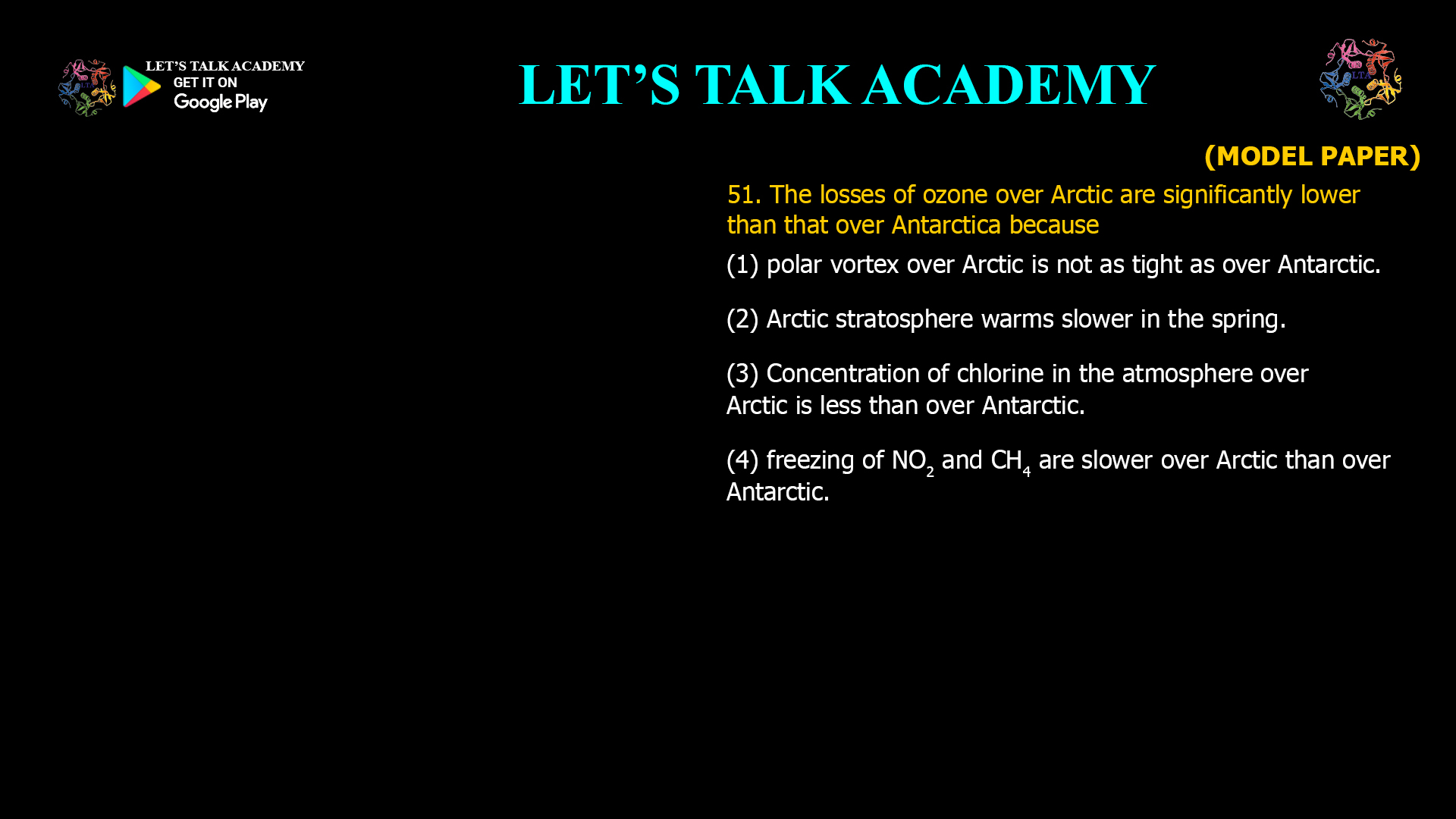
- The losses of ozone over Arctic are significantly lower than that over Antarctica because
(1) polar vortex over Arctic is not as tight as over Antarctic.
(2) Arctic stratosphere warms slower in the spring.
(3) Concentration of chlorine in the atmosphere over Arctic is less than over Antarctic.
(4) freezing of NO2and CH4are slower over Arctic than over Antarctic.
The Basics of Polar Ozone Depletion
Ozone depletion at the poles is driven by a combination of human-made chemicals (especially chlorofluorocarbons, or CFCs) and unique meteorological conditions. When chlorine and bromine from these chemicals are released in the stratosphere, they react on the surfaces of polar stratospheric clouds (PSCs), which form at extremely low temperatures. These reactions convert chlorine into forms that rapidly destroy ozone when sunlight returns in spring.
Comparing Arctic and Antarctic Conditions
1. The Polar Vortex and Its Strength
-
Antarctic Polar Vortex:
-
The Antarctic continent is surrounded by ocean, creating a highly symmetrical and stable atmospheric circulation pattern.
-
This leads to a very strong, tight, and persistent polar vortex—a swirling mass of cold air that isolates the Antarctic stratosphere in winter and early spring.
-
The tight vortex traps air inside, allowing temperatures to drop extremely low and remain cold for long periods, promoting the formation of PSCs and efficient ozone destruction.
-
-
Arctic Polar Vortex:
-
The Arctic region consists of ocean surrounded by land, resulting in a less symmetrical and more variable atmospheric circulation.
-
The Arctic polar vortex is generally weaker, less stable, and more prone to disturbances from weather systems.
-
As a result, the Arctic stratosphere warms up more quickly in spring, and the vortex is less effective at maintaining the cold temperatures needed for extensive PSC formation and ozone loss.
-
2. Stratospheric Temperatures and PSC Formation
-
Antarctica:
-
The stratosphere over Antarctica becomes extremely cold (often below −80°C) and remains so for many weeks.
-
These conditions allow for the widespread formation of PSCs, which are essential for converting chlorine into ozone-destroying forms.
-
-
Arctic:
-
The Arctic stratosphere is generally warmer and more variable.
-
While cold enough for PSC formation in some years, the temperatures are not as persistently low, and PSCs are less common and less widespread.
-
This results in less efficient activation of chlorine and lower ozone loss.
-
3. Chlorine and Bromine Concentrations
-
Global Distribution:
-
CFCs and other ozone-depleting substances are well-mixed throughout the global atmosphere.
-
The concentrations of chlorine and bromine are similar over both poles, so this is not the main reason for the difference in ozone loss.
-
-
Chemical Activation:
-
The key factor is not the total amount of chlorine but how much is converted into active, ozone-destroying forms.
-
This conversion depends on the presence of PSCs, which are more common and persistent in Antarctica.
-
4. Nitrogen and Methane Chemistry
-
Role of Nitrogen Oxides (NO₂) and Methane (CH₄):
-
Nitrogen oxides (NOₓ) and methane can react with chlorine, reducing its effectiveness in destroying ozone.
-
In the Arctic, the stratosphere is generally warmer, and less nitrogen is removed by PSCs, so more chlorine is “tied up” in less harmful forms.
-
In Antarctica, extremely low temperatures cause more nitrogen to be removed from the air (by forming nitric acid trihydrate in PSCs), leaving chlorine free to destroy ozone.
-
However, the question of “freezing of NO₂ and CH₄” is not the primary driver; rather, it is the removal of nitrogen species that matters.
-
Evaluating the Options
Let’s review the options in the context of the above explanations:
-
(1) Polar vortex over Arctic is not as tight as over Antarctic.
-
Correct. The Arctic polar vortex is weaker and less persistent, leading to less isolation, higher temperatures, and less PSC formation.
-
-
(2) Arctic stratosphere warms slower in the spring.
-
Incorrect. The Arctic stratosphere actually warms up more quickly in spring due to the weaker vortex and more variable weather.
-
-
(3) Concentration of chlorine in the atmosphere over Arctic is less than over Antarctic.
-
Incorrect. Chlorine concentrations are similar over both poles due to global mixing of CFCs.
-
-
(4) Freezing of NO₂ and CH₄ are slower over Arctic than over Antarctic.
-
Incorrect. It is not the freezing of NO₂ and CH₄ that matters, but the removal of nitrogen species (as nitric acid) in PSCs, which is more efficient in Antarctica.
-
Why the Polar Vortex Is Key
The strength and persistence of the polar vortex are the main reasons for the difference in ozone loss between the Arctic and Antarctic. The tight, stable vortex over Antarctica allows for prolonged cold temperatures and extensive PSC formation, leading to efficient activation of chlorine and severe ozone depletion. In contrast, the weaker, more variable Arctic vortex results in less persistent cold, fewer PSCs, and less ozone loss.
Broader Implications
Understanding these differences is important for predicting future ozone depletion and evaluating the effectiveness of international agreements like the Montreal Protocol. While the Antarctic ozone hole is expected to recover slowly as CFC concentrations decline, the risk of severe Arctic ozone loss remains low due to the inherently less favorable conditions.
Key Takeaways
-
The Antarctic polar vortex is stronger, more stable, and more persistent than the Arctic vortex.
-
This leads to colder, more prolonged stratospheric temperatures in Antarctica, promoting extensive PSC formation and efficient chlorine activation.
-
Chlorine concentrations are similar over both poles, so this is not the main reason for the difference in ozone loss.
-
The Arctic stratosphere warms up more quickly in spring, not more slowly.
-
The correct explanation is that the polar vortex over the Arctic is not as tight as over Antarctica.
Summary Table
| Factor | Antarctica | Arctic |
|---|---|---|
| Polar Vortex | Strong, tight, persistent | Weaker, less stable, variable |
| Stratospheric Temperatures | Very cold, persistent | Warmer, more variable |
| PSC Formation | Extensive, long-lasting | Less common, less persistent |
| Chlorine Activation | Efficient | Less efficient |
| Ozone Loss | Severe (“ozone hole”) | Much less severe |
Conclusion
The primary reason ozone losses over the Arctic are significantly lower than over Antarctica is that the polar vortex over the Arctic is not as tight or persistent as over Antarctica. This leads to less persistent cold, fewer polar stratospheric clouds, and less efficient activation of chlorine, resulting in lower ozone depletion in the Arctic.
In summary, the correct answer is:
(1) Polar vortex over Arctic is not as tight as over Antarctic.


3 Comments
Kirti Agarwal
November 7, 2025Opt 1
Kajal
November 15, 2025Due to polar vortex
Sakshi Kanwar
November 28, 2025Polar vortex over Arctic is not as tight as over Antarctic.