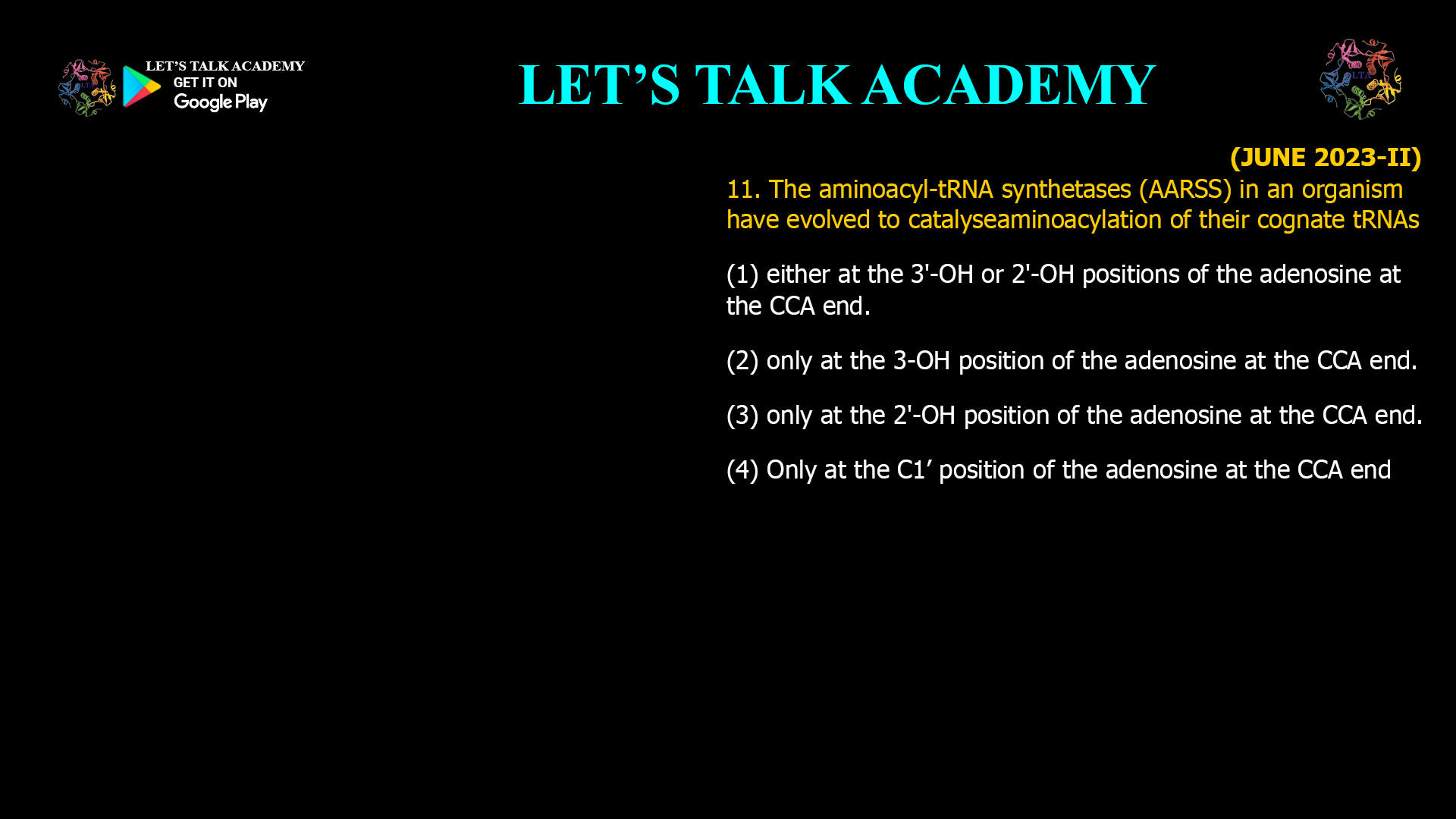
- The aminoacyl-tRNAsynthetases (AARSS) in an organism have evolved to catalyseaminoacylation of their cognate tRNAs
(1) either at the 3′-OH or 2′-OH positions of the adenosine at the CCA end.
(2) only at the 3-OH position of the adenosine at the CCA end.
(3) only at the 2′-OH position of the adenosine at the CCA end.
(4) Only at the C1’ position of the adenosine at the CCA endAminoacylation of tRNA by Aminoacyl-tRNA Synthetases: Site of Attachment on the tRNA Molecule
Aminoacyl-tRNA synthetases (aaRSs) are essential enzymes that catalyze the attachment of amino acids to their corresponding tRNAs, a process known as aminoacylation or tRNA charging. This reaction is critical for accurate translation of the genetic code into proteins.
Site of Amino Acid Attachment on tRNA
-
The amino acid is covalently attached to the adenosine nucleotide at the 3′ end (CCA tail) of the tRNA molecule.
-
Specifically, the amino acid can be linked to either the 2′-OH or the 3′-OH group of the ribose sugar of the terminal adenosine (A76) at the CCA end.
-
Different aminoacyl-tRNA synthetases may catalyze the attachment at either the 2′-OH or 3′-OH, but the amino acid is ultimately transferred to the 3′-OH before delivery to the ribosome for protein synthesis.
-
This flexibility in the site of attachment is intrinsic to the enzyme-tRNA interaction and does not affect the functionality of the charged tRNA.
Mechanism Summary
-
The aaRS first activates the amino acid by forming an aminoacyl-adenylate intermediate (aminoacyl-AMP) using ATP.
-
The activated amino acid is then transferred to the tRNA’s terminal adenosine at either the 2′-OH or 3′-OH position.
-
The charged tRNA (aminoacyl-tRNA) is released and ready for participation in translation.
Why Other Options Are Incorrect
-
Attachment only at the 3′-OH (Option 2) or only at the 2′-OH (Option 3) is not universally true since both positions can be used depending on the synthetase.
-
Attachment at the C1′ position of the adenosine (Option 4) is chemically implausible and not observed in aminoacylation.
Correct Answer
(1) either at the 3′-OH or 2′-OH positions of the adenosine at the CCA end
Keywords for SEO Optimization
-
Aminoacyl-tRNA synthetase mechanism
-
tRNA aminoacylation site
-
2′-OH vs 3′-OH amino acid attachment
-
tRNA charging process
-
Protein translation initiation
-
Amino acid activation and transfer
-
Role of CCA tail in tRNA
-
ATP-dependent aminoacylation
-
Ribose hydroxyl groups in tRNA
-
Translation fidelity
Conclusion
Aminoacyl-tRNA synthetases have evolved to catalyze the attachment of amino acids to their cognate tRNAs at either the 2′-OH or 3′-OH position of the terminal adenosine (A76) at the CCA end of the tRNA molecule. This flexibility is a fundamental aspect of the aminoacylation process, enabling efficient and accurate translation.
Correct answer: (1) either at the 3′-OH or 2′-OH positions of the adenosine at the CCA end
-


10 Comments
Kirti Agarwal
November 1, 2025AARSS enzyme binds with 2’oH and 3’OH both
Pooja
November 3, 2025either at the 3′-OH or 2′-OH positions of the adenosine at the CCA end
Sakshi yadav
November 3, 2025either at the 3′-OH or 2′-OH positions of the adenosine at the CCA end
Neha Yadav
November 3, 2025Either at the 3′-OH or 2′-OH positions of the adenosine at the CCA end
Kajal
November 4, 2025Correct answer is (1) either at the 3′-OH or 2′-OH positions of the adenosine at the CCA end
anjani sharma
November 4, 2025Either at the 3′-OH or 2′-OH positions of the adenosine at the CCA end.
Answer 1
Dipti Sharma
November 4, 2025Correct answer is (1) either at the 3′-OH or 2′-OH positions of the adenosine at the CCA end.
Heena Mahlawat
November 5, 2025Either at 3′ OH or 2’OH position
Mohd juber Ali
November 7, 2025Aminocylation means charging of trna
Acceptor codon :- pairing 3’ end Adenosin Conserved at (CCA) end
Option 1 ) is right 3’oh or 2’ position
Sakshi Kanwar
December 6, 2025Option 1