Altruism describes a behaviour performed by animals that may be disadvantageous to self while benefitting others. Which one of the following statements is INCORRECT about altruism? (1) It is the […]

No posts found.
Altruism describes a behaviour performed by animals that may be disadvantageous to self while benefitting others. Which one of the following statements is INCORRECT about altruism? (1) It is the […]

Individual A performs to another individual a behavioral act which has a fitness consequence. Match the behavioral acts (a to e) with the correct fitness consequence (i) to (iv) (1) […]

In hymenoptera insects, males are haploid and females are diploid. All fertilized eggs give rise to female and unfertilized eggs give rise to males. As a result, if a female […]

The development of advanced social behavior is related to (1) Complex Brain size (2) Genetic relatedness (3) Size of population (4) Size of organism What Drives Advanced Social Behavior? […]
Ants and bees social structure include queen, sterile female workers and soldier drones. This is best example of (1) Eusociality (2) Sub-social (3) Group selection (4) Altruism What Is […]
In honey bee males are developed parthenogenetically while workers are developed as sexual reproduction. The workers exhibits more similarity among themselves as compare to queen. If workers starts giving organisms […]
In honey bee queen and workers are diploid while male are haploid. If a queen honey bee is fertilized with equal number of sperms from two different males, then genetic […]
Honey bee shares more its genes with sister (75%) as compare to its daughter (50%) due to (1) Eusocialbilty (2) Kin selection (3) Haploidy diploidy sex determination system (4) Parthenogensis […]
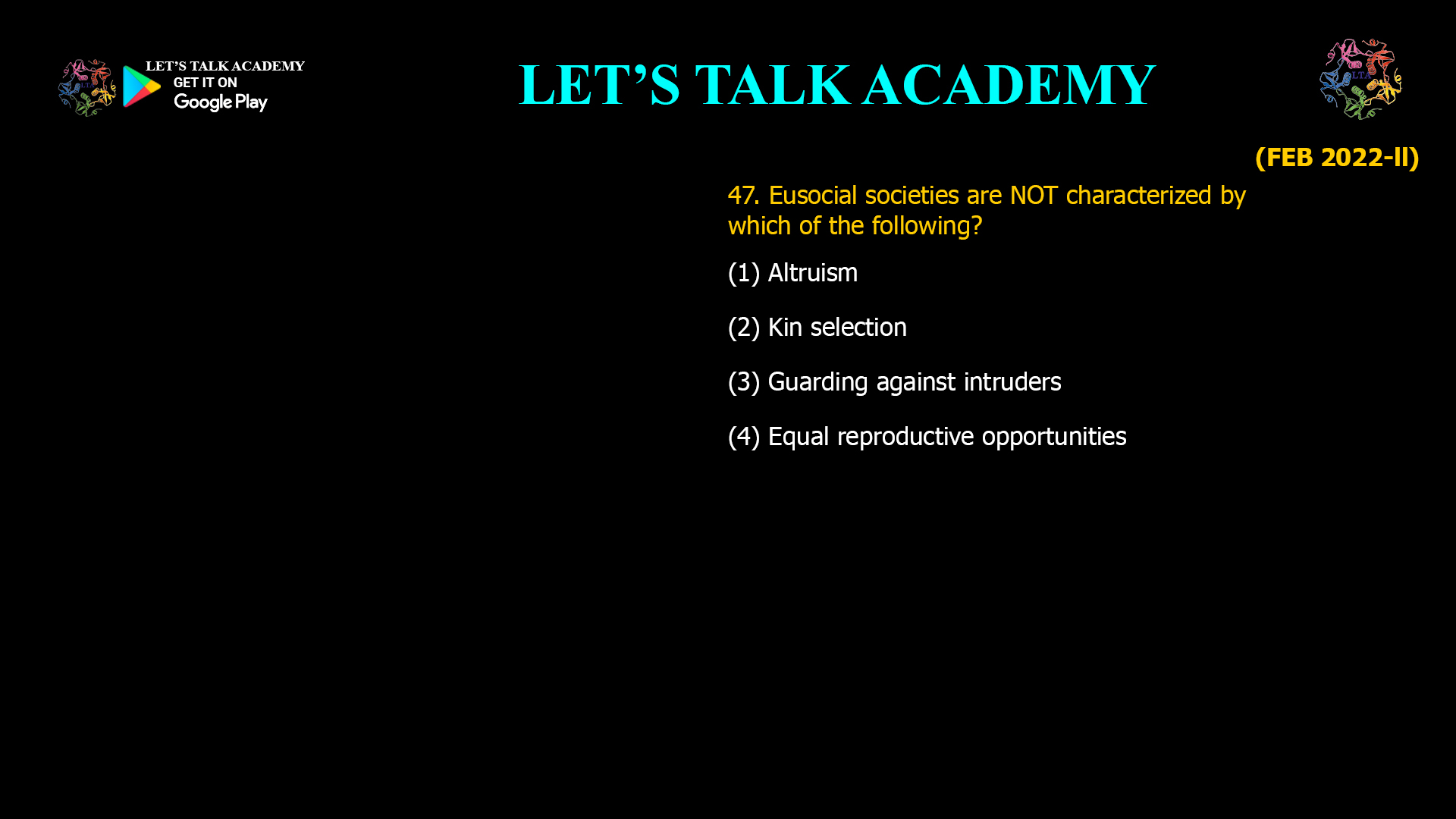
Eusocial societies are NOT characterized by which of the following? (1) Altruism (2) Kin selection (3) Guarding against intruders (4) Equal reproductive opportunities Core Characteristics of Eusocial Societies […]
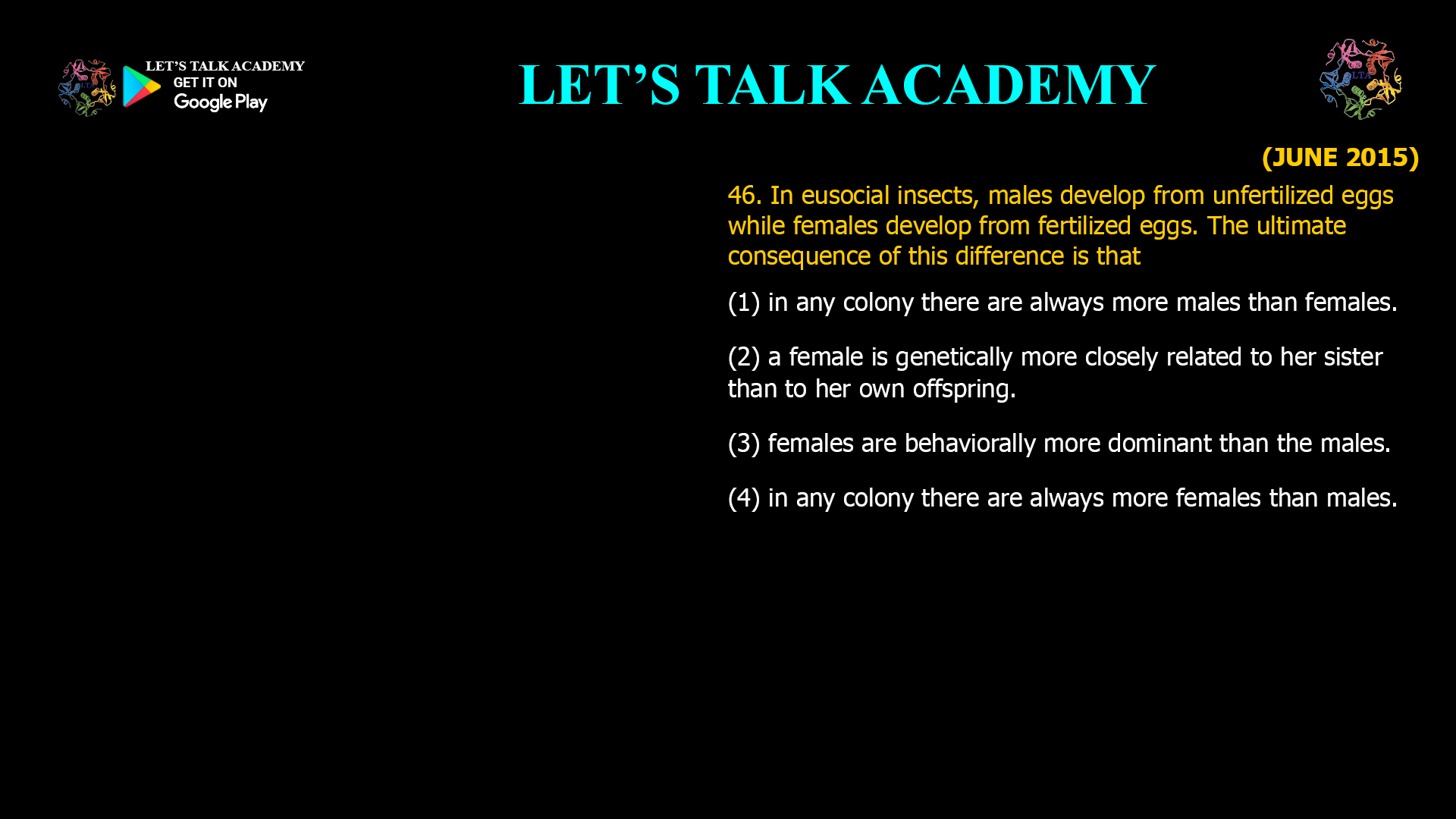
In eusocial insects, males develop from unfertilized eggs while females develop from fertilized eggs. The ultimate consequence of this difference is that (1) in any colony there are always more […]


