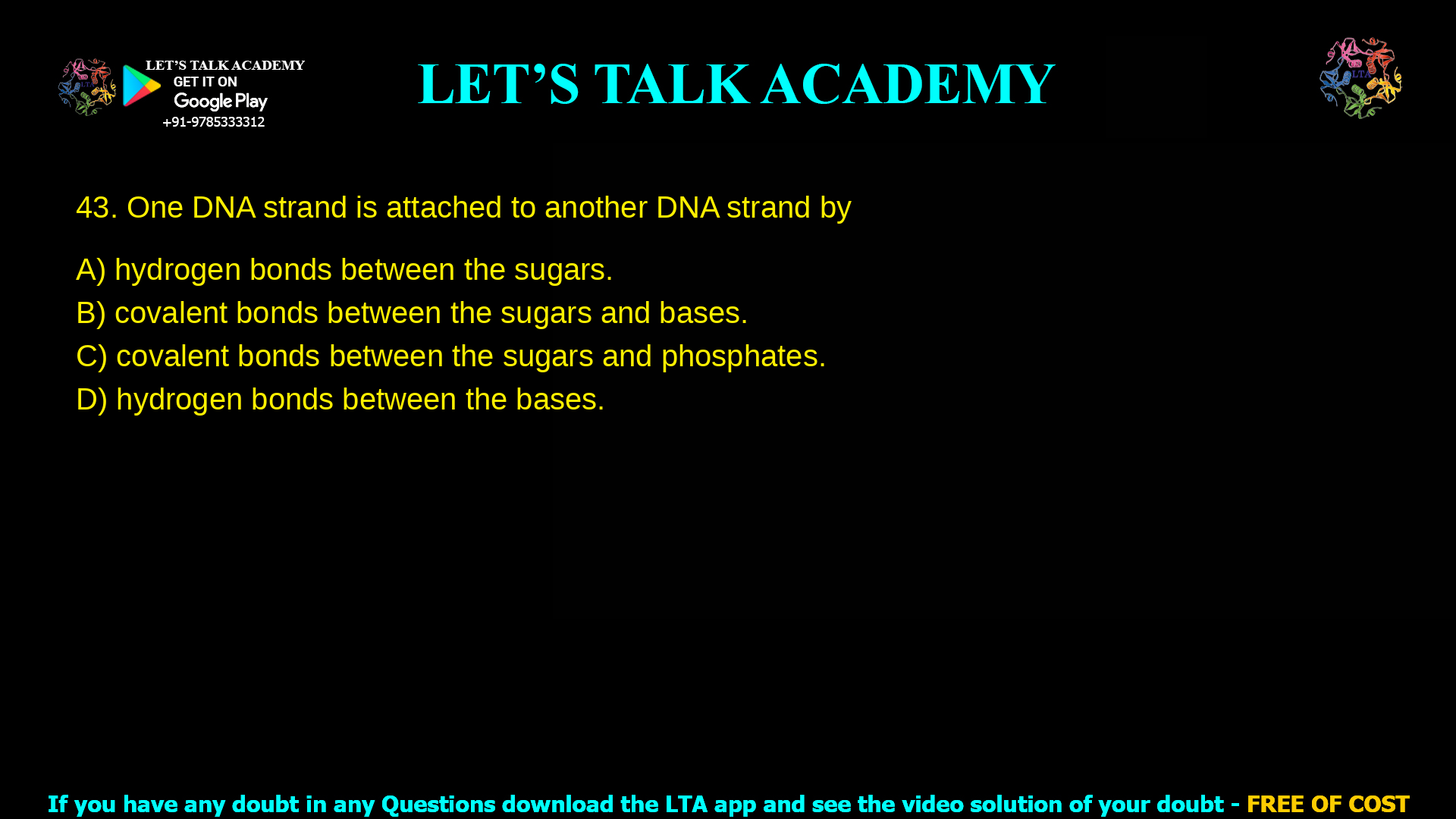
13. One DNA strand is attached to another DNA strand by
a. hydrogen bonds between the sugars.
b. covalent bonds between the sugars and bases.
c. covalent bonds between the sugars and phosphates.
d. hydrogen bonds between the bases.
DNA Strands Held by Hydrogen Bonds Between Bases
The correct answer is d. hydrogen bonds between the bases. In DNA’s double helix, two strands connect specifically through these weak bonds between complementary bases (A-T and G-C), enabling easy separation for replication and transcription.
Option Analysis
a. Hydrogen bonds between the sugars: Incorrect, as deoxyribose sugars form the backbone via covalent phosphodiester bonds within each strand, not hydrogen bonds across strands.
b. Covalent bonds between the sugars and bases: Wrong, since glycosidic bonds (covalent) link bases to sugars within nucleotides, but strands connect via weaker inter-strand bonds.
c. Covalent bonds between the sugars and phosphates: False, as phosphodiester bonds (covalent) join sugars and phosphates along one strand’s backbone, not between strands.
d. Hydrogen bonds between the bases: Correct, with 2 bonds for A-T pairs and 3 for G-C, stabilizing the helix without preventing unwinding.
In DNA structure, hydrogen bonds between the bases hold the two antiparallel strands together, forming the iconic double helix discovered by Watson and Crick. This key interaction ensures genetic stability while allowing processes like replication. For CSIR NET Life Sciences aspirants, mastering bonds in DNA is crucial for molecular biology questions.
Bonds in DNA Double Helix
-
Hydrogen bonds: Weak, specific pairings (A-T: 2 bonds; G-C: 3 bonds) between bases of opposite strands.
-
Covalent phosphodiester bonds: Link nucleotides within each strand’s sugar-phosphate backbone.
-
Glycosidic bonds: Attach bases covalently to deoxyribose sugars inside nucleotides.
Why Hydrogen Bonds Matter
These bonds provide reversible attachment, essential for DNA unwinding during cell division. Stronger covalent bonds would hinder this, disrupting heredity. Exam tip: Compare bond types to eliminate distractors quickly.


