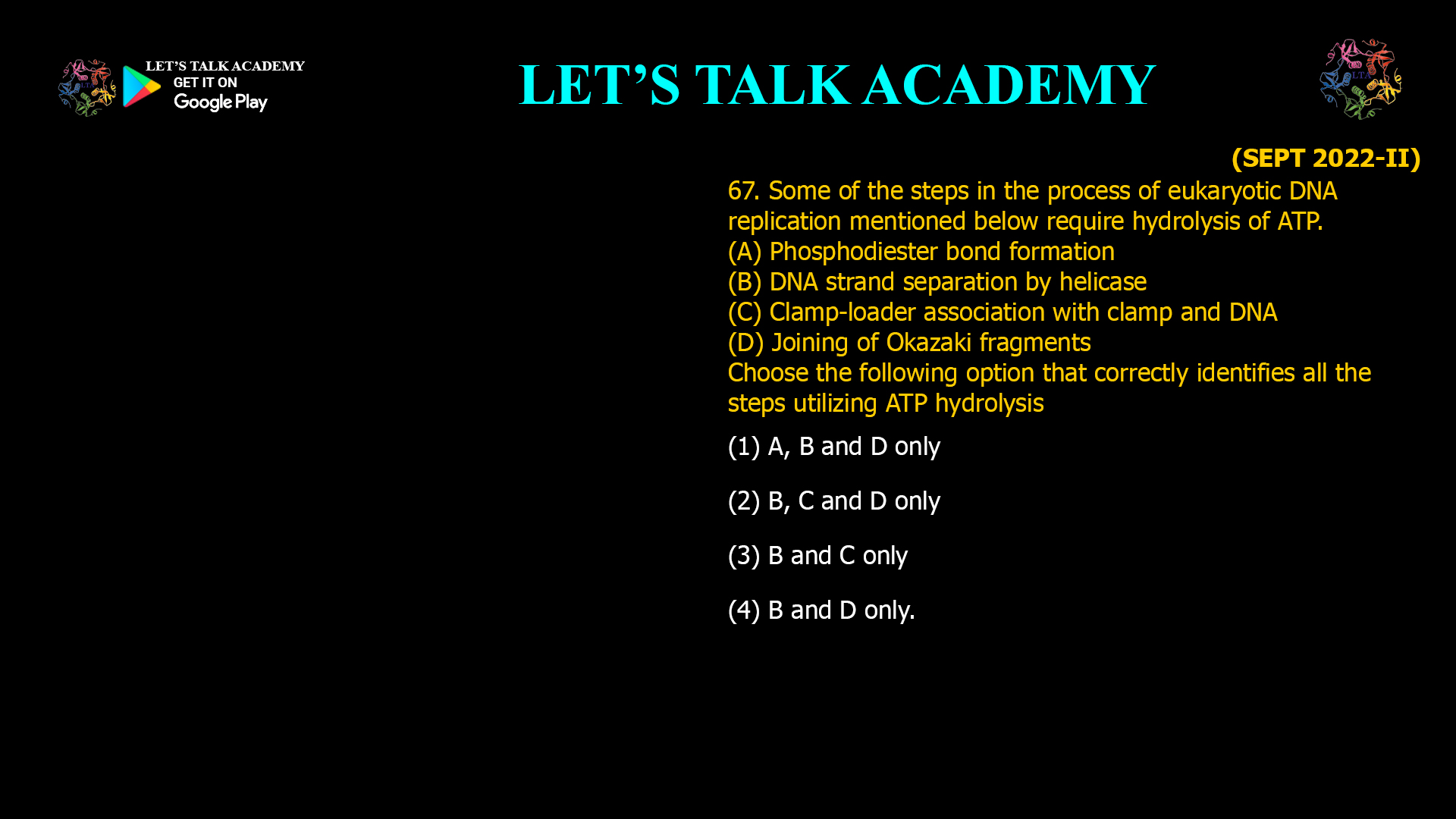
- Some of the steps in the process of eukaryotic DNA replication mentioned below require hydrolysis of ATP.
(A) Phosphodiester bond formation
(B) DNA strand separation by helicase
(C) Clamp-loader association with clamp and DNA
(D) Joining of Okazaki fragments
Choose the following option that correctly identifies all the steps utilizing ATP hydrolysis
(1) A, B and D only (2) B, C and D only
(3) B and C only (4) B and D only.
Understanding ATP Usage in DNA Replication
DNA replication is an energy-intensive process. ATP hydrolysis provides the energy necessary for several molecular machines to perform their functions, including unwinding DNA, loading sliding clamps, and sealing DNA fragments.
Analysis of Each Step Regarding ATP Hydrolysis
(A) Phosphodiester bond formation
-
This refers to the formation of the DNA backbone by DNA polymerases during strand elongation.
-
DNA polymerases do not directly hydrolyze ATP for phosphodiester bond formation; instead, they use the energy from the incoming deoxyribonucleotide triphosphates (dNTPs).
-
ATP hydrolysis is not required here.
(B) DNA strand separation by helicase
-
DNA helicases are ATP-dependent enzymes that unwind the double helix by hydrolyzing ATP to break hydrogen bonds between DNA strands.
-
ATP hydrolysis is essential for helicase function.
(C) Clamp-loader association with clamp and DNA
-
Clamp loaders are ATPase complexes that use ATP hydrolysis to open sliding clamps and load them onto primer-template DNA junctions.
-
ATP hydrolysis drives clamp loading and clamp-loader release.
(D) Joining of Okazaki fragments
-
DNA ligase seals nicks between Okazaki fragments by forming phosphodiester bonds.
-
This ligation reaction requires ATP hydrolysis to activate the enzyme and catalyze bond formation.
-
ATP hydrolysis is essential for ligation.
Summary Table
| Step | ATP Hydrolysis Required? | Explanation |
|---|---|---|
| (A) Phosphodiester bond formation | No | Energy comes from dNTP hydrolysis, not ATP |
| (B) DNA strand separation by helicase | Yes | Helicase uses ATP hydrolysis to unwind DNA |
| (C) Clamp-loader association with clamp and DNA | Yes | Clamp-loader uses ATP to load sliding clamps |
| (D) Joining of Okazaki fragments | Yes | DNA ligase requires ATP for nick sealing |
Correct Option
(2) B, C and D only
Keywords
ATP hydrolysis, DNA replication, helicase, clamp-loader, DNA ligase, Okazaki fragments, phosphodiester bond formation, sliding clamp, DNA strand separation, eukaryotic DNA replication
Conclusion
In eukaryotic DNA replication, ATP hydrolysis is crucial for DNA strand separation by helicase, loading of sliding clamps by clamp-loaders, and ligation of Okazaki fragments by DNA ligase. However, phosphodiester bond formation by DNA polymerases does not directly consume ATP, relying instead on the energy from nucleotide triphosphates. Therefore, the steps utilizing ATP hydrolysis are DNA strand separation, clamp loading, and Okazaki fragment joining.
Final answer:
(2) B, C and D only


42 Comments
Priti khandal
July 27, 2025Done sir
Monika jangid
July 29, 2025Yes B,C,and D are correct option helicase unwind dna , clamp loader use Atp and load sliding clamp , ligase seal nick
Priya khandal
July 27, 2025Done sir
Khushi agarwal
July 29, 2025Joining of okazaki fragments, association of Dna with clamp, saparation of helicase
Shivani .
July 29, 2025Helicase needs ATP to unwind DNA.
Clamp loader opens using ATP and load sliding clamp .
Ligase needs ATP to seal nicks
So statement B,C,D are correct
Asha gurzzar
July 29, 2025Option b,c,,d will be correct because ligase needed to seal nick,by using atp beta clamp will opens and slide on dna by attaching dna polymerase,and atp used by helicase activity too
Neelam Sharma
July 29, 2025Done sir
Akshita
July 29, 2025DNA strand separation by helicase
Clamp loder association with beta clamp and dna
Joining of okazaki fragments
B c d answer is correct sir
Divya
July 29, 2025Answer bcd is correct
Divyanshi Vaishnav
July 29, 2025Yes in eukaryotic DNA replication, separation of helicase from DNA strand for ATP hydrolysis, clamp loader’s association with clamp and DNA and joining of okazaki fragment are required so option b,c and d is correct.
Surbhi Rajawat
July 29, 2025Helicase working, joining of okazaki fragments and clamp loader all requires direct ATP hydrolysis whereas PDB formation does not directly hydrolyses ATP
Khushi Vaishnav
July 29, 2025Option bcd are correct because Helicase used to unwind DNA , Clamp loader needed to load sliding clamp, Ligase needed to seal nick for joining okazaki fragments
Sonam
July 29, 2025Sir Right answer is B,C,d
A opetion isliye nhi hoga sir qki p.D ka formation (dNtps) ke hydrolysis ki entry se found hota h na ki direct Atp hydrolysis se
Sonam Saini
July 29, 2025Sry sir entry nhi engry typing mistake
Aman Choudhary
July 29, 2025Atp ke hydrolysis ki need nahi h yahan dekhte he ho gaya tha
Aman Choudhary
July 29, 2025Yahan Atp hydrolysis ki need he nahi h class me acche se bataya tha sir
B,c & d
Ankita Pareek
July 29, 2025Steps in replication required atp hydrolysis….. correct option is b,c and d
Anisha jakhar
July 29, 2025Options B, C and D
Mitali Saini
July 30, 2025Answer is B, C and D only
Juber Khan
July 30, 2025Option first wrong bcs dna poly. Don’t directly hydrolysis atp for pdb formation, use energy from dntps other then all options are right helicase= unwind dna (atp hydrolysis)
Dna ligase requires atp for sealing nick
Dipti Sharma
July 30, 2025Correct answer : B,C,D ONLY
because phosphodiester bond formation doesn’t require ATP HYDROLYSIS instead dntps.
Dharmpal Swami
July 30, 2025B,C,D are write
Because atp are use -dna strand seperation, loading of clamp and joining of oka-zaki fragments
anurag giri
July 30, 2025Ans 2 bcd correct because posphodiester bond formation by dna polymerase DNA polymerases do not directly hydrolyze atp
Mansukh Kapoor
July 30, 2025The correct answer is option 2nd ( B C D)
Helicase use atp to unwind ds
Clamp uses the atp to load
Ligase use atp to seal the nicks
Swati Choudhary
July 30, 2025StatementB,C and D are correct.
Soniya Shekhawat
July 30, 2025In working of DNA unwinding, clamp loader, and DNA ligation is directly required ATP hydrolysis where as a PDBs does not directly use ATP hydrolysis instead using the dNTPS
Kajal
July 30, 2025Option 2 is right
ATP required in unwinding of Dna strand by helicase and beta clamp loader to load beta clamp on dna and Dna ligase need ATp to seal nick
Santosh Saini
July 30, 2025Statement B, C, D are correct because helicase unwinds the DNA strand using ATP, loading of sliding clamp by clamp loader used ATP and ligase join the okazaki fragments due to ATP hydrolysis activity
Manisha gujar
July 30, 2025Helicase need atp of unwinding dna also clamp using atp for attachment with dna and atp is essential for seal the Okazaki fragment
Ajay Sharma
July 30, 2025for clamp loading and ligation of nick and for unwinding ofcource
Payal Gaur
July 30, 2025Hydrolysis of ATP in melting of DNA by helicase, clamp loader associate with DNA and joining of okazaki fragments.
Niti Tanwar
July 30, 2025Answer is b,c,d
Manisha choudhary
July 30, 2025Phosphodiester bond formation k liye DNA polymerase direct ATP hydrolysis nhi krte h incoming dntp deoxyribonucleotide tri phosphate s energy lete h jisme pyrophosphate relase hota h
Helicase DNA k unwinding k liye ATP hydrolysis krta h
Beta clamp k loading and loader k relase k liye ATP hydrolysis hota h
Okazaki fragments k ligation k liye bhi bhi ligase enzyme ATP hydrolysis krwata h jisme pahle ligase-amp complex then DNA – aap complex form hota h
Vanshika Sharma
July 31, 2025Ans is BCD bcz ATP hydrolysis is crucial for dna strand synthesis by helicase ,loading clam on dna and ligation of okazaki fragments by dna ligase
Komal Sharma
July 31, 2025The steps utilizing ATP hydrolysis are DNA strand separation, clamp loading, and Okazaki fragment joining. So b,c,d option are correct
Alec Joseph
July 31, 2025correct ans is 2- B,C and D as Atp hydrolysis is not required in phosphodiester bond formation.
Anjani sharma
August 5, 2025Answer 2 is correct because ATP hydrolysis is not required in formation of phosphodiester bond, it hydrolysis in helicase unwinding ,clamp loading and joining of okazaki fragments
Mohini
August 3, 2025The correct answer is option 2.
Varsha Tatla
August 3, 2025In replication processer,Atp hydrolysis are required for unwinding of ds to helicase enz , loading and opening of beta clamp, ligation of okazzaki fragment by ligase
Deepika sheoran
August 4, 2025Option 2 is correct answer
Because Helicase ATP to unwind Dna strand clamp uses the ATP to load ligase use ATP to seal the nicks.
Aafreen Khan
August 23, 2025B,C,D are correct answer
Bcoz Helicase uses ATP hydrolysis to unwind DNA and Clamp-loader uses ATP to load sliding clamps and DNA ligase requires ATP for nick sealing
Deepika Sheoran
November 7, 2025Option B, C, D is correct